.png)





SaaS spent 25 years selling access to expertise but rarely embedded that expertise in the product itself. “We can show you what great looks like” was hawked by sales teams and left to professional services teams to figure out. AI opens up a much bigger opportunity: applications that capture how work gets done, learn from the outcomes, and turn that accumulated experience into better judgment on the next run. The application layer isn’t disappearing—it is finally becoming what enterprise SaaS always aspired to be but could never quite achieve.
Raw intelligence is becoming abundant. The next frontier? Turning intelligence into expertise. We’d all prefer the defense lawyer who has handled hundreds of relevant cases over the new law school grad. Nobody asks for the heart surgeon fresh out of scrubs. The next great enterprise AI companies will unlock the encoding of expertise into a compounding advantage.
We call this “Expertise Power”: the ability to turn accumulated production experience into measurably better judgment. The mechanism is a continual learning loop (CLL) in which each agent run adds proprietary data, expert grading, business metrics, and true outcomes to a scorebook. Where learnings from those scorebooks can generalize across customers, the advantage compounds into real moats.
The race for context is really a race for expertise
AI agents today are like new grads. Smart, eager, tireless, but with no knowledge of the job, the company, or the industry in which they’re meant to operate. AKA largely useless on day one.
What a new grad is missing is not information. Hand them every document in the company and they will consume all of that context. What they are missing is expertise: knowing which protocols and answers actually worked and which ones did not. That perspective is earned through on-the-job experience.
Transforming raw intelligence into useful agentic systems requires three core inputs:
- Context – what the model needs to know to do the job: the relevant data, history, prior decisions, and company-specific knowledge.
- Harness – the scaffolding around the model – the plumbing into core systems, the step-by-step playbooks for how the job gets done, and the “filing cabinet” holding historical records of what actually got done.
- Model – the underlying intelligence that reasons over the context and executes the non-deterministic parts of the work.
Coding agents are the breakaway success story because software engineering already had unusually complete infrastructure for this. The work lives in repositories. Changes show up in pull requests. Tests provide immediate feedback. If only other enterprise functions looked like this too…
Data is fragmented, messy, or straight up non-existent. Completing a workflow requires multiple tools and input from a whole host of stakeholders. Varsha Udayabhanu, the CFO of Turing, described the biggest challenge in deploying agents as “the gap between the standard operating procedure (SOP) and how things actually get done.”
Today, most enterprises are still stuck at step one. Before they can deploy useful agentic systems, they have to connect, clean, and standardize existing data and systems. Thus, the explosion of forward deployed engineers (FDEs) to build the wiring. Scrubbing data and connecting systems might be in high demand today, but if that’s where the work stops, that’s a consultancy.
Context + harness + model make an agent capable of doing the work. A scorebook is what allows the system to learn from doing that work. It creates a record of what the agent decided, what happened, and whether it was right. It ties together:
- Data. The inputs required to make the decision, pulled from existing systems of record or captured net new.
- Ontology. The architecture and schema by which the data is structured: the entities, relationships, and states that matter to the workflow, creating a shared language.
- Playbooks. The procedures and decision rules that define how the work should be done, including when to branch or escalate.
- Decision traces. A record of what the system saw, the steps and tools it used, the output it produced, and any human edits, overrides, or retries.
- Expert grading. How internal experts evaluate the quality of the decision: what mattered, what was missed, and when an exception was appropriate.
- Business outcomes. What actually happened after the decision — and whether the system ultimately made the right call.
As an example, Casap (a Primary portfolio company) processes card disputes for large financial institutions. The inputs are easy to find: transaction records, device history, and merchant receipt. What’s harder, and often goes uncaptured, is everything that turns those inputs into a decision. The reality of the dispute process rarely matches the three-year-old SOP. Judgment is difficult to encode – a $100 dispute where the device fingerprint, IP, and delivery address match prior orders may read as first-party fraud, but the analyst may still grant credit because the customer is high-value, has banked there for decades, and has never made a dispute. Then there’s the outcome: was the chargeback won? How much was recovered? Did the customer churn?
Scorebooks are the foundation that unlocks continuous agent improvement. The end-to-end workflows combined with real outcomes create a feedback loop that allows the “new grad” agent to evolve into a grizzled vet. The system learns from each success and failure to identify where the playbook, harness, or evals need to be tweaked. Production experience gets translated back into product improvement.
Scorebooks compound into Continual Learning Loops
If the value of the application layer is to productionize internal know-how, why not just build it in-house?
An internal system learns from one environment. It sees one company’s workflows, one company’s edge cases, and one company’s outcomes. A strong scorebook unlocks iterative improvement at a local level. A third party with the same scorebook deployed in many customer environments unlocks a Continual Learning Loop (CLL) that compounds expertise across an entire customer base.
.png)
To bring this to life, let’s look at Tabs (a Primary portfolio company), whose platform runs billing, invoicing, and collections for B2B companies.
The biggest obstacle to full expert-level automation is in the nuances and exceptions for each customer. Every AP portal works differently and asks for different items. The AR inbox receives a constant mix of remittances, disputes, W-9 requests, and changes of contact, each needing to be told apart and routed. While every contract has its own quirks – usage billed in arrears, a discount that steps down after year one, or an invoice split across two entities.
None of that sits in a system of record. It is learned one exception at a time. Tabs learns it and pulls it back into the system: a correction made for one customer becomes the starting assumption for the next. This compounds so that each new customer starts closer to an “expert CFO” on day one, and reaches that level faster.
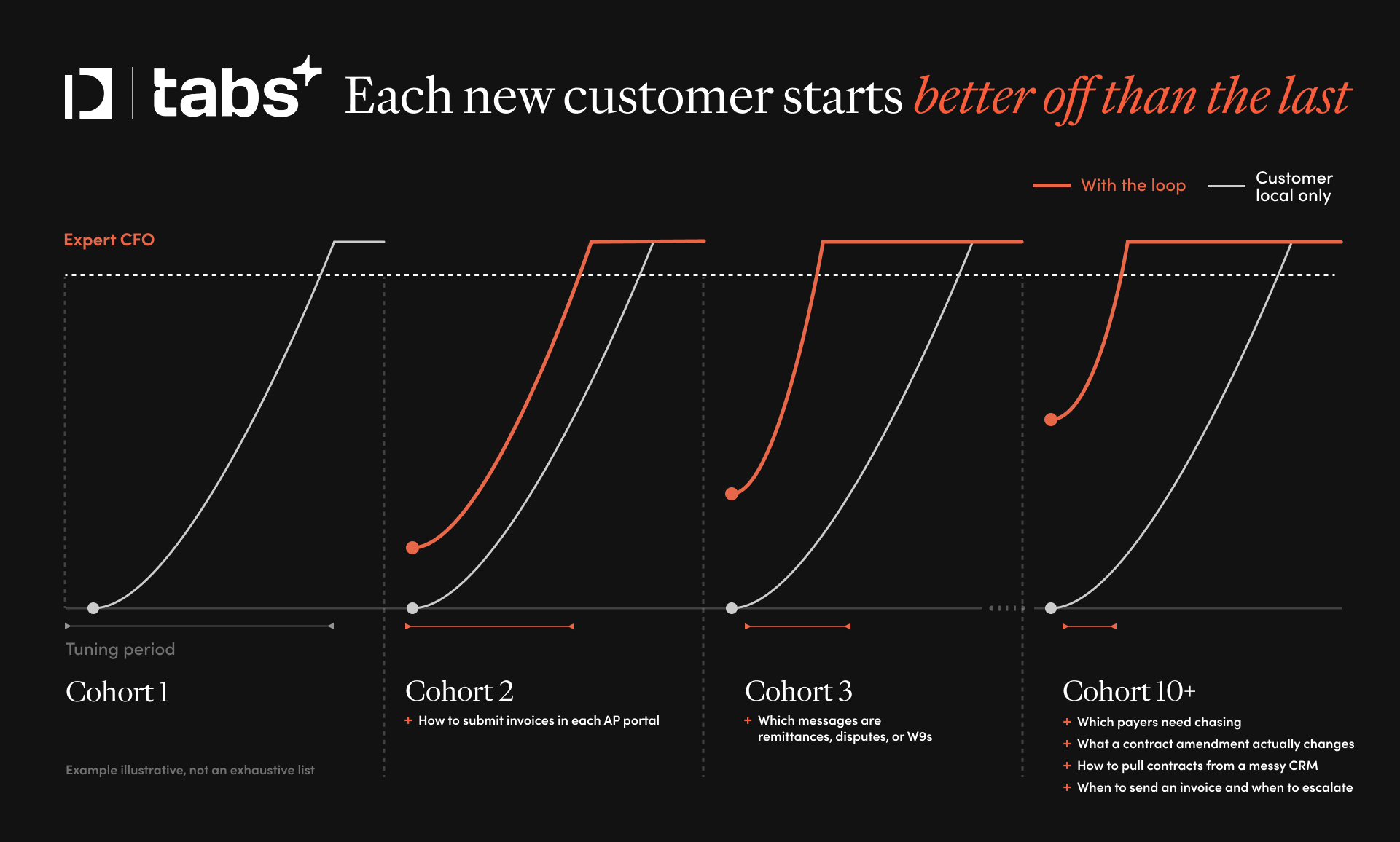
Over time, a real CLL should also change the economics of deployment. The 50th customer should be meaningfully easier to implement than the 5th. On day one, the system should have better evals, more robust support of edge cases, and a stronger opinion of what good looks like. Some portion of every bespoke implementation needs to become a reusable product.
To be precise, the CLL does NOT necessarily require raw customer data (most enterprises are too savvy for that). True pooled-data learning can exist but it is primarily in situations where customers have a shared interest – fraud, known vulnerabilities and attack vectors, or equipment failure to name a few.
What can compound across customers, however, is process knowledge: which implementations fail, which exceptions matter, which evals catch the edge cases, and what good looks like on day one. There will inevitably always be some workflows that are so proprietary and core to a company’s “alpha” that they will never be entrusted to a third party (think Bridgewater’s investment research process). Here we think in-house builds will continue to dominate. For less sensitive functions, the pitch from vendors with a successfully executed CLL will be — “how would you like to be able to hire the best [function] in the world out of the box?”
Moreover, the CLL unlocks greater accountability. A vendor that has seen more decisions, edge cases, and outcomes can do more than provide capability. As the quality builds, the application provider can increasingly stand behind the quality of the work itself. As expertise compounds, so too can the share of the outcome the vendor is able to own.
But won’t the labs just win this?
The labs are all clearly pushing up the stack, quickly launching plenty of tooling to make it easier to build a harness or an agent. As providers of raw intelligence, it is in their best interest to continue to do so.
Many have taken this to suggest that there are no app layer opportunities safe from the labs. We disagree. Historical analogs suggest that the platform owner can but does not automatically win the application. Amazon owned infrastructure, launched Redshift, yet watched Snowflake build a category-defining business on top of AWS. Microsoft owned the operating system, the productivity suite, the enterprise agreement, and the distribution, launched Dynamics CRM, and lost CRM to a company with none of those things.
Not all applications are equally exposed and the taxonomy we use falls along two axes: Harness Intensity and Frontier Intensity.
.png)
The x-axis asks how much of the product is the model vs. the harness around it. The y-axis asks whether today’s models are already capable enough for the job. The two harness-heavy quadrants are where we see the strongest opportunities for independent AI applications.
As raw capability improves and open-weight models catch up, intelligence becomes more readily available. In model-heavy markets, that compresses differentiation. For many jobs, “good enough” intelligence may also simply be good enough – you don’t need a world-class mathematician to write some marketing copy.
On the right side of the chart, the heavy lifting is outside the model: the integrations, workflow, data structures, playbooks, evals, and execution required to actually do the job. Model progress still raises the floor and can make these products better, but it does not erase the proprietary system built around the model.
Could the labs move right and do that heavy lifting themselves? In some markets, absolutely. Harness-heavy products require deep integrations, domain-specific ontologies and playbooks, implementation work, support for long-tail exceptions, and ultimately accountability for the workflow itself. Those requirements vary enormously by function and industry. A lab optimized to improve and distribute a horizontal intelligence layer does not have a comparative advantage.
That does not mean the labs will stay out of applications. In large, horizontal markets where the workflow is close to the model, they likely will. But as the product becomes more domain-specific and operationally embedded, the advantage shifts toward companies willing to own the messy last mile.
Harness intensity tells us where an independent application layer can exist. Expertise Power tells us which applications within those categories can become defensible. Models will continue to improve. Thus, the most important question is whether a company can build an expertise advantage that gets stronger with every deployment.
One tell is how the labs run themselves: Anthropic runs its own go-to-market stack on Salesforce, Gong, and Clay, with Claude as the connective tissue. Even the people building the models still buy their workflows like everyone else.
How We Pick
As seed investors, there’s not yet signal on how cross-customer learnings compound. So at a high level, we underwrite two things: is becoming the dominant expert valuable, and is it achievable?
- Market Attractiveness. How consequential is the underlying work? How much economic value does better expertise unlock? Is the company attacking a large enough pool of labor, spend, or risk for that advantage to matter? Can outcomes be observed and graded?
- Expertise Power Potency. Does accumulated experience make the system measurably better? How quickly does the loop turn? What learning can persist or generalize across customers?
The most interesting companies score highly on both: a large market where expertise commands a premium, paired with a system capable of compounding that expertise over time. We further break these down into the following diligence questions:
.png)
Beyond the criteria, we still come back to the same things buyers have wanted from their vendors for decades: The workflow has to create clear value. The expertise has to compound across the install base. And as the system takes on more consequential work, the vendor needs to take on more accountability for the outcome.
Areas We’re Excited to Back
This framework points us toward a few “shapes” of company that we’re actively looking to invest in, including:
- New sensors. Some of the most valuable context simply does not exist yet. Products such as Inspiren and Granola create new datasets as a byproduct of doing the work. Capturing the data is only the first step; the more durable opportunity is owning the ontology and workflow around it.
- Full-loop decisioning systems. We are searching for products that deeply own an important workflow and see full decisions end-to-end. This is the prerequisite to building an opinionated scorebook that neither labs nor copilots that hand off to humans can see on their own.
- Implementation and data modernization. Agentic systems are only as good as the data, integrations, and workflows underneath them, and much of the enterprise stack (especially where there are legacy homegrown systems) was not built for agents. We see an opportunity for a new category of tooling that makes implementations faster, more reliable, and more resilient.
- Efficiency and spend management. As AI becomes a meaningful P&L line item, enterprises need a better view into what they are spending, where AI is replacing labor, and whether the system is actually producing ROI.
- The future of work. Large companies run partly through formal systems and partly through people knowing who to ask. As agents enter those environments, managing human-agent collaboration, permissions, and incentives becomes a new systems problem.
- Headless applications. Software is losing its head. The UI is becoming less important as humans and agents increasingly interact with systems through other surfaces. We are interested in applications that meet the user where the decision is being made while continuing to own and structure the underlying data and workflow.
It’s time for AI to deliver on SaaS’s promise
The first phase of AI was about creating intelligence. The next is about harnessing that intelligence into valuable expertise.
Enterprise buyers will still pay third parties for the same things they always have: workflow, expertise, and accountability. What changes with AI is that the application layer can finally productize the expertise SaaS always promised.
As the cost of building software drops, compounding advantages will accrue to the companies that turn real-world experience and usage into objectively better judgment over time by mapping out workflows end to end, designing the right scorebooks, and turning that into continual learning loops. To a buyer, working with that vendor becomes a no-brainer.
The application layer isn’t disappearing. It is finally becoming what enterprise software always promised it could be, and we want to partner with the ambitious teams that are running that race to take raw intelligence and own the expertise in their domain.
We want to back the founders that are building against this theme! If this spoke to you, we’d love to hear from you at:
- Email: enterprise@primary.vc
- X: @dukecass, @emily__man, & @nwdaley
- LinkedIn: Cassie Young, Emily Man, & Nick Daley
A huge special thank you for those that gave feedback on multiple drafts and pushed our thinking along the way: Tasso Argyros, Ali Hussain, Jenn Jeong, Sachin Bhat, Ganesh Ramakrishna, Varsha Udayabhanu, Jason Grunberg, Glen Coates, Sonalee Parekh, Eleanor Dorfman, Vivek Raju Muppalla, and the entire Primary team.