Primary Thoughts

We’re hiring a Head of AI
Across the application layer, every investment we make is, in some way, a bet on AI delivering ROI. The organizing principle for those investments is that the marriage of proprietary data and frontier intelligence can produce compounding ROI for customers.
We look for founders who understand a powerful learning loop. A company does important work on behalf of its customers and, in the process, collects proprietary data and context. It exposes that data to increasingly capable intelligence, allowing it to automate better business decisions. Those decisions generate more data, context, and feedback, making the system more capable and the ROI more substantial over time.
This learning loop is at play throughout our portfolio. Tabs is reinventing revenue management, Inspiren is transforming elder care, and Casap is changing how companies manage disputes and chargebacks. They serve very different markets, but the underlying architecture is similar. Each company is building a proprietary data advantage, connecting it to frontier intelligence, and using the combination to automate increasingly consequential decisions for its customers.
Over the past year, we have been applying the same principle internally. We assembled a team of four and began building PrimaryOS. Our honest assessment is that the progress has been real, but modest. We have automated workflows such as outbound founder campaigns, improved parts of our diligence, and developed better portfolio views. These are useful gains, but they do not yet amount to transformation.
At the same time, the work has made us more convinced than ever that transformation is possible. We believe we can generate meaningful alpha by betting harder on compounding systems of intelligence. We are beginning to connect Primary’s proprietary data, institutional knowledge, and daily work to frontier models, while giving people across the firm the tools to build and experiment for themselves.
This is consistent with how we have always built Primary. We think of ourselves as builders, not backers. We built the largest portfolio support team of any early stage venture firm. Primary Labs is our incubation engine, producing six or more new businesses a year. Primary Summit has become one of the largest annual gatherings of the New York technology ecosystem. We believe the best venture firms create capabilities, not just deploy capital.
PrimaryOS is the most ambitious capability we have undertaken inside the firm. We have learned enough over the past year to see its potential, and now we want to double down. We are hiring a Head of AI to help us completely reinvent how Primary works for the age of AI.
The Ambition
Venture capital can be reduced to four jobs: find, decide, win, and exit. The words are simple. The work underneath them is confoundingly complex.
Finding an exceptional founder early requires enormous surface area and strong pattern recognition. Developing conviction requires making decisions with incomplete evidence and understanding a market before its future is obvious. Winning requires trust and an understanding of what a particular founder needs. Helping a company succeed requires knowing which person, customer, or intervention could change its trajectory.
Our objective is alpha: finding exceptional companies earlier, building sharper conviction, winning the investments that matter, and helping those companies become more consequential.
Achieving that will require us to reconsider the workflows themselves. What should sourcing look like when an intelligent system can evaluate emerging founders and learn from our decisions? How should we research a market when agents can assemble evidence, challenge a thesis, and update our view? How does portfolio support change when we can match the needs of hundreds of companies against thousands of people, customers, and resources with far greater precision?
These questions extend across investing, portfolio support, finance, LP relations, incubation, and firm operations. The opportunity encompasses everything we do.
The Role
The Head of AI will own the strategy, architecture, product, and team behind PrimaryOS. You will work directly with our Chief Investment Officers and leaders across Primary to define what AI should make possible for the firm, decide what to build and in what order, and measure whether it materially improves our work.
The technical mandate includes our context and data layer, models, retrieval, agents, evals, permissions, shared tooling, and feedback systems. You will also own the application layer, building products that improve how we find companies, conduct diligence, make decisions, win investments, support founders, and run the firm.
You will lead the PrimaryOS team and grow it over time. This is a leadership role, but we are looking for someone who still wants to build. You should be comfortable writing code, prototyping, reviewing architecture, assessing vendors, and getting directly involved when the problem demands it.
The organizational challenge is as important as the technical one. Primary is a complex firm with sixty smart, opinionated people working across investing, recruiting, go to market, finance, networks, incubation, and firm operations. You will need to understand their work, identify common problems beneath different workflows, and earn enough trust to change how people operate. You will also need to bring coherence to the experimentation already happening without diminishing its energy.
Who You Are
There is no single obvious background for this role. You are likely some combination of engineering leader, product thinker, and founder, with meaningful experience building complex systems that people actually use.
You have worked on AI products that advance knowledge work and have seen what it takes to move from an impressive demonstration to a system that changes how people research, reason, decide, and collaborate. You are current on the technical frontier, with hands on fluency across LLMs, agents, retrieval, evals, data infrastructure, and the rapidly changing model ecosystem.
You have also operated inside a complex organization. You understand that stakeholder management is part of the product, particularly when users have different workflows, incentives, and levels of technical fluency. You can listen carefully, form an independent view, and build alignment among smart people without sanding down the ambition.
Most importantly, you want something entrepreneurial. This role comes with an existing team, proprietary data, committed users, direct access to the firm’s leadership, and a substantial surface area of meaningful problems. It does not come with a predetermined roadmap. You will have enormous freedom to determine what we build, how we build it, and what an AI native venture firm should become.
.png)
EZ Health raises $26M to navigate healthcare for seniors
Navigating the healthcare maze
Navigating the United States healthcare system is a never ending maze. For seniors, the maze is often the largest and the most complex with different specialists, multiple medications, and a vast array of non-medical issues. But, with EZ Health, seniors finally get the care and the guidance they deserve.
We are excited to announce our pre-seed and seed investment in EZ Health as the company announces over $26M in financing from Primary, Construct Capital, and Conversion Capital. Co-founded by Artem Petakov, the former co-founder of Noom, EZ Health is building the definitive navigation platform for seniors. Artem, alongside his cofounders Nikhil, and Allison, are creating one of the most important consumer healthcare companies in the country.
Today, there are 70 million seniors on Medicare and 40% more Americans will enter their 80s over the next decade. Helping each of them manage their care is an enormous amount of work that often falls on an adult child, a spouse, or nobody at all.
EZ Health’s combination of AI, technology, and human guides remove the friction of navigating the healthcare system, ensuring seniors are better equipped to live healthy and happy lives.
Independent navigation for seniors
There are many different care navigation products in the market today, but many are intertwined inside of a payer, health system, or pharmacy benefit manager. Although these systems mean well, they often lack the holistic context needed to truly support someone in their journey.
EZ Health sits on top of these existing systems, with a laser focus on helping members with everything they need. EZ Health’s purview is wide and stretches into many of the ancillary social determinants of health that affect people’s health. To list just a few examples, the company can help people find the right medical specialist, set up meal delivery, arrange transportation, and in one case, even find a carpenter to help with a home modification.
Core to EZ Health’s mission is keeping the senior at the center of every interaction and delivering the most delightful consumer experience. Although this sounds obvious, it is not the reality with most care navigation products in the market.
The technology behind the guide
EZ Health meets the members where they are and most seniors talk to their guide on their regular phone line, with no app to download and no portal to log into. Over time, that guide becomes the one person with the full picture of their current healthcare status.
EZ Health has built proprietary AI tooling at every layer of their product, enabling guides to maintain an incredibly high quality and proactively ensure that members are getting the help that they need. Every interaction, learning and outcome compounds, helping the next senior get even better care.
Why we invested
We have known Artem since his years at Noom, where he scaled the business to hundreds of millions in revenue. His passion for helping people navigate the healthcare system is palpable, and when he first described his vision for EZ Health, we were hooked.
Joined by co-founders who helped scale Noom and managed teams of hundreds of people, we are deeply confident that this team knows how to build a massive and hugely impactful business. Most importantly, they understand how to build trust and keep the consumer at the center of every interaction.
We believe EZ Health has the team, the model, and the timing to define this category, and we are thrilled to partner with Artem, Nikhil, Allison, and the entire team for many years to come.
.png)
Enterprise AI is finally delivering on the promise SaaS made
SaaS spent 25 years selling access to expertise but rarely embedded that expertise in the product itself. “We can show you what great looks like” was hawked by sales teams and left to professional services teams to figure out. AI opens up a much bigger opportunity: applications that capture how work gets done, learn from the outcomes, and turn that accumulated experience into better judgment on the next run. The application layer isn’t disappearing—it is finally becoming what enterprise SaaS always aspired to be but could never quite achieve.
Raw intelligence is becoming abundant. The next frontier? Turning intelligence into expertise. We’d all prefer the defense lawyer who has handled hundreds of relevant cases over the new law school grad. Nobody asks for the heart surgeon fresh out of scrubs. The next great enterprise AI companies will unlock the encoding of expertise into a compounding advantage.
We call this “Expertise Power”: the ability to turn accumulated production experience into measurably better judgment. The mechanism is a continual learning loop (CLL) in which each agent run adds proprietary data, expert grading, business metrics, and true outcomes to a scorebook. Where learnings from those scorebooks can generalize across customers, the advantage compounds into real moats.
The race for context is really a race for expertise
AI agents today are like new grads. Smart, eager, tireless, but with no knowledge of the job, the company, or the industry in which they’re meant to operate. AKA largely useless on day one.
What a new grad is missing is not information. Hand them every document in the company and they will consume all of that context. What they are missing is expertise: knowing which protocols and answers actually worked and which ones did not. That perspective is earned through on-the-job experience.
Transforming raw intelligence into useful agentic systems requires three core inputs:
- Context – what the model needs to know to do the job: the relevant data, history, prior decisions, and company-specific knowledge.
- Harness – the scaffolding around the model – the plumbing into core systems, the step-by-step playbooks for how the job gets done, and the “filing cabinet” holding historical records of what actually got done.
- Model – the underlying intelligence that reasons over the context and executes the non-deterministic parts of the work.
Coding agents are the breakaway success story because software engineering already had unusually complete infrastructure for this. The work lives in repositories. Changes show up in pull requests. Tests provide immediate feedback. If only other enterprise functions looked like this too…
Data is fragmented, messy, or straight up non-existent. Completing a workflow requires multiple tools and input from a whole host of stakeholders. Varsha Udayabhanu, the CFO of Turing, described the biggest challenge in deploying agents as “the gap between the standard operating procedure (SOP) and how things actually get done.”
Today, most enterprises are still stuck at step one. Before they can deploy useful agentic systems, they have to connect, clean, and standardize existing data and systems. Thus, the explosion of forward deployed engineers (FDEs) to build the wiring. Scrubbing data and connecting systems might be in high demand today, but if that’s where the work stops, that’s a consultancy.
Context + harness + model make an agent capable of doing the work. A scorebook is what allows the system to learn from doing that work. It creates a record of what the agent decided, what happened, and whether it was right. It ties together:
- Data. The inputs required to make the decision, pulled from existing systems of record or captured net new.
- Ontology. The architecture and schema by which the data is structured: the entities, relationships, and states that matter to the workflow, creating a shared language.
- Playbooks. The procedures and decision rules that define how the work should be done, including when to branch or escalate.
- Decision traces. A record of what the system saw, the steps and tools it used, the output it produced, and any human edits, overrides, or retries.
- Expert grading. How internal experts evaluate the quality of the decision: what mattered, what was missed, and when an exception was appropriate.
- Business outcomes. What actually happened after the decision — and whether the system ultimately made the right call.
As an example, Casap (a Primary portfolio company) processes card disputes for large financial institutions. The inputs are easy to find: transaction records, device history, and merchant receipt. What’s harder, and often goes uncaptured, is everything that turns those inputs into a decision. The reality of the dispute process rarely matches the three-year-old SOP. Judgment is difficult to encode – a $100 dispute where the device fingerprint, IP, and delivery address match prior orders may read as first-party fraud, but the analyst may still grant credit because the customer is high-value, has banked there for decades, and has never made a dispute. Then there’s the outcome: was the chargeback won? How much was recovered? Did the customer churn?
Scorebooks are the foundation that unlocks continuous agent improvement. The end-to-end workflows combined with real outcomes create a feedback loop that allows the “new grad” agent to evolve into a grizzled vet. The system learns from each success and failure to identify where the playbook, harness, or evals need to be tweaked. Production experience gets translated back into product improvement.
Scorebooks compound into Continual Learning Loops
If the value of the application layer is to productionize internal know-how, why not just build it in-house?
An internal system learns from one environment. It sees one company’s workflows, one company’s edge cases, and one company’s outcomes. A strong scorebook unlocks iterative improvement at a local level. A third party with the same scorebook deployed in many customer environments unlocks a Continual Learning Loop (CLL) that compounds expertise across an entire customer base.
.png)
To bring this to life, let’s look at Tabs (a Primary portfolio company), whose platform runs billing, invoicing, and collections for B2B companies.
The biggest obstacle to full expert-level automation is in the nuances and exceptions for each customer. Every AP portal works differently and asks for different items. The AR inbox receives a constant mix of remittances, disputes, W-9 requests, and changes of contact, each needing to be told apart and routed. While every contract has its own quirks – usage billed in arrears, a discount that steps down after year one, or an invoice split across two entities.
None of that sits in a system of record. It is learned one exception at a time. Tabs learns it and pulls it back into the system: a correction made for one customer becomes the starting assumption for the next. This compounds so that each new customer starts closer to an “expert CFO” on day one, and reaches that level faster.
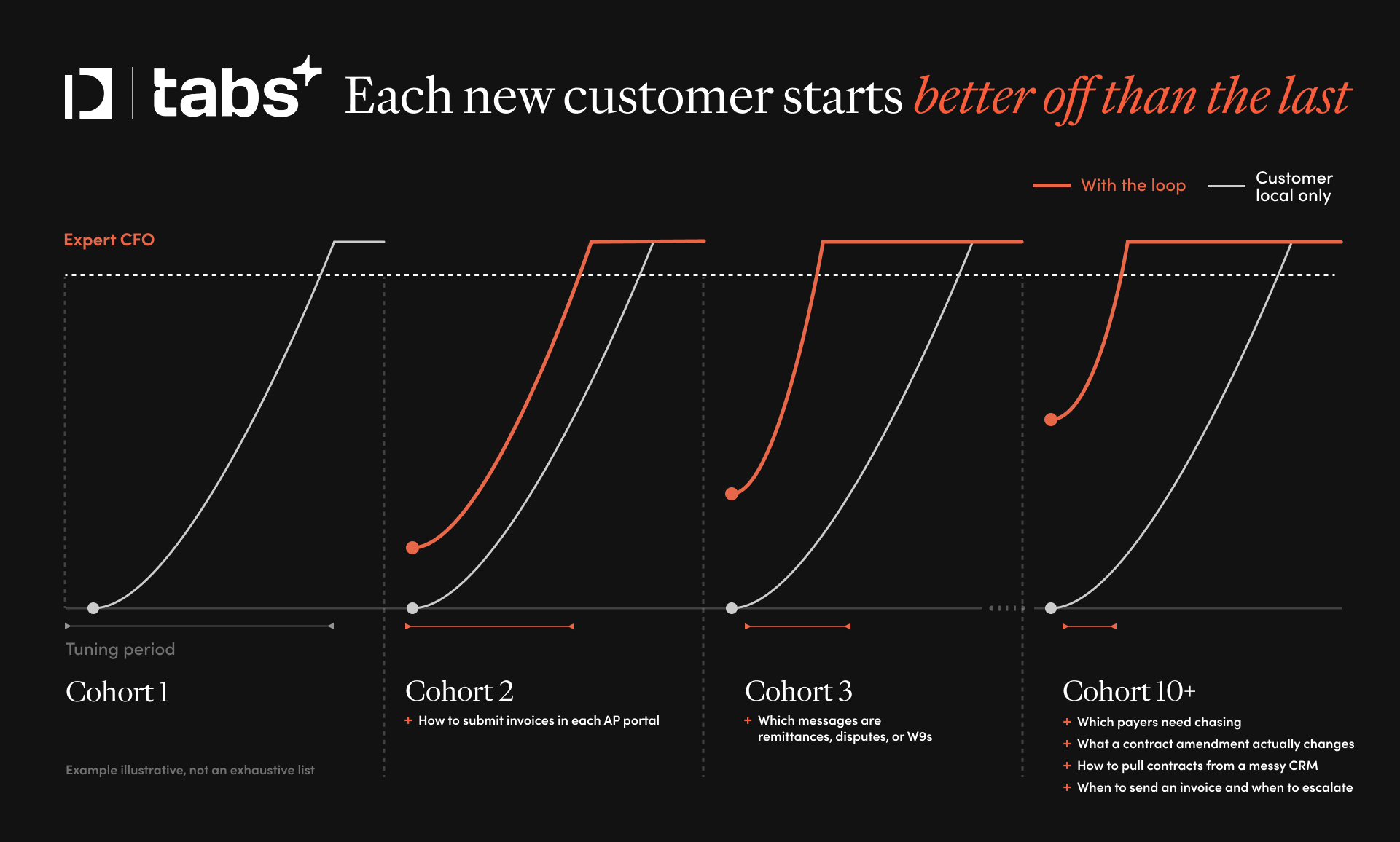
Over time, a real CLL should also change the economics of deployment. The 50th customer should be meaningfully easier to implement than the 5th. On day one, the system should have better evals, more robust support of edge cases, and a stronger opinion of what good looks like. Some portion of every bespoke implementation needs to become a reusable product.
To be precise, the CLL does NOT necessarily require raw customer data (most enterprises are too savvy for that). True pooled-data learning can exist but it is primarily in situations where customers have a shared interest – fraud, known vulnerabilities and attack vectors, or equipment failure to name a few.
What can compound across customers, however, is process knowledge: which implementations fail, which exceptions matter, which evals catch the edge cases, and what good looks like on day one. There will inevitably always be some workflows that are so proprietary and core to a company’s “alpha” that they will never be entrusted to a third party (think Bridgewater’s investment research process). Here we think in-house builds will continue to dominate. For less sensitive functions, the pitch from vendors with a successfully executed CLL will be — “how would you like to be able to hire the best [function] in the world out of the box?”
Moreover, the CLL unlocks greater accountability. A vendor that has seen more decisions, edge cases, and outcomes can do more than provide capability. As the quality builds, the application provider can increasingly stand behind the quality of the work itself. As expertise compounds, so too can the share of the outcome the vendor is able to own.
But won’t the labs just win this?
The labs are all clearly pushing up the stack, quickly launching plenty of tooling to make it easier to build a harness or an agent. As providers of raw intelligence, it is in their best interest to continue to do so.
Many have taken this to suggest that there are no app layer opportunities safe from the labs. We disagree. Historical analogs suggest that the platform owner can but does not automatically win the application. Amazon owned infrastructure, launched Redshift, yet watched Snowflake build a category-defining business on top of AWS. Microsoft owned the operating system, the productivity suite, the enterprise agreement, and the distribution, launched Dynamics CRM, and lost CRM to a company with none of those things.
Not all applications are equally exposed and the taxonomy we use falls along two axes: Harness Intensity and Frontier Intensity.
.png)
The x-axis asks how much of the product is the model vs. the harness around it. The y-axis asks whether today’s models are already capable enough for the job. The two harness-heavy quadrants are where we see the strongest opportunities for independent AI applications.
As raw capability improves and open-weight models catch up, intelligence becomes more readily available. In model-heavy markets, that compresses differentiation. For many jobs, “good enough” intelligence may also simply be good enough – you don’t need a world-class mathematician to write some marketing copy.
On the right side of the chart, the heavy lifting is outside the model: the integrations, workflow, data structures, playbooks, evals, and execution required to actually do the job. Model progress still raises the floor and can make these products better, but it does not erase the proprietary system built around the model.
Could the labs move right and do that heavy lifting themselves? In some markets, absolutely. Harness-heavy products require deep integrations, domain-specific ontologies and playbooks, implementation work, support for long-tail exceptions, and ultimately accountability for the workflow itself. Those requirements vary enormously by function and industry. A lab optimized to improve and distribute a horizontal intelligence layer does not have a comparative advantage.
That does not mean the labs will stay out of applications. In large, horizontal markets where the workflow is close to the model, they likely will. But as the product becomes more domain-specific and operationally embedded, the advantage shifts toward companies willing to own the messy last mile.
Harness intensity tells us where an independent application layer can exist. Expertise Power tells us which applications within those categories can become defensible. Models will continue to improve. Thus, the most important question is whether a company can build an expertise advantage that gets stronger with every deployment.
One tell is how the labs run themselves: Anthropic runs its own go-to-market stack on Salesforce, Gong, and Clay, with Claude as the connective tissue. Even the people building the models still buy their workflows like everyone else.
How We Pick
As seed investors, there’s not yet signal on how cross-customer learnings compound. So at a high level, we underwrite two things: is becoming the dominant expert valuable, and is it achievable?
- Market Attractiveness. How consequential is the underlying work? How much economic value does better expertise unlock? Is the company attacking a large enough pool of labor, spend, or risk for that advantage to matter? Can outcomes be observed and graded?
- Expertise Power Potency. Does accumulated experience make the system measurably better? How quickly does the loop turn? What learning can persist or generalize across customers?
The most interesting companies score highly on both: a large market where expertise commands a premium, paired with a system capable of compounding that expertise over time. We further break these down into the following diligence questions:
.png)
Beyond the criteria, we still come back to the same things buyers have wanted from their vendors for decades: The workflow has to create clear value. The expertise has to compound across the install base. And as the system takes on more consequential work, the vendor needs to take on more accountability for the outcome.
Areas We’re Excited to Back
This framework points us toward a few “shapes” of company that we’re actively looking to invest in, including:
- New sensors. Some of the most valuable context simply does not exist yet. Products such as Inspiren and Granola create new datasets as a byproduct of doing the work. Capturing the data is only the first step; the more durable opportunity is owning the ontology and workflow around it.
- Full-loop decisioning systems. We are searching for products that deeply own an important workflow and see full decisions end-to-end. This is the prerequisite to building an opinionated scorebook that neither labs nor copilots that hand off to humans can see on their own.
- Implementation and data modernization. Agentic systems are only as good as the data, integrations, and workflows underneath them, and much of the enterprise stack (especially where there are legacy homegrown systems) was not built for agents. We see an opportunity for a new category of tooling that makes implementations faster, more reliable, and more resilient.
- Efficiency and spend management. As AI becomes a meaningful P&L line item, enterprises need a better view into what they are spending, where AI is replacing labor, and whether the system is actually producing ROI.
- The future of work. Large companies run partly through formal systems and partly through people knowing who to ask. As agents enter those environments, managing human-agent collaboration, permissions, and incentives becomes a new systems problem.
- Headless applications. Software is losing its head. The UI is becoming less important as humans and agents increasingly interact with systems through other surfaces. We are interested in applications that meet the user where the decision is being made while continuing to own and structure the underlying data and workflow.
It’s time for AI to deliver on SaaS’s promise
The first phase of AI was about creating intelligence. The next is about harnessing that intelligence into valuable expertise.
Enterprise buyers will still pay third parties for the same things they always have: workflow, expertise, and accountability. What changes with AI is that the application layer can finally productize the expertise SaaS always promised.
As the cost of building software drops, compounding advantages will accrue to the companies that turn real-world experience and usage into objectively better judgment over time by mapping out workflows end to end, designing the right scorebooks, and turning that into continual learning loops. To a buyer, working with that vendor becomes a no-brainer.
The application layer isn’t disappearing. It is finally becoming what enterprise software always promised it could be, and we want to partner with the ambitious teams that are running that race to take raw intelligence and own the expertise in their domain.
We want to back the founders that are building against this theme! If this spoke to you, we’d love to hear from you at:
- Email: enterprise@primary.vc
- X: @dukecass, @emily__man, & @nwdaley
- LinkedIn: Cassie Young, Emily Man, & Nick Daley
A huge special thank you for those that gave feedback on multiple drafts and pushed our thinking along the way: Tasso Argyros, Ali Hussain, Jenn Jeong, Sachin Bhat, Ganesh Ramakrishna, Varsha Udayabhanu, Jason Grunberg, Glen Coates, Sonalee Parekh, Eleanor Dorfman, Vivek Raju Muppalla, and the entire Primary team.

Inspiren is shaping the future of senior living
The Future of Senior Living
The infrastructure to ensure that millions of seniors age safely is dangerously close to breaking. Inspiren is here to fix that. Co-founded by Michael Wang, a former Green Beret and nurse, and Alex Hejnosz, a multi-time healthcare founder, Inspiren is building the definitive AI-native operating system for senior living.
Today, we are excited to share our continued support for Inspiren as they announce their $70M Series C led by NewView Capital. Powered by proprietary hardware and AI, Inspiren is working with many of the leading senior living facilities across the country and already keeping thousands of seniors safe.
Most senior living facilities still rely on human eyesight, outdated software, and plastic pull cords to run their operations. Although this worked in the past, it is no longer scalable with a growing elderly population.
Instead, we believe the future of senior living requires a completely different architecture. Inspiren’s platform is driven by proprietary data captured through an ecosystem of custom ambient hardware, replacing an analog system with continuous insights and agentic workflows. Operators, staff, and seniors now get a proactive health engine instead of a reactive call button.
Why senior living is breaking now
The math underpinning senior care no longer works. People aged 85 and older make up the fastest-growing demographic cohort in the country. The oldest Baby Boomers turn 80 this year. For two decades, technology providers and venture capital ignored this asset class. As software ate the enterprise and hardware chased consumer wearables, senior living was left to manage on its own.
A more traditional analog model worked when labor was plentiful and seniors aged at home. But operators today face chronic understaffing and relentless caregiver burnout. Staff are asked to monitor sprawling halls of closed doors with zero visibility into what is happening behind them until something goes wrong.
The sheer volume of Baby Boomers entering senior living over the next five years will overwhelm existing operational capacity. You cannot physically hire enough people to check on every resident every hour of the night and properly manage residents throughout the day. Facilities need a mechanism to know exactly who needs help right now, before a routine movement becomes a catastrophic emergency. The entire industry is buckling under this reality.
The power of hardware
Inspiren’s hardware, sensors, and software sit in tens of thousands of resident rooms across more than 500 communities, producing a continuous record of how older adults actually live in senior living facilities. No company, no wearable, and no facility has ever captured this data.
Inspiren’s hardware ecosystem, coupled with AI, enables completely new insights and automations for facilities and staff. Most importantly, it ensures residents are safer. Through computer vision, the wall-mounted hardware watches for the specific physical precursors to a fall or potential problem. When the system detects a resident struggling to get out of bed, it immediately opens a two-way communication channel. Staff can de-escalate the situation verbally while physically running down the hall. For many facilities, this has resulted in a reduction of more than 50% in falls and hospitalizations. This means residents are safer in their homes, and caregivers can spend their time delivering care instead of managing trauma.
Fall reduction is just the start. Across an ecosystem of hardware devices, Inspiren is building a proprietary dataset of physical movement that flags early signals of cognitive decline and overall health degradation. Sleep disruption, changes in gait, increased bathroom visits, and many other signals are early indicators of larger problems. The platform captures these data points automatically and surfaces them to operators.
Why we invested
A little over three years ago, Primary led Inspiren's Seed round and has backed the company in every round since.
When we first met Michael and Alex, the broader venture market was obsessed with purely software-based digital health plays. Building hardware for healthcare environments was considered simply too hard to do. Yet we saw a founding team with a deep understanding of a massive problem and a completely unique way to solve it.
We are leaning in again today because it is the perfect convergence of technology and market dynamics. Inspiren’s ability to deploy hardware, capture proprietary data, and leverage AI ensures that the company will continue to build the definitive technology infrastructure for seniors across the world. We are proud to keep building alongside them.

The next medical provider
Labor constraints and shortages are a permanent feature of US healthcare. Over the last hundred years, the system’s response to these constraints has been the same: when the healthcare system runs short of one kind of worker, it mints a new one. Physician assistants and nurse practitioners came in 1965. Then medical assistants and community health workers in the decades that followed. This approach clearly didn’t solve healthcare access or cost in the US, but each new tier of providers did enable specific workloads to be spread across varying levels of training and licensure. The result was leverage, expanding the effective output of a holistic care team.
Agentic AI is the next iteration of a new “medical provider” entering the system and creating leverage. But, the implications are much larger than in the past. Democratizing access to the best medical care, for pennies on the dollar, will structurally shift the global healthcare system. If the cost of care compresses to the cost of compute, it’s not hard to suddenly imagine millions of newly minted clinical agents delivering specific clinical work across the world.
To reach a multi-agent care future, we need to ask the same question that the US healthcare system has asked in the past, “What work can and should be shifted to this new medical provider?”
To do this, we went deeper into specific clinical roles across healthcare to better understand where there are actual opportunities to deliver care agentically and the potential business impacts of doing so. Making this a reality is multi-faceted, nuanced, and complex. We are not attempting to answer every question here, but we know this is a topic worth exploring.
The future of clinical AI is clear. Software won’t just assist the clinician. Agents will deliver care and create true leverage in the system. This will not hollow out the practice of medicine. It will instead return time to providers, increase the quality of care for patients, and make medicine more human.
The clinical AI opportunity
Today, when people talk about clinical AI, they start in the wrong place. The conversation often starts with the same number: over $1 trillion of annual clinical labor spend in the US. But, not every minute or dollar of clinical labor is equally exposed to AI.
An ICU nurse still needs to be at the bedside. An anesthesiologist still needs to administer drugs in the OR. A phlebotomist still needs to physically draw a patient’s blood. Even if AI models get dramatically better (which we have no doubt they will), large portions of clinical labor will remain tied to physical presence, licensure requirements, and workflows that simply cannot be automated. Robotics could eventually change all this, but that’s a separate topic.
To find where the real leverage sits, you have to go role by role and workflow by workflow to identify the work AI can realistically manage. Based on the work we've done, we believe there is ~$425B of work that can be directly affected by AI today. It is not perfect, but we use dollars as our proxy for AI exposure and impact on the US healthcare system, given it’s an indication of time and labor today. The the reality is that AI could both increase healthcare spend by generating more billable care in some case, while also reducing spend in other scenarios.
To get to $425B, we split the $1.05T of clinical labor into four buckets:
- Physicians (~1.1M practicing physicians and ~$350B in wage spend):
The largest line item per worker, roughly 20-21% of national health expenditures, the only group that bills the bulk of clinical encounters directly
- Advanced practice providers (~740K NPs and PAs and ~$65-100B in wage spend):
Billable in most states under varying scope-of-practice rules, often supervised, often the marginal unit of throughput growth in primary and specialty care
- Nurses (~5M RNs, LPNs and $375B in wage spend):
The largest clinical workforce by headcount
- Allied health and medical assistants (10M+ workers across dozens of professions and $200-300B in wage spend):
Radiology and lab techs, MAs, therapists, phlebotomists. Labor-intensive, fragmented
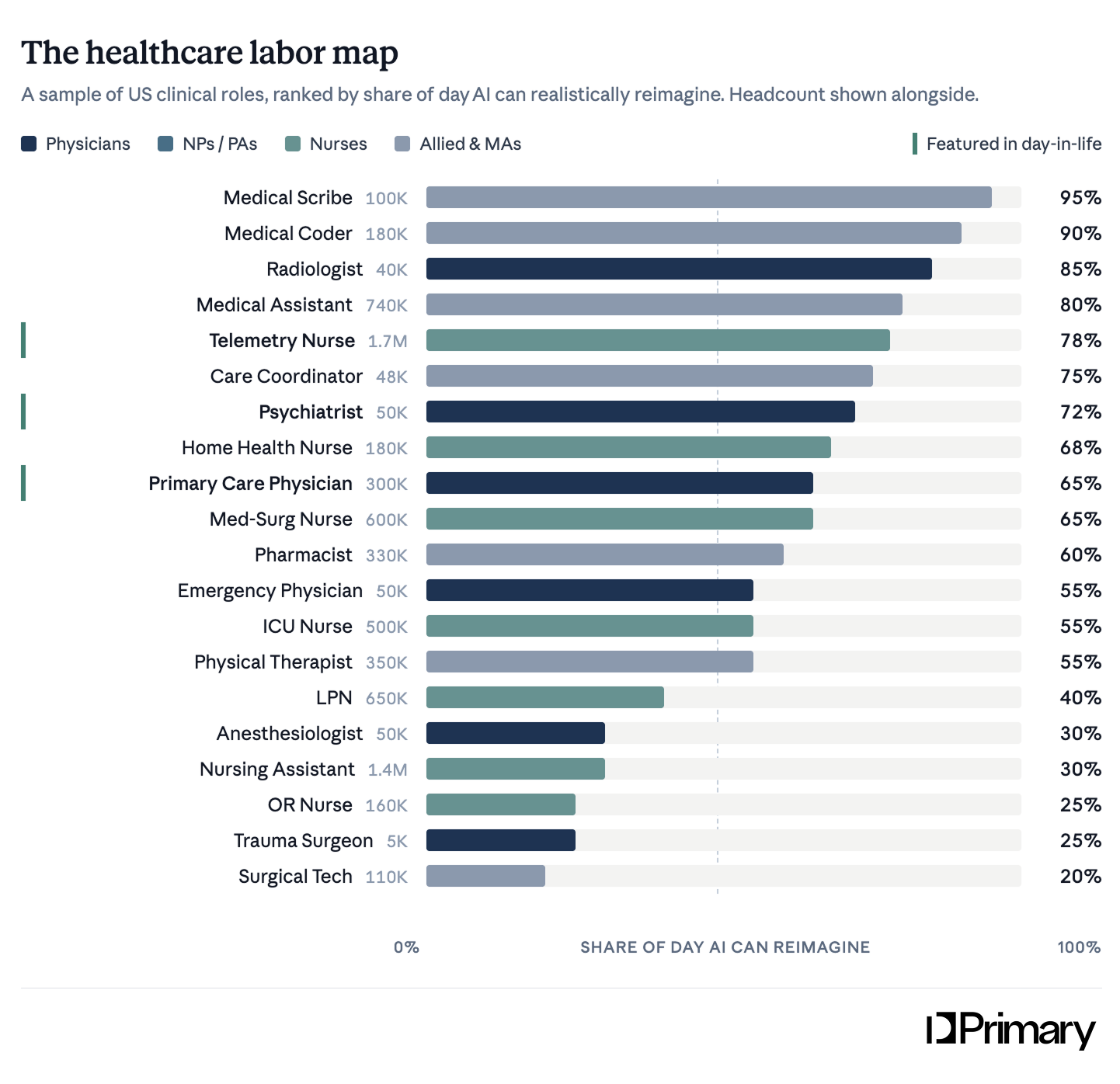
For each medical provider type, we broke the average workday into 6-8 core workflows (documentation, patient encounters, procedural work, monitoring, inbox, prior auth, coding, coordination, etc.), estimated how much of each workflow AI can realistically reimagine, and then weighted each by how much of the day it consumes. We then repeated the exercise for specific roles inside each bucket, since the average hides big differences (e.g. a radiologist’s job could be impacted more than a trauma surgeon's). The map below ranks ~20 clinical roles by how much of their workday AI can reimagine. Our approach isn’t perfect, but we think it's directionally the right way to think about this.
Managing multi-agent care
Pushing deeper into the world of autonomous clinical agents, or as we are calling it “multi-agent care,” we look to software development as a mental model for how the world will continue to evolve. Despite the proliferation of amazing coding agents, the job of a software developer is far from dead dead, but it's very different than it was a few years ago.
Top engineers now manage tens, if not hundreds, of different agents at a time. Each agent is specialized and hyperfocused on a specific task at hand. The writing of high quality code is more accessible now than ever before as developers oversee and guide these agents. Many of the tasks, or workloads, associated with the medical field are based on interpreting a combination of text, voice, and imaging, tasks all particularly well-suited for large language, vision, speech, and multimodal models. Software engineers have orders of magnitude more leverage today than ever before. Why can’t medical providers?
It’s not a 1:1 analogy (clinical work isn’t always deterministic the way code is and takes longer to verify), but the mental model holds. As we consider this future, we're not currently modeling zero clinician involvement. What we're modeling is the physician managing multiple AI agents at once and retaining accountability while the agents do the work. To bring this to life, we went deeper into three specific roles to see how AI could reimagine both the administrative and clinical aspects of each job.
Primary Care Physician

Today’s primary care physicians are overloaded generalists: 20 fifteen-minute visits a day, 40 portal messages, hours of pajama-time charting, and a dozen prior auth calls a week, with a panel that caps out around 1,800 patients, if not much lower. By leveraging ambient scribes and AI-triaged inboxes, one could potentially expand panel sizes to around 2,500.
But, the vision that changes everything is when a primary care physician starts to manage multiple different agents, each focused on specific tasks. Imagine a physician cosigning 200 AI-drafted encounters a day, seeing only 3-4 escalation visits, supervising 8 concurrent AI virtual visits, and covering a panel of 12,000+ lives. At that scale, the existing US PCP workforce could theoretically cover every American, and then some.
Psychiatrist
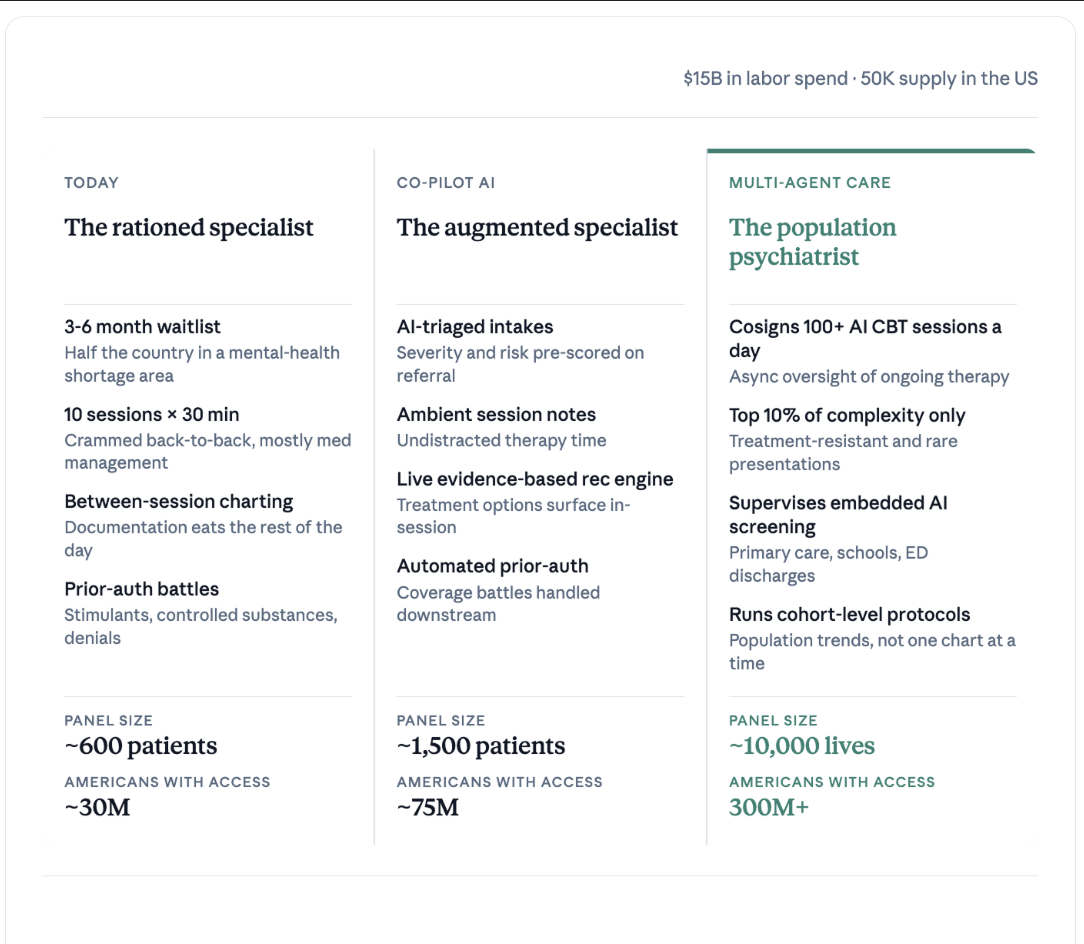
We see a similar opportunity for mental health. Psychiatrists are overwhelmed today with triage and administrative work. Only 30 million Americans have practical access to a psychiatrist today and half the country lives in a mental health shortage area.
Even when imagining a human still being in the loop, with autonomous multi-care agents, access to mental health has the opportunity to explode. With multi-agent care, one psychiatrist could cosign and review 100+ AI-delivered CBT sessions a day, while focusing their time on the most complex, highest acuity cases.
Telemetry Nurse

Today’s telemetry nurse is monitor-bound: eyes on 4 patients at once, 100+ alarms per shift with 85% of them false, every vital hand-charted, and roughly 90 minutes of actual bedside time in a 12-hour shift.
Multi-agent care, coupled with hardware, turns the role into a completely different job: a rapid-response clinician on standby vs on watch, intervening on the 3-5 events per shift that AI escalates. This could unlock continuous monitoring across 40 rooms, pushing the nurse-to-patient staffing ratio much higher.
What does this mean for the business of healthcare?
In the simplest terms, the leverage created by AI and autonomous clinical agents shows up in two distinct places: the revenue line (through more care delivered per clinician) or the cost line (through fewer people needed to deliver the same care).
- Revenue:
Increased care delivery with the same headcount and revenue increases. This greatly expands patient access and is often framed as “care abundance.”
- Cost:
Deliver that same care, or more, but with fewer people. Simply put, the labor bill shrinks and savings flow to operating margin.
If AI is fully adopted, most provider organizations will see some mix of the two, but the impact will depend on their business model, payer mix, and willingness to adapt.
As we look at the income statement, physicians, NPs, and PAs generate billable encounters, so their AI leverage primarily sits on the revenue side. In a fee-for-service world (holding current reimbursement paradigms steady), more productivity means more billable events. At the same time, it will also mean more total spend, which is good for a health system billing fee-for-service, but not for the health plan. Today, there’s a fundamental tension between the abundance story (closing the access gap) and increasing the total cost of care. Admittedly, a value-based structure resolves some of this tension, but solving the FFS and reimbursement tension is the only way to drive true abundance in US healthcare.
Nurses and allied health professionals are on the cost side of the income statement. The AI-oriented math becomes “easier” to understand, but is still incredibly hard to operationalize. Because, although nurses and allied health professionals are a fixed expense, the healthcare system breaks without them. They are the operational backbone that creates leverage for physicians.
From a math perspective, the impacts of AI on cost are cleaner. Labor is a fixed expense, so creating leverage and efficiency flows straight to operating margin. If you have 20 telemetry nurses and clinical agents create a 40% efficiency gain, you can then theoretically manage the same amount of work with 15 telemetry nurses. We are not advocating for the firing of clinical staff, but it is a simpler story to unpack since it's decoupled from the realities of reimbursement and billing.
Sorting through the above dynamics on the revenue and cost side of delivering healthcare will not be simple given regulation, reimbursement, and people’s livelihoods, but it will be a key imperative as the world of multi-agent clinical care starts to take shape.
Restoring humanity back to medicine
There is a common fear that AI will hollow out the practice of medicine. Less human contact. Less human judgment. A patient talking to a “machine” instead of a doctor. We think AI does the opposite.
Look at what a clinician's day actually consists of today. A PCP spends three hours after clinic writing notes she'll likely never read again. A telemetry nurse spends 85% of her shift dismissing false alarms and hand-charting vitals. A psychiatrist spends half her day arguing with the payer over a prescription refill. None of that is the work these people trained for. None of it is why they went into medicine. None of it is the human core of the encounter.
There’s a tension here that we are still thinking through. Under FFS, freed time has historically gone to more visits vs more meaningful visits. Payment reform will be necessary for AI adoption to truly take off. Done well , though, the version of AI worth building doesn't remove humans from medicine. It supercharges them. It removes from medicine the work humans shouldn't be doing in the first place and lets people focus on the human elements of delivering care.
What we’re still contemplating
As we consider the implications of clinical AI, autonomous agents, and the effects they will have on the business of healthcare, we’re still working through lots of things:
- The billing code question.
If AI delivers clinical care, who bills for that encounter, and at what rate? The AMA, CMS, and CMMI are all actively working on new codes and coverage frameworks, with the AMA’s proposed CMAA codes for autonomous AI furthest along.
- The regulatory question.
FDA pathways were designed for software as a medical device, not for clinical agents. State medical practice laws were designed for human licensees. The companies that figure out how to operate inside both, or help build new licensure paradigms, will end up with a structural moat.
- The liability question.
Co-pilots today explicitly defer liability to the clinician, which is one of their core legal design features. Agents can't, so who carries the malpractice risk when an AI agent makes a clinical decision, and how does that risk get actuarially priced?
- The abundance vs. cost-savings tension.
Same clinician, cheaper encounters, more of them, higher total spend. That math is bullish for a health system billing FFS, bearish for a payer holding risk, and mixed from a public-health lens. Which side of it the AI vendor lands on determines whether the product is worth paying for, and by whom.
We will continue to work to answer these questions for the months to come. Today's clinical AI mostly falls into a few familiar buckets (e.g. documentation, decision support, empathetic agents, and narrow software-as-a-medical-device). The one we're most interested in sits outside all of them: where AI itself is the credentialed, insured, billable unit of clinical work.
If you're working anywhere on this map, or have thoughts on the above piece, we’d love to hear from you.
- Email: sam@primary.vc & hannah@primary.vc
- LinkedIn: Sam Toole & Hannah McQuaid
.png)
Announcing Etched's Series C, led by Sequoia at $10.3B
Etched announced its $300M Series C at a $10.3B valuation, led by Sequoia. Onward, Etched.
The Etched thesis is simple. First, AI inference will be the largest market of the AI revolution. Second, meeting that demand requires new hardware: purpose built for inference, vertically integrated from silicon through systems, and designed to operate at gigawatt scale.
We’ve recently shared what makes the founders so remarkable and why we’ve invested in every round since then. The thesis, team, and opportunity have only compounded since.
The execution at Etched is remarkable. In under four years, Gavin Uberti, Robert Wachen and the team assembled hundreds of engineers, designed a new chip and system, secured the supply chain, had a successful A0 tapeout (something industry insiders repeatedly said would not happen), and began validating their first rack scale product with customers. Production is underway, with the first racks expected to ship this summer against more than $1B in customer contracts.
Etched is the first company with working silicon born after the ChatGPT moment. The team started with the requirements of frontier models and worked backward through the chip, memory, networking, power, cooling and software. Its Low Voltage Inference architecture allows more of the chip’s compute to remain active without thermal throttling. Its Cluster Scale Memory system combines the speed of SRAM with the capacity and economics of HBM. Together, these innovations are designed to deliver more throughput, lower latency and better economics at scale. The team explains the architecture in more detail here.
Alongside the financing, Etched announced a new 10 MW lab near its San Jose headquarters. The facility will allow the team to deploy its first generation product while developing the generations that follow. It is an important step toward serving gigawatt scale inference deployments.
We are thrilled to welcome Sequoia, one of Nvidia’s earliest institutional investors, to the partnership. This round gives Etched more resources to do what everything until now has prepared it to do: enter the market and deploy at scale.
It’s go time.
Congratulations to the entire Etched team.

The Energy Flexibility Stack: How Data Centers That Bend Get Power Faster
The fastest way to get more power from the US grid is to promise to use less of it. This is fast becoming the defining trade of the AI buildout. Plugging a large data center into the grid takes years today and is the single biggest obstacle to the buildout. Yet, Duke's Nicholas Institute found the grid can absorb about 98GW of new load without building a single new power plant. Last month, the federal energy regulator, FERC, did something to try to shake that capacity loose, ordering the six organizations that run America's grid to publicly defend their wait times or change the rules that create them. Regulators do not issue ultimatums like that unless something is badly stuck.
Something is definitely stuck. The 98GW of headroom is accessible only if new loads can prove that they are flexible and agree to power down for 44 hours per year (or 0.5% of the time). So, we have nearly 100GW of energy sitting in plain sight, but we can’t unlock it today because becoming a flexible load on the grid that can power down, or “curtail,” on demand is very hard to pull off. We think the machinery that will enable data centers to do that is a massive venture opportunity we call the “energy flexibility stack.” This month's issue is about what goes into that stack.
A data center that can prove to the utility and the regulator that it will power down during peak events (e.g hot summer days) gets onto the grid years faster than one that can’t. That is the whole trade. Keeping the promise without dropping customer compute work means having backup power on site, shifting jobs between facilities, and above all, knowing when an energy crunch is coming. Predicting that well is a very hard math problem, and hard math problems that gate a trillion-dollar capex buildout tend to become great venture markets. The incentive to solve this one is only growing. The grid is getting more attractive as a power source, with ERCOT now charging a deposit for every megawatt requested to flush speculative projects out of a grid interconnection queue. As we argued in our GET piece, time-to-power is everything in this buildout, and we expect serious investments to be made in solving the flexibility problem.
We look at the energy flexibility stack through a supply chain optimization lens. That’s our background, so it’s what we know. During the pandemic, I was at a logistics technology company, watching global supply chains collapse under structural bottlenecks and fickle supply networks. Companies responded by building redundancy, durability, and ultimately more complexity into their supply chains. “Redundancy” was the term we all used in 2020, and it’s “flexibility” now. The lasting winners of that era were the companies that figured out the optimization of these complex supply chains (companies like Lyric in our own portfolio). We see the same pattern forming around energy for compute. Compute sits on top of the energy supply chain, the fastest-growing and most structurally constrained and complex supply chain in the world. The past year, from sold-out turbines to jammed interconnection queues to Hormuz closures, rhymes with what we saw in 2020 and 2021. The similarities are uncanny. The shortages will pass, but in the aftermath, complexity will grow. The value will go to the optimization engines that power flexibility.
Flexibility is how you buy speed
Flexibility is a win for every party at the table. For the data center, curtailing 44 hours a year costs at most 0.5% of its compute hours, and in practice far less, since backup power covers most of the gap. This is a better trade than waiting years. For the utility, a flexible load fits inside the grid it already owns, with no new capex outlay. For the regulator and the public, Duke's follow-up study found a 1 to 2% trim in data center peak demand cuts everyone's electricity rates 0.5 to 2.8% while protecting reliability. That is why flexibility is faster. Nothing new has to be built, and nobody at the approval table has a reason to say no. Data centers have noticed, and are increasingly trading curtailability for faster interconnection.
Regulators are now working to make that trade the new norm. FERC is asking directly whether flexible loads should get interconnection studies in 60 days instead of years. ERCOT went further last week, launching the Provisional Controllable Load Resource (PCLR). Before this, a data center could only connect as much power as the grid could guarantee to deliver at every hour of the year, and because that guarantee had to cover peak demand hours, it is what causes years of studies and construction. The PCLR splits the connection in two. The data center gets a guaranteed slice sized to what today's wires can handle, plus a much larger flexible slice it can use whenever the grid has room, in exchange for letting the grid operator dial that slice down during peak hours. If you are a large load buyer and can prove you can work within this system, you get connected sooner.
ERCOT also approved new market rules under which almost any commercial or industrial load, from a factory to a data center, can become both a buyer and a seller on the grid. This means every node on the grid can be a sophisticated trader now. That door used to be closed. A building bought electricity at whatever rate its provider set, and selling into the market was reserved for power plants and a handful of specialized large loads that could meet strict technical requirements. Now the meter works both ways for most parties. These new rules and PCLR together make it clear that flexibility gets you power faster, but as more nodes on the grid participate in open market trading, competition will get tighter. This means that operating anything on the grid, whether a data center, a battery, a power plant, will get more complex from here. We think that complexity is a great opportunity for intelligence.
Companies are already capitalizing on this opportunity. Emerald AI is an Nvidia-backed startup whose software slows and reshuffles computing jobs when the grid needs relief. In a live test in Phoenix, it cut a working GPU cluster's power use 25% for three hours during real grid peaks, without breaking any customer SLAs. Emerald, Nvidia, EPRI (the electric utility industry's research institute), Digital Realty (one of the world's largest data center developers), and PJM (the regional grid operator) are bringing Aurora online this year, a 96MW Virginia data center designed to be flexible the day it goes live. PJM's participation is major validation. It runs the grid for 65 million people and decides who gets connected to it. It does not attach its name to experiments. When the organization that controls the queue co-sponsors a flexible data center, it is signaling that flexibility is how it wants the next wave of load to show up.
Flexibility is hard to pull off
Most large data centers plan to get power from both the grid and the assets they build behind the meter. They will have a portfolio of grid power, on-site gas generation, batteries, potentially solar and nuclear, and sometimes sister facilities in other regions. Promising the grid flexibility means orchestrating all of it in real time. When the grid calls, something has to decide which jobs slow down, which site picks up the work, whether to discharge the batteries or spin the turbines, or whether the smarter move is to sell power back at that hour's price. Prices move every five minutes, and every asset in the portfolio can now trade. The energy supply chain feeding a single facility has the complexity of a global logistics network now.
Optimizing assets in this environment is definitely hard, and we believe the stack needed to pull it off boils down to three things:
- Forecasting. You need to see peak demand spikes and price swings coming before they arrive, both in power markets and in your own asset.
- Decision intelligence and execution. Something has to take those forecasts and autonomously decide when to curtail, where to draw power from, and when to sell it back to the grid. Something also has to execute on those decisions.
- Intelligent Hardware. The batteries, turbines, cooling systems, etc all have to be connected and fast enough to respond the moment the decision is made.
It should go without saying that this whole stack has to be AI-native. No human team can watch this many variables at five-minute resolution and act effectively.
What we are looking for
We think the energy flexibility stack is a theme that can support multiple venture scale categories. Large C&I loads are turning into intelligent assets that manage their own energy supply chain end to end. They need power market forecasts that feed their decisions, intelligence that make decisions, systems that execute on those decisions and hardware that responds.
Inside the data center, flexibility starts with compute and cooling, and that ground is already well covered. Emerald decides which AI jobs slow, pause, or move when the grid calls, without breaking customer performance guarantees. Phaidra applies machine learning to the cooling and power systems that set how fast a facility can respond.
The optimization layer is the brain, deciding what to run, store, buy, or sell across behind-the-meter and grid assets. It splits into two jobs that reward different skills. Companies like Lumora equip the traders, rebuilding grid simulation to run fast enough for real-time price forecasting. Others like Shatterdome do the trading, aggregating batteries and flexible demand into a virtual power plant it dispatches autonomously. Few teams will be great at both.
The orchestration layer carries those decisions into the physical world. We have met multiple seed teams pairing software with connected hardware so that the turbines, batteries, and switchgear on a behind-the-meter island actually move when the model says move. Important work, but downstream of the more valuable decisions made above at the optimization layer.
Every one of these companies stand to be a control layer application on someone else's physical assets, and our test for all of them is the same. Do they own the dispatch decision or merely advise it? Can they earn their way deeper into the asset's economics, and eventually earn the right to operate it? Those are the big questions we are focused on. We believe that energy assets will attract a staggering amount of capital, but most will earn infrastructure returns. The venture outcomes belong to the software that makes a complex, flexible portfolio more efficient.

HAANs: Hardware-Activated Agent Networks
We've been using the term HAANs (Hardware-Activated Agent Networks) to describe a new category we see emerging. HAANs deploy hardware to capture real-world operational data, then use agents to reason on top of this data to automate downstream workflows.
We view HAANs as the AI-native successors to the hardware-enabled software companies of the last decade... but much bigger. HAANs are AI-native, more powerful, more scalable, and able to capture >10x more value by penetrating labor budgets.
In addition, an explosion of low-cost, high-powered sensors and cameras is unlocking the possibility for category creation in multiple new markets.
Categories are created when massive swaths of information become digitized for the first time.
What is possible when the majority of the physical world becomes machine-readable?
And when AI agents can reason on this data in real time and take actions autonomously?
Check out the full presentation to learn more.
— Jason & Adam

Why we invested in Etched in every round
Today, Etched has launched, announcing $800M in cumulative funding. The progress since Primary led the seed round less than 40 months ago is remarkable; we have invested in every round and refreshed our underwriting each time.
Remarkably, the thesis has not changed: first, inference would be the central system through which AI turns model capability into revenue, and therefore be one the largest markets in the AI revolution; second, serving frontier models at scale would require frontier inference clusters with extraordinary speed, tokens-per-watt, and ROI.
But the company has evolved constantly. From a founding team in their dorm rooms at Harvard with no money, team, partners, customers, or technology, to a 400+ person talent juggernaut, the best partners you can get in the semiconductor industry, over $1B in orders, and customers testing rack scale systems. This is skeptic-defying magic at scale.
Our conviction has grown as the thesis has become reality. Today, we celebrate Etched’s A0 tapeout for frontier inference clusters that deliver uncanny performance, and we are excited for the world to see what is coming.
Brian has led these investments and sits on the Board at Etched; he wrote a reflection on the past 40 months of watching the team, especially the founders, execute. Check it out on X here.
What follows is our view on their accomplishments and vision, through the lens of our investment memos for the company.
Seed, March 2023
AI Phase: Chat
Estimated monthly tokens: 2 trillion
NVIDIA’s data center run rate: ~$15B
When we led the seed round in Etched, we had never made an investment in semis, although we had been thinking deeply about Nvidia, AI, and the looming GPU bottleneck. We wrote this post the same month we met the Etched team in which we pondered, “What’s next?... Fit-for-purpose hardware built with LLMs in mind.” This led to Brian being quoted in the WSJ, which was serendipitously published the day we met Gavin: “There’s new openings for attack and opportunity for those players because the types of chips that are going to most efficiently run these algorithms are different from a lot of what’s already out there.” The problem was becoming clear to us, but we had not met the team to usher us into this new era.
While unconventional to the max for the semiconductor industry, Gavin seemed special. We commissioned experts from ASIC startups and scaled incumbents to read Gavin’s white paper and spend time with him on the phone. Every time, they started off as non-believers, borderline indignant, and left curious, impressed, and rooting for Gavin. (We have now seen this same pattern play out again and again for 40 months.) Mark Ross, former CTO of Cypress Semiconductor who would later become the CTO of Etched, helped us understand the strategy and Gavin’s hunger to learn. He retold his experience of reading the first draft of the white paper, and his feedback to Gavin, which was, “People buy systems, not chips. You need to build the whole thing.” Within days, Gavin had worked out a new overview for the Etched strategy.
We came to be believers in his raw horse power. In our memo, we quoted Gavin’s manager at OctoML: “I’ve had exposure to a lot of incredible engineers, including being Mark Zuckerberg’s professor at Harvard, a close friendship with the Head of Research at OpenAI, and a decade at Google as a Principal engineer. Gavin is the best software engineer I’ve ever met.”
Seed investing comes down to the scale of the market and the talent of the founders, and we decided to make a bet on Etched. The first thing to derisk: can Etched build a world class team?
Series A, June 2024
AI Phase: Reasoning
Estimated monthly tokens: 40 trillion
NVIDIA’s data center run rate: $90B
By the time Etched raised its Series A, as we said in our memo, “We believe AI compute is the great market opportunity of our generation.” And Etched was on a tear.
- The critical technical team members were in place. Mark Ross had pivoted from advisor to CTO. Saptadeep Pal joined as Chief Architect. Ajat Hukkoo joined as VP of hardware.
- Early simulations showed better than expected performance
- The team had secured capacity at TSMC on their 4nm node
- Etched co-founder and President, Rob Wachen, had built a commercial machine and closed tens of millions in purchase orders
- Rob’s deal-making superpower had emerged around raising capital as well, with over $100M brought into the business from strategic investors
It was clear the team and commercial motion, enabled by a superior technology in an exploding market, were coming together. There was work ahead to get the system up and running.
Demand was accelerating as usage kept growing and reasoning models increased the token per task count exponentially. The compute crunch was becoming more real each day. Multi-silicon strategies for hyper scalers and the labs were starting to get serious. And more startups focused on inference were emerging.
The Etched thesis, at a high level, was clearly right. But could they deliver? Semis is notoriously unforgiving. Supply chain challenges, software complexity, sharp-elbowed competition, failed tapeouts, and more will routinely set companies back years, not weeks or quarters.
We knew that risks were everywhere, but our conviction in the team had only grown. Notably, Rob was emerging as a generational leader, capable of seeing multiple steps ahead to technical, commercial, and cultural challenges, and he had the wherewithal to call it out, develop plans, galvanize talent, and plow through any setback. He was an incredible complement to Gavin’s deep technical nature, giving Etched the necessary technical and commercial depth to solve their next set of challenges.
The inference market was clearly at a tipping point. The potential for what Etched could be was growing in front of us. But the challenges were abundant, the competitors were growing, and the skeptics were not appeased. The next thing to de-risk became product superiority and rapid commercial growth.
Series B, December 2025
AI Phase: Agents
Estimated monthly tokens: 3 quadrillion
NVIDIA’s data center run rate: $205B
By now, the centrality of the inference market had gone mainstream. Jensen, who had for years scoffed at the idea of anything beyond GPUs and their incredible flexibility with CUDA, was talking about inference constantly, saying things like “compute is revenue,” and buying Groq IP and talent to improve their inference offering. Hardware providers were being stacked up on the Pareto curve, measuring throughput versus interactivity, with the goal to be to push the curve up and to the right across all workloads. To meet the demands of inference, many looked to disaggregation, watching companies choose to win at either pre-fill or decode, then needing to partner, or sell, to complete the stack.
Etched remained contrarian to the market in their technical bet: disaggregation was not necessary if the system was built for AI inference from the start.
Etched made two critical decisions that would architect their system to be massively performant across both prefill and decode: Low Voltage Inference (LVI) enables an order of magnitude throughput in the same energy footprint as existing hardware while their Cluster Scale Memory (CSM) is a novel memory subsystem that allows for extremely fast latencies for users. You can build one system to solve for the multitude of demands from inference if you build that system – chip to rack – from the bottom up.
This team is ready for the road ahead. Etched’s leadership expanded materially beyond architecture as challenges moved away from chip design into systems and software. David Munday joined to lead software, after having built Google’s TPU software stack from v1 through v5. Brian Loiler joined as VP of Platform after two decades at Nvidia scaling HGX and DGX systems. Wayne Cao joined as VP of Production after a career at Google and Apple as a critical component needed to meet demand.
Now, the bet is execution: can Etched scale their systems into the real world? The team is ramping their office in Taiwan, customers are testing deployments, and racks will be installed at scale this fall. Soon, the most powerful and important AI workloads will be running on Etched hardware. The bet is scaling, across every part of the system, all at once.
Game time!
Fast forward to today: Etched is building frontier inference clusters. They co-design chips, racks, software, and manufacturing methods to deliver rack-scale inference systems with unprecedented cost-efficiency and performance. Their chips are working after a successful A0 (first-try) silicon tapeout and they’ll be shipping their first-generation rack-scale product to customers this summer while kicking off production to fulfill $1B+ in customer contracts.
Etched and its market have in some ways grown up together, and we’ve been lucky enough to have a front row seat to this technological renaissance through the eyes of Etched. Etched is a company that has always surprised us on the upside, and we are confident that this trajectory will continue for many years to come.
Today, as Etched announces its fundraise and product, we celebrate all of these accomplishments, while looking ahead to the next challenges and milestones to come, more aware and in awe of them than ever.
Congratulations to the whole Etched team!

Introducing The Compute 100
Compute rules the world.
AI capex is running at over 1% of US GDP. Hyperscalers are signing contracts measured in gigawatts. 20M H-100 equivalent units shipped as of the end of 2025, up from 2M just two years prior. The compute buildout underway is the defining story of our era.
Today, we're announcing something we've been working on for the last several months as a resource for this market: The Compute 100.
The Compute 100 is an initiative highlighting 100 companies building across the semiconductor and compute value chain — 50 public, 50 private. It spans chip design, fabrication, advanced packaging, memory, power delivery, networking, and the software stack powering AI workloads.
The Compute 100 is live at thecompute100.com. Alongside it, we're launching a daily newsletter, X and podcast focused on capturing conversations with founders and operators inside these companies.
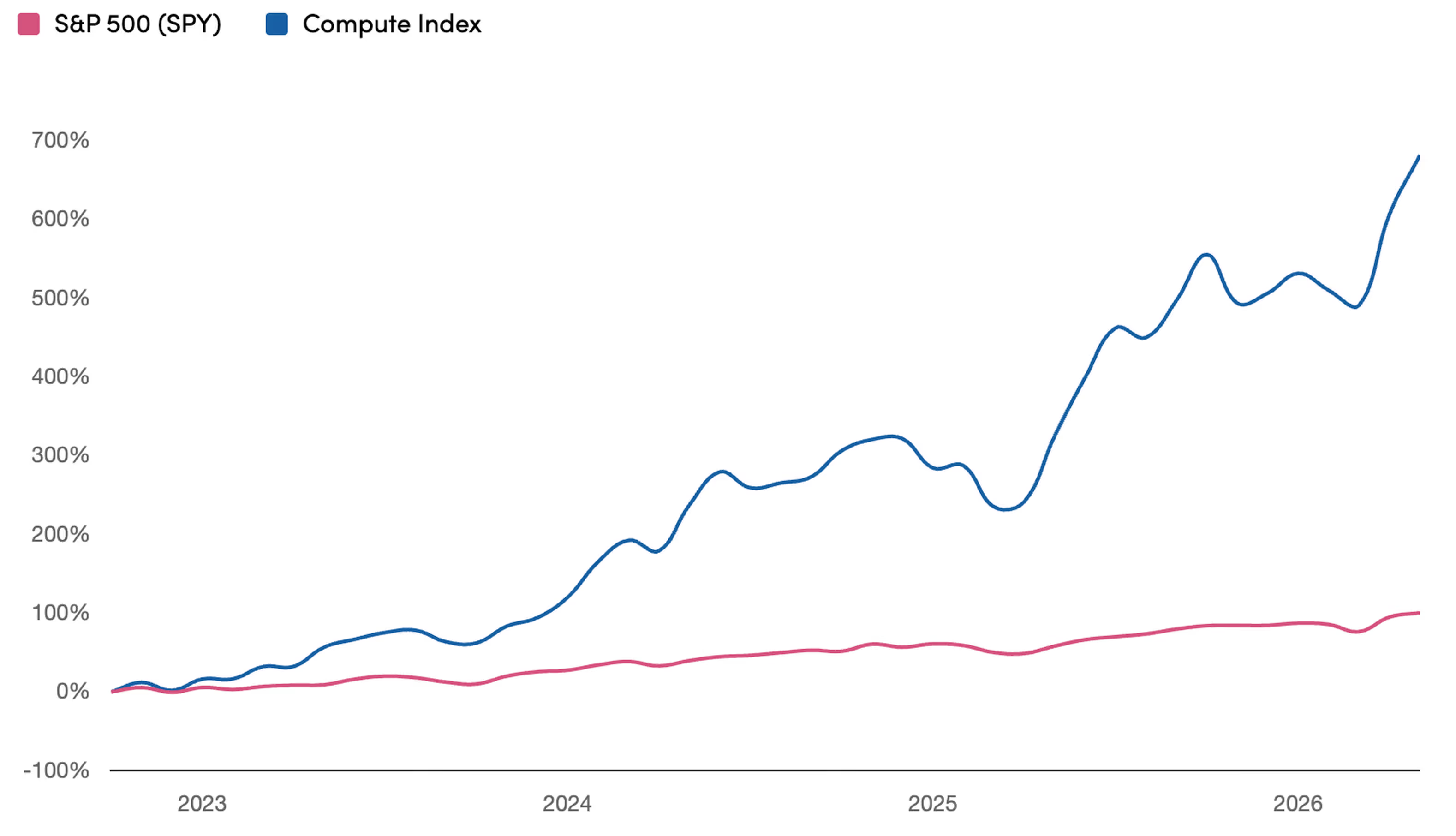
Our public markets Compute Index, tracking featured public companies traded on NYSE and NASDAQ, has seen incredible growth since October 2022. In the last month alone, the Compute Index has grown over 100%.
For public companies, we evaluated market capitalization, revenue, exposure to AI-driven end markets, and growth attributable to rising AI demand. Private company selection emphasized technical innovation, strategic importance within the compute stack, valuation, and capital raised within the last three years. For all companies, we drew on publicly available company data, Primary's experience evaluating compute and semiconductor startups, and feedback from industry experts on which companies are driving real change in the industry.
The AI boom has placed unprecedented demand on every layer of the semiconductor stack, and the companies navigating that demand are reshaping the global economy. The Compute 100 is our attempt to make that work public: a resource for founders, investors, and operators trying to map this landscape and track how it evolves.
Subscribe for updates. We’re excited for what’s ahead. Stay tuned!

Grid-Enhancing Technologies and the Time-to-Power Economy
Coordination is now the binding constraint on AI-era infrastructure
Buying behavior in power markets is changing fast. For decades, electricity was a slow-moving commodity. Customers could tolerate long lead times and were cost-conscious above all else. That’s no longer the case. Large scale AI and electrification workloads are now the fastest growing source of power demand, and they care far more about time-to-power than the cost of electricity. We think flexibility and load orchestration may get them to power faster than building their own co-located power plants and that they will increasingly turn to Grid-Enhancing Technologies (GETs). GETs aren’t a new concept, but now that hyperscalers are fixated on time-to-power, we think there will be an explosion in demand for GETs from a new, fast-moving, deep-pocketed customer.
A GPU cluster or a training run is ready to deploy in 18 months, but a traditional grid interconnection takes eight years. That’s an existential threat to a hyperscaler. Most of the conversation about the emerging energy constraint has focused on the supply side, examining new generation technologies (nuclear, geothermal, turbines, etc), power plant construction, transmission buildouts, and ever-larger capex plans.
What’s been underappreciated is how much power capacity is locked up by conservative grid planning assumptions and inflexible infrastructure. Because the grid is relatively rigid today, we have a lot of backup power that sits idly on the grid for those peak electricity demand days that only happen a few times a year (e.g. hot summer days). There is enough capacity on the grid already to meet the projected data center electricity demand over the next five years. This is why we view the energy constraint as a failure of coordination instead of a shortage of steel, copper, turbines and fuel.
The "Worst-Case" capacity trap
To understand why coordination is the unlock, we have to look at how the grid is currently planned. Historically, utilities have used "brute-force" construction to meet worst case scenarios. Think of the power grid like a massive highway system. To ensure that traffic never crawls even on a busy holiday weekend, the utility builds 12 lanes in both directions. For 360 days a year, 8 of those lanes sit effectively reserved for rare peak events. Because the utility’s mandate is to ensure the lights stay on during a record-breaking heatwave in August, they treat the grid as full the moment those holiday-peak lanes are accounted for.
This "worst-case" modeling locks up massive amounts of idle capacity. It’s constrained by the assumption that every load is inflexible and must be served during those rare peak hours.
Unlocking the idle lanes
This is where the opportunity for a massive shortcut lies. If new, large-scale loads (like data centers and factories) can be smarter and more flexible than a typical residential home, they can access those empty lanes without putting people at risk on peak demand days. In grid planning terms, they have to prove flexible “curtailment,” which means they can tolerate consuming less power when the grid needs them to.
If a data center agrees to a minimal curtailment model for just a few hours a year (less than 1% of the time) during those extreme heatwaves, the math changes instantly. According to the Nicholas Institute, this level of flexibility could unlock 76 to 126 GW of additional demand from our existing grid assets. To put that in perspective, most industry estimates suggest we need between 100 and 130 GW of new capacity to meet total data center demand through the end of the decade. If we can unlock 76-126 GW simply by coordinating existing assets more intelligently, we solve the majority of the data center power problem without waiting a decade for new transmission lines. This is why we are so excited about GETs and flexibility enablement.
Grid-enhancing technologies and why they matter now
Grid-enhancing technologies, as traditionally defined, are a set of hardware and software tools designed to increase the capacity, reliability, or utilization of the existing power grid without building new generation or transmission. Common examples include:
- Dynamic Line Rating (DLR): Adjusts transmission capacity based on real-time weather conditions.
- Advanced Sensors: Improve situational awareness and monitoring.
- Power-flow Control: Redirects electricity around congested paths.
- Forecasting & Optimization Software: Allows operators to run the system closer to its physical limits.
Historically, GETs struggled with adoption because they were framed almost exclusively as utility-facing solutions, which never aligned with utilities’ incentives. Utilities have always been incentivized to favor capital buildout (building more assets) over optimization. From the utility perspective, the benefits of GETs accrued to ratepayers, while the costs and integration risks were still on them.
The buyer dynamic around GETs has now flipped. In today’s environment, GETs are capabilities that large load buyers actively want because they believe it helps them get approved for interconnection sooner. It’s more about speed-to-power than marginal optimization. Flexibility, when made legible and enforceable, makes large load additions more palatable to regulators. It reduces perceived system risk and smooths approval pathways.
Under this broader framing, GETs are best understood as coordination technologies. They can’t change the underlying physics of the grid, but they can change how uncertainty is managed.
Where value actually accrues
The opportunity created by this shift in demand can be understood as a stack of solutions running from physical power to orchestration to capital.
At the base is physical acceleration. Modular generation, rapidly deployable substations, transformers, and switchgear exist because the system cannot wait, making buyers price-insensitive to delays. These capital-intensive assets create the operating envelope for coordination technologies.
Above that sits visibility. Much overbuilding is due to ignorance; operators lack real-time, probabilistic insight into system constraints. Software that dynamically maps headroom, forecasts stress, and replaces static reserve margins changes decisions upstream before capex commitment.
The next layer is control and orchestration, offering the most attractive risk–return profile for venture. Large AI loads are volatile. Grid operators care about behavior under stress: ride-through, failover, and predictability. Hardware-enabled software platforms coordinate on-site generation, storage, and grid interaction, turning large loads into manageable system participants. This layer will increasingly be a condition of interconnection or tariff eligibility.
Above control sits planning and interconnection compression. Interconnection queues are coordination failures. Tools that pre-qualify projects, reduce speculative noise, and allow planners to reason about flexible behavior unlock enormous value. Shaving months off a study cycle can unlock billions in downstream investment.
Finally, there is capital and risk infrastructure. Flexibility only scales when trusted. Insurance, guarantees, underwriting, and structured finance that price curtailment risk, uptime, and fuel exposure turn flexibility from an operational promise into a financial asset. As balance sheets determine who moves fastest, this layer becomes decisive.
We believe that visibility, control and orchestration, and planning offer the lowest capital intensity for VC-backed, asset-light models to start, but ultimately, all these layers will be necessary for a resilient, flexible grid.
Startup ideas implied by this thesis
Several concrete company archetypes fall directly out of this stack:
- Flexible Interconnection Platform (“ERIS-for-load”): A product that combines hardware and software to give large energy users a fast, guaranteed way to connect to the grid. It offers speed to the customer and predictable behavior to the utility.
- AI Load Stability Controller (Behind-the-Meter OS): A smart control system for large data centers/AI loads that smooths out power spikes, manages backup power, and allows the grid operator to safely manage the load without impacting the customer's work.
- Grid Headroom Intelligence Platform: Software that forecasts exactly how much spare power capacity (headroom) is available across the grid at different times. This helps planners, regulators, and developers choose the best location for new large energy users.
- Curtailment Guarantees and Risk Infrastructure: An insurance and finance product that prices the financial value of a customer's willingness to temporarily reduce their power use (flexibility). This allows flexible load to be treated and financed like traditional, reliable power infrastructure.
- Interconnection Queue Intelligence & Hygiene: Tools that clean up the grid's waiting list for new projects by filtering out speculative applications and standardizing technical information. This frees up capacity and time without building new physical infrastructure.
The synthesis
The dominant constraint in the next phase of grid scaling is coordination under uncertainty, and we think GETs are how the system adapts to that reality. They allow institutions to bend without breaking by making flexibility visible, enforceable, and ultimately bankable. In doing so, they enable faster growth than infrastructure timelines can alone.
The old mental model was linear. Build more grid to serve more load. The emerging model is nonlinear. Make load smarter, and the grid effectively gets bigger. In a world where time-to-power is strategic, GETs are foundational infrastructure for the AI and electrification economy.

Implementations are the edge
We are entering into a third era of enterprise software. Each era has seen a distinct shift of the onus of value delivery away from the customer and onto the vendor. We believe that value capture by AI-native software companies will hinge almost entirely on their ability to continuously deliver exceptional outcomes — making implementations and customer success mission critical.
We see the three eras of enterprise software as:
- On-prem (“Buy the House”) - large upfront investment, extremely high switching costs, ongoing monetization through professional services, in-sourcing of customization/implementation
- Cloud/SaaS (“Pay Rent”) - medium upfront investment, medium switching costs, ongoing monetization driven through expansion, outsourcing of implementations
- AI-native (“Hotel Rooms?”) - low cost of ownership, increasingly lower switching costs, ongoing monetization driven by value delivered to the business, high need for proper implementation
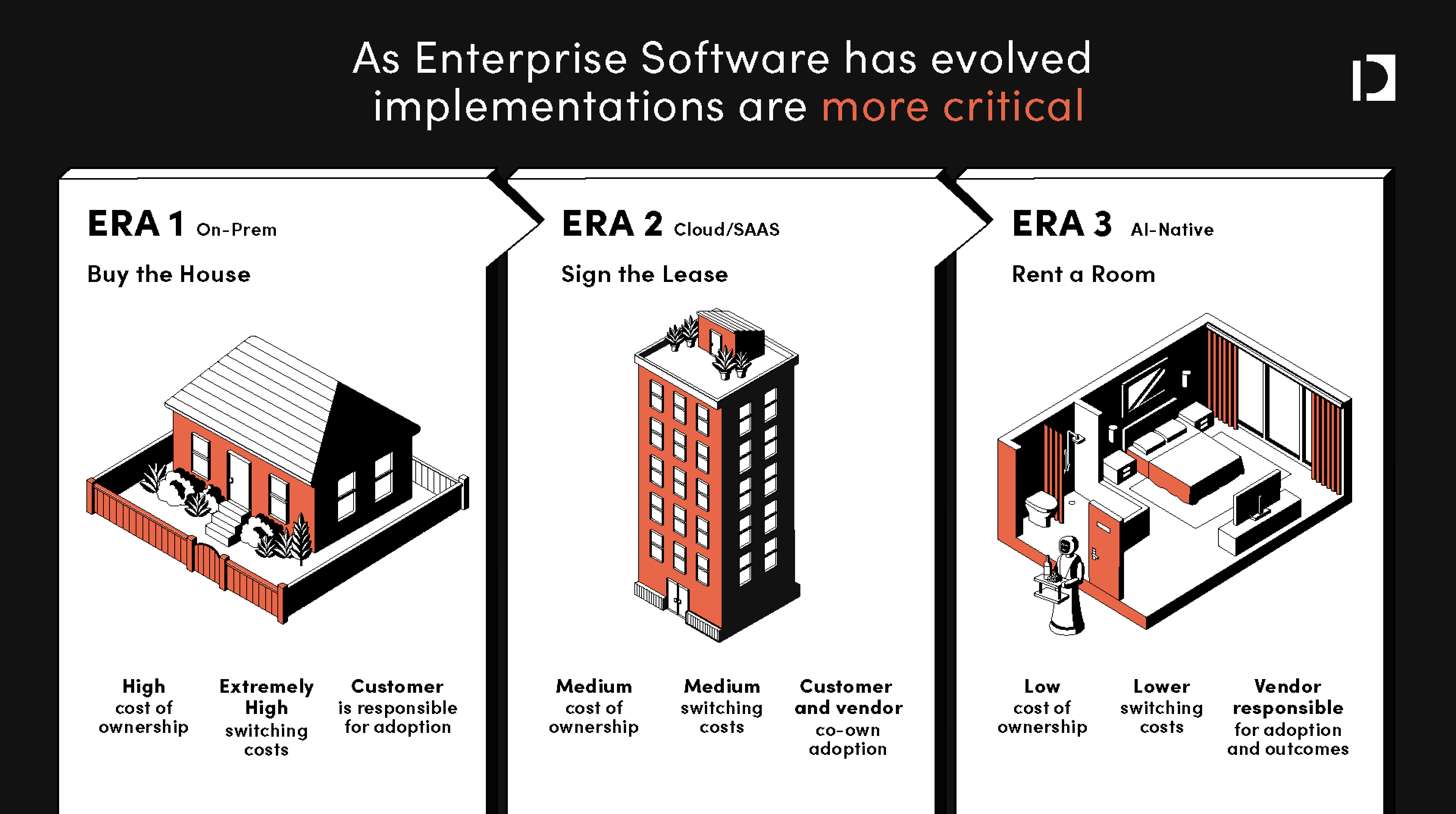
The On-Prem Era - “Buy the House”
In the on-prem era, enterprise software functioned much like buying a home outright: customers made a large, upfront license commitment long before any value was realized. Extremely high upfront cost of ownership and on-prem delivery meant that picking any system was a monumental decision. From there, software vendors were both able to and forced to extract ongoing value by charging through the nose to send a team onsite for every upgrade, patch, workflow change, or new integration.
As a result, professional services became a significant revenue line and a structural dependency. The knock on effect was that software had slow improvement cycles, deployments were brittle, and releasing new functionality was expensive and logistically complex. Switching costs were so high that “Customer Success” did not exist as we know it today; rather post-sale engagement centered on “Account Managers”, whose remit was increasing contract value rather than ensuring product outcomes. The guiding principle of the on-prem era was stability and control, not adaptability or continuous value realization.
The Cloud/SaaS Era - “Sign the Lease”
The transition to cloud introduced a fundamentally different software operating model. Instead of owning software outright, customers switched to recurring subscriptions akin to paying rent. Delivery in cloud environments made software improvements effectively free, with vendors shipping updates in the form of new features and functionality directly to customers. Professional services largely moved away from being a consistent, recurring revenue stream (that’s paying for the software instead) and more limited in scope to the “one time” upfront customization and onboarding work needed to adjust an “out of the box” solution to an enterprise customer.
The more one-time nature of the implementation meant that the scaled platforms largely outsourced this work — creating one of the largest services markets in enterprise IT. Global systems integrators (GSIs) emerged as a category – a $550B+ services ecosystem to support SaaS adoption. GSIs today represent nearly ~9% of all global IT spend.
In this era, the growth path for software companies in this era shifted to license / seat growth within accounts. NRR became the north star metric and therefore the optimization of expansion, renewals, and upgrades. This lowered switching costs (relative to the on-prem era) and birthed the “Customer Success” function to professionalize the processes behind account growth.
SaaS improved time-to-market and made product improvements effectively free. The lower cost of ownership meant the average number of SaaS applications per company grew from 8 in 2015 to 130 in 2022. For complex enterprises, value realization still depended on services-heavy, bespoke implementation work. This compounded with complexity as tech stacks broadened through the “unbundling” era of software. In this era, how the product was configured, integrated, and rolled out often determined actual ROI.
Entering the AI-Native Era - “Rent a Room”
In this emerging era, “software” is increasingly shifting to usage/value based models where customers effectively “pay as you go” for the value that they’re consuming.
The risk of a “bad” implementation increases exponentially because:
- Revenue starts at consumption - usage/outcome-based pricing moves revenue recognition and ACV growth to consumption, making implementations the primary bottleneck
- Probabilistic nature of AI requires more testing - non-deterministic output makes continuous evals and tuning critical, and model updates mean today’s functionality cannot be taken for granted tomorrow
- Implementations become a moving target - the combo of rapidly evolving underlying models and customer-side inputs mean implementations are stale almost immediately. “Go-live” becomes the start, not the end, of implementation. In the SaaS era, it was widely accepted that “Phase II” of an implementation oftentimes never happened as customers were so fixated on the exercise of “going live” that they more often than not lost steam on anything further. AI-era buyers will demand more.
- Software adapts to customers, not the other way around - the SaaS era provided opinionated solutions that were largely “take it or leave it”. AI-native solutions need to capture the nuances of tacit knowledge, tone, and culture of the end customer in a way that makes discovery exponentially more complex.
As a result, AI-native app companies today are each reinventing the implementation playbook from scratch. There is no “system of record” that captures customer level configurations and playbooks in a repeatable way. Implementations are increasingly a product problem (in fact – we are seeing an increase in implementation orgs structurally rolling up to the CTO). Companies are throwing bodies at the problem – and they’re expensive ones (in the form of “FDEs” too):

The last generation of customer success software (i.e. Gainsight, Catalyst) was largely a disappointment. The main challenges they faced were 1) mediocre ROI and 2) CS leaders had thin budgets and 3) existing solutions were largely reactive to what happened (oftentimes too late) vs. proactively recommending intervention and 4) data ingestion was massively painful
This is now changing. The AI-era is blurring the line between pre and post sales as we move to a continuous delivery model. In this world, the implementation org is no longer a cost center, they are becoming a core revenue driver.
Early observations in the market suggest:
- Persistently wide CARR > ARR gaps – Anecdotally we are regularly seeing CARR 3-5x higher than live ARR as many AI apps providers enter “land grab mode in an aggressive market”. Strong market pull is no longer the hallmark of PMF given top down AI experimental mandates. Retention is the new bar for PMF. This is shifting implementations from “expensive” problem to board level “hair on fire” priority
- Structurally lower gross margins – 70-80% SaaS margins are a thing of the past. Up to 56% of SaaS vendors now have variable pricing. With unit costs scaling with model usage, poorly tuned systems will become more expensive to deliver (as you have to re-run queries) and lead to weaker gross margins.
- “Implementing” is a continuous state – the underlying models and products are evolving so quickly that implementations are basically out of date as soon as they are complete. As vendors and customers alike are adopting agentic workflows in real time, there needs to be constant communication and adjusting (vs. a customer success team parachuting in right before the contract expires!). Again, this is a stark contrast to the SaaS era, where both buyers and customers became complacent with stale implementations until they reached the point of churn risk.
- GTM teams need new metrics around customer health – GTM teams will rely on new leading indicators of customer health in addition to the tried and true NRR metric. NRR is a lagging indicator of customer health and AI-native companies do not have the luxury to wait it out. Forward-thinking leaders are adopting new metrics to hold themselves accountable to customer value (e.g. Outcome Metrics 1.0) and we expect some of these to become the new normal.
- The right talent to do this is way more expensive – “FDEs” of every kind are en vogue – demand has grown 12x in the past year. Given the product depth, subject matter expertise, and oftentimes technical needs to get these implementations right, this talent is a much more expensive one — roughly 1.5-2x the cost of a typical CS associate. Historically a good implementation manager could manage 8-10 projects at a time; the deeply embedded model is scaling that way down. That’s changing too with 50% more of AI-native GTM teams in post-sales roles (vs. SaaS peers). Add this up and the total cost of implementations skyrockets.
The bottom line is that the onus of ownership is shifting from the customer (in the pre-SaaS world) to now almost entirely on the vendor. Getting in the door is now easy, staying relevant towards actually delivering value is much more difficult.
So What Does this Mean?
For Enterprise AI Apps, the implementation layer is emerging as the true battleground for category leadership. What endures is a vendor’s ability to implement, align, and maintain AI systems in live environments.
So the questions for a company in this space become:
- Is this a point in time problem? It’s still early days and most of the app layer is in “land grab” mode. At a more steady state of market penetration and product maturity, does the severity of the problem change?
- Can it be productized? Each category and even each end customer may require a bit of a different approach. Is there a set of collective primitives that will emerge that allow for repeatability (vs. just becoming a modern systems integrator)?
- Will implementations be “too” mission critical? Is a good implementation too much of the “secret sauce” to the point where each AI-native app company will want to own the process themselves? Anecdotally – we don’t think so. From what we’ve seen, although implementations are a huge problem, companies would rather dedicate limited resources towards core product development.
AI-native companies need to cross a new kind of chasm. The willingness to try is largely there, the willingness to stay is yet to be seen. We believe this dislocation creates a unique “why now” for a new “system of record” that is centered on the existing customer and enables continuous, ongoing implementations to emerge.
There have been a handful of new companies that have emerged to tackle this problem and automate implementations leveraging AI. There’s three main approaches:
- Arm the SIs – companies like Auctor builds tools to help traditional SIs deliver better implementations.
- Replace the SIs – these are tech-enabled services businesses that are focused on replacing the legacy consultants that are brought in to implement heavyweight software systems. Tessera focuses on ERP migrations while Echelon centers around ServiceNow work.
- Augment (and over time automate) internal delivery teams – systems like Axiamatic serve companies going through transformations while Genera supports AI-native companies who have hefty implementations processes.
As last mile delivery of software — in particular agentic software — becomes increasingly critical we know that the “FDE” role is only going to continue to grow in popularity. Implementations are becoming a front office problem and there’s a massive opportunity to help support this delivery problem as we shift into this new era of software consumption.
.avif)
Tokaido Health raises $25M
Healthcare costs for employers continue to skyrocket with no end in sight. Here in the US, we have put ourselves in an untenable position with very few solutions in the market that actually bend the curve. Look at where the cost is growing and the picture is hard to miss: pharmacy is the fastest-growing line item in American healthcare, and the overwhelming majority of that growth has nothing to do with new science.
Instead, it’s about misaligned incentives and a lack of understanding. More often than not, the party choosing a patient’s medication is not thinking about the site of care, the drug’s price, or the downstream costs. This lack of understanding means billions of plan sponsor dollars get wasted every year.
Ben Ryugo, CEO & Founder, spent years at Included Health, where he sat inside one of the most operationally complex care navigation businesses in the world and saw these misaligned incentives around medication from every angle – payer, employer, member, and provider. He lived and breathed this problem on a daily basis, without a clear solution. Tokaido Health is changing that.
Tokaido Health is an AI-native medication steerage platform anchored in behavioral economics. In its simplest form, the company identifies same-or-better medications that cost less, and pairs those recommendations with incentives that compel members to actually make the switch. They deliver a clean and simple value prop to employers, while also delivering a better experience to patients.
AI now enables Tokadio to do this work at member-level granularity. Unlike navigation platforms of the past, this is not about building a static rules engine bolted on top of a benefits portal. To properly navigate a patient through any medical journey, the platform has to reason across clinical context, formulary specifics, member preference, geography, and incentive structure across millions of decisions.
To start, Tokaido delivers four motions on a single platform that have historically lived across separate vendors: site-of-care steerage, biosimilar substitution, formulary optimization, and polypharmacy reconciliation. The team sees this as just the beginning. The roadmap from here keeps expanding the surface area of decisions Tokaido can make on a member's behalf, and there is no shortage of places where misaligned incentives are pushing members toward the wrong choice.
Critically, Tokaido layers on top of the existing PBM and benefits stack. No PBM swap, no plan design overhaul, no fight with the incumbent ecosystem. The team does the concierge work of moving the member from the higher-cost option to the lower-cost one. The plan wins, the member wins, and the independent specialty providers absorbing biosimilar volume win.
We are thrilled to partner with Ben, Gus, Andrew, Samir and the rest of the Tokaido Health team as they come out of stealth and announce their $25M financing led by Norwest, Primary, Next Ventures, Constellation, Scrub Capital, and others.

Beyond Subscription: The business model case for AI-Native vertical EHRs
In Part 1 of this series, we laid out why we believe AI-native, vertical EHRs could represent one of the more interesting bets in healthcare software right now. We described the structural dynamics that make certain specialties worth targeting: provider independence, workflow complexity, administrative burden, and competitive fragmentation.
We closed with a question we've been spending time on since: does the EHR market need business model innovation to be truly venture scale?
The “SaaSpocalypse” has made this question hard to ignore. If the terminal value of the world's largest software companies is being written down, verticalized ambulatory EHR software is not immune.
At its core, the "SaaSpocalypse" debate is a structural one: when AI can automate the workflows per-seat software was built to support, does the subscription model hold? For vertical EHRs, the question cuts even deeper. These platforms sit on top of enormous clinical context and currently do almost nothing with it. AI doesn't just put pressure on the subscription model. It opens the door to a better one, priced on consumption rather than seats.
That pressure has direct implications for the incumbents. The last wave of EHR PE (Thoma Bravo's acquisition of NextGen, Warburg's backing of ModMed, Francisco Partners' ownership of AdvancedMD) was underwritten on a familiar thesis: sticky subscriptions, low churn, customers too entrenched to migrate. If AI-native entrants show up with better software at a cheaper price and a business model that makes money elsewhere, how much of that stickiness really holds?
The EHR business model status quo
Most vertical EHRs today charge per provider, per seat, or as a flat monthly fee. It's a clean model: predictable, easy to price, easy to negotiate. But we believe it also dramatically underprices the value that an EHR, sitting at the center of a practice's workflow, is actually positioned to deliver.
EHRs capture an immense amount of data: every prescription decision, every diagnosis code, every prior auth submission, every referral, every lab order, every payer interaction, every billing event. And yet they do almost nothing with it, which is reflected in their pricing. Ambulatory EHRs capture 1-2% of the revenue a practice generates. The data live in the EHR, but the actions and labor happen elsewhere.
A pure subscription specialty EHR runs $150 to $1,500 per provider per month depending on specialty and practice size. A mid-sized gastroenterology practice with 10-15 providers might net a $60-100K ACV for a company like ModMed, before you layer in any RCM take rate. Not nothing, but modest given how central the software is to the practice. Even with RCM layered in, CAC is high and implementation timelines are long, which is a big part of why this category has been hard to build at venture pace. This pressure has pushed operators in this category to rethink how an EHR should actually make money.
Moving past SaaS in EHRs
Expanding beyond pure SaaS isn't a new idea. Flatiron Health, athenaHealth, and Practice Fusion have all tried it, each with a different monetization approach, and each with varying degrees of success.
Flatiron Health’s vision was that pairing deep specialty ontology with a data asset would deliver outsized value. Flatiron bought an oncology EHR, Altos Solutions, that enabled them to structure real-world clinical data that could be sold to pharma for clinical trial optimization, drug development R&D, and regulatory support. They translated messy, unstructured notes into curated, analyzable datasets. The EHR was the entry point; the curated oncology dataset was the business.
Roche acquired Flatiron in 2018 for $1.9B, but the acquisition ultimately undermined the very business model that justified the price. Flatiron’s value rested on being a neutral data partner to all of pharma, and the moment Roche owned them, competitors became wary of working with them. Independent governance didn’t fix that, and Roche has since sold off parts of the Flatiron business at a fraction of the sale price.
While this data platform approach could theoretically work in other specialty markets, the post-acquisition structural problem is the central question to resolve.
Athena built its business around a different insight: if you process the revenue cycle for a practice, you should share in the outcomes, not just charge for the software. Although athena is now privately held by Bain Capital and Hellman & Friedman, its public market history tells a clarifying story. The business launched in 2000 not as an EHR but as a cloud-based revenue cycle company. In fact, their EHR product didn't come until 2006. When you look at the public filings, the revenue composition reflects that origin: the overwhelming majority of revenue came from RCM and a percentage of collections, not software subscriptions. Athena is widely categorized as an EHR company, but the business model is fundamentally different from a pure play SaaS company. The EHR was the wedge, while RCM was the business. That's a large part of why $17B was a reasonable price for a company that was nominally "just an EHR."
It is key to note that while athena pioneered this model, most large specialty EHRs now bundle RCM services very tightly with their EHR product including ModMed, Nextech, eClinicalWorks and others. So even in a world of SaaS disruption, these ambulatory EHRs have more revenue durability than most people believe.
Practice Fusion took the most aggressive swing, offering their EHR for free. At its peak, it was one of the largest EHR networks in the country by provider count — valued at around $1.5B in 2016 — built entirely on a free model. Revenue came primarily from advertising, de-identified data sales, and clinical decision support. The latter is where the company got into trouble, after accepting payment from a pharmaceutical company in exchange for encouraging physicians to increase prescriptions for extended-release opioids. They ultimately settled with the DOJ for $145M and then Allscripts acquired the company in 2018 for $100M. Legal issues aside, the underlying hypothesis and vision was compelling: when you have access to a broad clinical network, the monetization surface is substantially larger than a seat license. We’ve seen a similar thesis play out more successfully with Doximity and now OpenEvidence.
So are there opportunities for innovation?
The through-line across these examples is that the business model follows the product. In Part 1, we laid out three archetypes for companies looking to unseat the incumbents.
- Action layers that sit on top of EHRs. This is where most venture dollars have flowed to date. Automate workflows, integrate with the existing EHR, prove ROI, expand. The catch is that you're building on a platform you don't own, and the incumbent can pull the rug whenever they decide to
- Modern systems of record. The clean-sheet rebuild: better data models, modern architecture, native automation from day one. In theory, owning the system of record unlocks all the same business model optionality as a full vertical OS, but the timeline to get there is brutal
- Full vertical operating systems. This is where the business model fully unlocks. These platforms combine the system of record with end-to-end workflow execution and layer in revenue streams across RCM, prior auth, specialty pharma routing, diagnostics, and data. Companies like Ease Health appear to be taking this approach. The EHR subscription isn’t the prize here, but rather a way to lock in the customer and capture all your value elsewhere
Of the three, the full vertical OS is the one we keep coming back to. It's the only archetype that holds up across the dimensions we care most about: AI leverage, long-term defensibility, and TAM expansion.
AI-driven consumption business models
The historical examples point to the same conclusion: stand-alone seat-based pricing is not the ideal business model for EHRs. Instead, Flatiron, athena, and Practice Fusion each found their way to a consumption-driven business model. Most notable is athena given they structurally shifted how the entire ambulatory EHR market operated and pushed companies deeper into the world of RCM.
So does AI create a new structural business model shift in this market?
We believe it does across two dimensions: 1. Improving the economics of already existing consumption models, 2. Enabling new consumption models to more easily emerge.
Improving existing consumption models:
RCM
RCM is where AI has the clearest path to value in this stack. The AI RCM market has already attracted roughly $1B in cumulative venture funding, with companies like Akasa, Cohere Health, and Adonis growing aggressively. The story is simple: AI reduces human labor across coding, billing, denial management, and appeals while improving collection rates. Today, athena takes 4-8% of billings for its services, and with AI properly implemented, its profit margins should increase in a meaningful way.
In an ambulatory market where the dominant EHR doesn't provide RCM services, an AI-native competitor can offer a better EHR and undercut the standalone RCM vendor at the same time. The combined product is stronger than either piece sold on its own. But in markets where the incumbent EHR already bundles RCM, that wedge is closed, and an AI-native challenger has to find other consumption streams to compete on.
Enabling new consumption models:
Practice management
Many EHRs already layer in practice management capabilities, yet none have taken the step to truly “own” the administrative function and labor associated with it. We believe that’s where the next wave of value will be captured, and it has two dimensions: the labor that keeps the practice running and the analytics that grow it.
On the labor side, AI agents are already automating intake, scheduling, insurance eligibility, and other workflows that today are human-intensive and largely decoupled from care delivery. But the shift is not just in automation, it's in how these workflows are monetized. SaaS monetization has followed a clear arc: first, companies charged for software. Then the smartest companies realized they could charge for payments. Now, the next frontier is charging for labor. This is not feature expansion. It's a structural shift in how software companies will capture value. Rather than selling a seat license, companies are increasingly monetizing on work completed: per intake processed, per appointment scheduled, per eligibility check verified. In many cases, they are effectively becoming the staffing layer themselves, with a pricing model that directly maps to labor displacement and throughput.
On the intelligence side, the same system that captures every marketing touch, scheduling event, prescribing decision, and claim outcome is uniquely positioned to turn that exhaust into operational insight: CAC by referral source, LTV per patient, case acceptance rates by provider, the unit economics of an MA hire. Today, most practices either do this in spreadsheets or fly blind. Incumbent EHRs surface dashboards that technically exist but rarely answer the questions a practice owner actually needs to run their business. An AI-native system of record closes that loop natively, which is what it really means to run the practice and not just record it.
Folding staffing and analytics into the EHR is not just product expansion. It's the logical end state of this monetization shift. The EHR that moves first to own both layers will not just be a system of record. It will be the system that actually runs the practice end-to-end.
Clinical decisioning & workflows
On the clinical side, incumbents have conspicuously ignored assisting in clinical decisioning and the workflows that sit alongside these decisions. Instead, companies like Navina aggregate data to present a full patient picture at the point of care, while others like OpenEvidence help ensure that providers make the best decision possible at the point of care. Yet, a lot of these insights are driven by core data that lives within an EHR.
It’s not a large leap to imagine that an EHR could instead own this revenue stream directly, and then orchestrate the administrative and agentic workflows that flow from each clinical decision. The monetization doesn’t have to look like a seat license either. Doximity and OpenEvidence have both shown that alternative business models, including advertising and pharma sponsorship, can work at scale in healthcare software.
Pharmaceutical services
The specialty pharma opportunity may be the most overlooked opportunity by EHRs. Startups and non-EHR incumbents have already built consumption-driven businesses around it, yet most EHR companies have yet to attack this part of the market.
Across high drug-spend specialties (oncology, ophthalmology, rheumatology, dermatology, gastroenterology), significant dollars flow between a physician's prescribing decision and the moment a drug is dispensed. An EHR with full clinical context is positioned to own that entire chain: prior auth, hub enrollment, pharmacy routing, and group purchasing.
Companies like Tandem and Latent have already grown aggressively by automating prior auth, acting as non-dispensing pharmacies, and monetizing through pharmaceutical hub services. To do this, they rely heavily on existing EHR workflows to drive their growth. A new EHR built from scratch has no reason to cede that position. In addition to this workflow, there is also a drug GPO opportunity. Cencora and McKesson have already demonstrated that tying an EHR to a GPO is legally viable, yet no one else has followed. An AI-native EHR that automates the administrative overhead and takes a slice of drug spend would be a fundamentally different kind of business.
How the TAM expands
Not all specialties are created equal for this model of vertically integrating practice management, RCM, clinical decisioning, and pharma workflows.
We believe the specialties most worth targeting have high drug spend per patient, high administrative intensity relative to patient volume, and clear clinical AI use cases. The more of those boxes a specialty checks, the more the full vertical OS model makes sense over a pure subscription play. To help bring this to life, below is an illustrative TAM for gastroenterology. Worth flagging that the clinical AI aspect is the most uncertain piece here, given ongoing unknowns around how this care should be delivered and how clinical decisioning will be monetized.
In this framing, pricing the EHR cheaply isn't a bug, it’s a feature that helps drive a more aggressive customer acquisition strategy.
So are ambulatory EHRs a venture opportunity?
When you look at the above TAM, the short answer is yes. The TAMs aren’t massive, but they’re large enough with enough upside to make this category genuinely interesting.
There are still a lot of executional questions to answer around product sequencing. Do you need to build all of this at once? Do you start with a unique wedge? Some combination of a large product build, plus a unique light-weight wedge? There's no universal answer. The answer will heavily be driven by the specialty, the customer, and what you can credibly own from day one.
If you're a provider or operator who sees your practice in any of what we've described above, we want to hear from you. And if you're building or interested in building in this space, we'd love to talk.
- Email: sam@primary.vc & hannah@primary.vc
- LinkedIn: Sam Toole & Hannah McQuaid
%20(1).avif)
Our 2026 Request for Startups
AI is moving at warpspeed where entire categories are being created and destroyed seemingly overnight. Agents are systematically translating the “knowledge” part of knowledge work into systems and code. For the first time, many locked up $1T+ profit pools are in play.
There’s four meta-trends and tailwinds that we believe will create opportunities for value creation. For each, we’ve described some examples (not exhaustive!) of the types of opportunities that we’re actively looking to invest in.
.avif)
Extreme volatility is the new normal
Between covid shutdowns, tariffs, and now AI uncertainty, our economy has been enduring massive shock after massive shock. And if there’s anything the markets hate the most, it’s uncertainty. Add to that new unpredictable costs in token consumption, power usage, and more means it’s just harder and harder to control risks where it matters most. We believe the ability to manage and hedge risks are going to become more important than ever in a rapidly changing world.
Planning software for a usage-based world
SaaS isn’t dead but seat based pricing most definitely is. Up and down the PnL everything that was once “fixed” is becoming variable. Revenue is shifting to be usage or consumption based. On the costs side, AI spend is the fastest-growing and least understood line item on the P&L. We’re still in the “tokenmaxxing” era but play out the tape and could token/inference costs soon overtake G&A as a line item? Headcount planning, budgeting cycles, and even (human) employment offers are going to fundamentally reorient to include the costs of AI and organizations are going to need better ways to understand and plan for their organizations.
AI-native catastrophic risk simulation software
Tail risks are happening more frequently and they’re breaking risk models. We just hit our sixth consecutive year where natural catastrophe losses were $100B+. What most of the traditional actuarial models miss is that they price risks in isolation and rely heavily on backwards looking loss data. The insurance industry needs new modelling software to help them better understand how various risks cascade into one another. Can world models or new AI-architecture help fill that gap?
New ways to isolate emerging factors
It’s starting to feel absurd that the markets close…since the world definitely doesn’t. It’s clear that the markets are clamoring for new ways to get financial exposure to the changes in the world as they happen in real time. Prediction markets are now at $20B+ in volume. The Iran crisis causes oil perps to surge to $48B on hyperliquid over a weekend. We believe the markets are hungry for new ways to get or maintain new exposures and there will be opportunities for new ETFs and trading venues to emerge.
Agents are the new ICP
BCG estimates the agent market will grow at 45% CAGR, and that feels like a tragic underestimate. Smart, autonomous agents are here and they’re quickly being adopted across consumer and business operations and they search, discover, understand, and choose in fundamentally different ways. Our software and our internet were both designed by humans for humans not agents. Solutions here will bridge that gap.
The communication layer for agentic teams
If you think alert fatigue was bad now… imagine what happens when you add human-agent and agent-agent communications into every business workflow. When half the workforce becomes agents, there’s going to need to be a new way to manage and communicate (and it’s definitely not email + chat!) both inter and intra-organizationally.
Implementations need a new system of record
Implementations were already the pain in the ass that killed many a software sale. In the AI-era, a botched implementation means botched outputs which means botched outcomes. And it’s not one and done either. Each deployment needs to continue to iterate and adapt to evolve in tandem with the needs of the customer. The CARR to ARR gap for every AI-Native software company continues to widen and churn for poor ROI tools is also on the rise. This gap can’t be filled with FDEs forever. There’s a role for a new system of record to emerge that starts at implementation and moves to be the source of truth for customer-specific agent deployments.
Solving structural labor shortages
75% of accountants are retirement age. Insurance is facing an upcoming gap of 400K jobs. The average wealth advisor is 51 years old. AI is eating into the $6T of white-collar payroll spend but it’s not all a replacement story. And this doesn’t even consider economics around the world with rapidly aging populations. There are many structural labor gaps emerging, particularly across “old-school” industries where AI can serve as the structural unlock.
No more phone trees please
The voice context on a call is infinitely richer than a chatbox and the technology is roaring past the uncanny valley. We’ve only just scratched the surface of applications of voice technology and what that means for democratizing the “white glove service” that is associated with always being just a call away. Advisory calls, deal closings, complaints & claims – all run on legacy processes, generate zero structured data, and are staffed by a constantly changing roster. We’re looking for the solutions that aren’t afraid to get deep — unlocking vertical specific or even customer specific voice applications across industries.
AI accounting solutions for every industry
In the $650B accounting services market, we believe that the next iteration of AI-accounting will be deeply verticalized. Property accountants spend hours reconciling CAM charges, construction firms track detailed percentage-of-completion and project based costs, and healthcare providers juggling payer mix accounting, while retailers live in tangled webs of deductions, promotions, and rebates. Every vertical with complex value chains, ownership structures, and billing will need their own vertical specific accounting solution (and dare we say…system of record?).
Finance needs new plumbing
The GENIUS Act and MiCA mean for the first time ever we’re starting to have clarity around around stablecoins and digital assets. At the same time, the markets are more global and 24/7 than ever. Total stablecoin volume has surpassed $1.8T up from $668B a year ago. We’ve crossed the chasm regarding institutional interest and comfort in stables, blockchain, and tokenization but most traditional players are held back by 40+ year old infrastructure. The financial stack is being rewritten from the ground up in real time – but there’s a real need to bridge the gap between old and new.
‘Tokenize it’: the US equities edition
There are 185M stock market participants in the US. The global demand is easily 10x that. Foreign holdings of US securities has grown 10x in the last 20 years but this is still largely out of the hands of retail traders. The demand is there. But for billions of people in emerging markets — where crypto adoption is high while equity participation is <10% — the settlement, custody, and compliance infrastructure to actually buy a share of Apple doesn't exist. Add to that private equity firms, private companies, or other real world assets which are going to be opened up to the world.
Back office infrastructure supporting a T+0 world
Equity settlement has gone from T+5 to T+1 over the last 30 years and now, T+0 (i.e. instant settlement) is looking like it’s on the horizon. Faster settlement reduces risks and frictions in the system. The issue: the back office isn’t ready. Clearing, reconciliation, corporate actions, proxy reporting – all still run on batch processes, manual workflows, and systems built decades ago. Broadridge, founded in 1962, alone processes $10T in daily transactions and proxies for 70%+ of US public companies… in the new world, that’s not going to cut it
AI-Native + stablecoin-native treasury management system
Today’s treasury management and ERP systems for a fiat focused world. Focusing on helping customers manage and move their own cash around dozens of bank accounts across the world. However, companies are already leveraging stablecoins for inter-company transfers, sweeping excess cash into tokenized money markets, and paying contractors across borders in real time. Nobody has built the connective tissue for a business running over multiple sets of rails while the last generation of software in this space is still extremely clunky, manual, and expensive. There’s an AI-Native + stablecoin-native solution to be built.
Agentic workflows that backdoor into your new insurance core
Insurers have faced a lose-lose for years: keep creaking legacy cores or endure a ~10 year replacement cycle. When faced with open heart surgery, inertia always won. Now AI agents can instantly automate high-impact workflows that meaningfully drive down expense & loss ratios. Think submission processing, claims intake, and broker portals. We believe there’s an opportunity to start services-as-software that tackles those operational workflows and collects the context and data along the way to earn the way into becoming first a shadow core and then the real core.
What Are We Looking For?
Primary leads pre-seed and seed rounds with $1-10M checks. We back founders who are building from conviction, not consensus.
- Team over market timing -- at seed, we’re betting on you and your ability to founders and their ability to navigate twists and turns as the future unfolds. We want builders who are customer-obsessed, product-driven, and AI-native. Slope over intercept.
- Sell the outcome, not the platform -- the best companies in this cycle will be measured by what they deliver, not what they enable. FDEs, not sales engineers.
- Paths to compounding moats: This era of AI will be defined by last mile delivery. It’s getting easier to build but that does not mean it’s easier to figure out “what” to build. We believe that the core tenants that lead to structural moats ring true – capturing proprietary data sets, network effects, deep applied industry knowledge.
If this is you and you’re building against one of the trends above, we want to know you. Here’s where you can find us.
- Email: fintech@primary.vc
- X: @emily__man & @nwdaley
- LinkedIn: Emily Man & Nick Daley

Eos: identity security for the agentic era
Today, we’re excited to announce our investment in Eos, and AppViewX’s acquisition of Eos. To think this has all happened in just the last nine or so months is staggering. However, the story started with deep conviction in a market and some serendipity.
When we met Archit Lohokare and Kash Ivaturi in the summer of 2025, it felt meant to be. For months, we had been thinking about the area of agent identity and access, so much so that we were considering incubating a business in this space.
In our view, the majority of the AI security startups at that point were focused on the obvious, low-hanging fruit issues of using ChatGPT and Claude. These included making sure sensitive data did not end up being fed into an LLM, or having a customer-facing chatbot go off the rails and make a bad business decision. These problems seemed like just the beginning – a wave of enterprise-grade problems was still to come. Chief among them were the issues of governance, access, and privilege. What does an AI agent access, and when? How should companies treat agents within their identity and governance frameworks? Who has permission to use what agents, and in what contexts? All of these problems were not getting enough attention, even though they represent the critical questions underpinning identity in the age of AI, a massive market that is up for the taking.
With this idea, and these open questions, we met Archit and Kash as they were beginning to form what would become Eos. The connection and alignment was instantaneous. Archit and Kash, having been leaders of identity and access management and governance products at CyberArk and Idaptive, had seen firsthand the disruption heading this market’s way because of agentic systems. Agents change the way we need to architect identity and governance programs within the enterprise. The traditional incumbents are not prepared for that disruption. This was the opportunity that led to Eos, and in the summer of 2025, we seeded the business and they were off to the races.
Today does not mark the end of that story, but a very exciting step change and acceleration of it. We are excited that Eos is being acquired by AppViewX, a leader in the Machine Identity Security, Certificate Lifecycle Management (CLM), PKI and Post-Quantum Cryptography (PQC) space. Archit and Kash will assume the CEO and CTO roles at the new combined company, and AppViewX will integrate Eos into its product offering, repositioning around a next generation AI Agent and Machine Identity Security platform.
We could not be more excited about this milestone. AppViewX provides Archit and Kash the platform and distribution resources to go after the Eos vision, but to do so bigger and faster than they could have otherwise. AppViewX’s Machine Identity Security and CLM products should be a natural component of the Eos offering, and make the technology even stronger. In AppViewX, we saw a partner that could help get Eos to market faster, and with more impact, in a space that is getting hotter by the second.
We could not be happier for Archit and Kash, two unbelievably seasoned professionals and operators in the identity security space. There are no better builders in this market than them, and the combined Eos-AppViewX entity will be a force to be reckoned with in this next wave of Identity Security companies built for the AI and Post-Quantum era. We’re excited to be along for the ride.
A special thanks goes to Doug Steinberg, an Operator-in-Residence with us who spearheaded much of the research and diligence that led to our interest and conviction in this market. Without his hard work, the Eos story would have been very different, and it almost definitely would not have included us at Primary.
Congratulations to Archit, Kash, and team Eos!
.avif)
Primary’s 2026 investment thesis for GTM Tech
Go-to-market is a space our team knows intimately well: many of us were previously buyers and users of these solutions, and Primary spends thousands of hours each year working with our portfolio companies on their sales, marketing and customer success rhythms. When we published our last GTM thesis, AI was just beginning to shake things up; today, that shakeup has accelerated dramatically. We have gained clarity on what truly matters for building a category-defining GTM company and are excited to hear your feedback.
GTM startups must fundamentally transform the company P&L
Our thesis: AI has finally made it possible to transform the GTM P&L, and the market is demanding companies act accordingly. Today’s best-in-class GTM solutions embrace these four market realities:
- Gross margin pressure requires companies to radically reduce operating expenses
The best companies are investing heavily in compute to stay competitive and eroding gross margin in the process. They simply must get more efficient with their operating expenses, but GTM financial metrics such as CAC payback and net magic number have been stagnant for years.
- AI-native companies are prompting an evolution to leaner org design
Growing revenue has historically been expensive and wildly inefficient due to the number of people required: human BDRs can only handle so many touches per week even with the newest tools, companies are forced to hire another middle manager for every X new AEs, and so forth. AI-native companies are achieving staggering productivity per employee, and are setting new expectations for what’s possible. Every company must reconsider the human intensity of their GTM motion. - Function-specific software silos are collapsing
It’s finally possible to break down the barriers across functional software categories (e.g. marketing software vs. sales software vs. customer software).
- Companies will collapse and integrate traditional GTM roles
We are on the brink of a new “full-funnel GTM” role, removing the traditional functional specialization between Marketing - BDR - Sales - SC - CS - AM. It’s conceivable to have one person – backed by powerful agents – cover pipeline generation, sales, and ongoing customer management.
We are excited to back founders building AI-native solutions to enable this exciting new world.
Introducing PRIME
We are looking for founders or aspiring founders building GTM businesses with a direct-line impact on the P&L.
We've codified this as having demonstrable impact on PRIME:
- Productivity (Revenue per Employee)
- Retention (NRR or GRR)
- Investment Efficiency (Net Magic Number / S&M Efficiency)
- Momentum (Top-Line Growth)
- Expense Reduction (Headcount and Cost Eliminations)
This is our non-negotiable filter for GTM investing. Companies who explain ROI through opportunity cost, marginal efficiency gains, or indirect metrics don't fit our mold.
Consider a category such as digital deal rooms: they may accelerate cycle times and marginally improve win rates, but there are multiple steps of math required to translate that to the P&L. Marginal gains are certainly valuable, but we are committed to backing the companies that seek to deliver an order of magnitude impact.
Founders: we thrive with serial entrepreneurs who are obsessed with their customers
We've learned that second-time founders are where we add the most value. Our strongest fit tends to be with serial entrepreneurs who value what we bring beyond a logo on the cap table: our network connectivity and operating experience. Exceptional talent is exceptional talent and we’re excited to meet any high-slope founder who shares our category conviction. But founders such as Amanda Kahlow at 1mind, Ganesh Ramakrishna at Lyric, Richard Harris at Black Crow AI and Jon Sherry at Alium exemplify the type of builders we're excited to partner with: they have unfinished business.
The founders we're drawn to are aggressive about their own GTM and deeply customer-obsessed. They understand you cannot build enduring enterprise value without enduring customer value, and they're constantly challenging their own assumptions based on what they learn in the market. They obsess over the risk of the gross retention apocalypse. At the same time, they're Challenger sellers—teaching the market where it should be headed. Importantly though, the founding team must marry this customer obsession with world-class technical acumen.
The path to full-stack GTM
We love hearing a founder’s articulation for how they will bring this new GTM operating system to life. We’ve thought extensively about wedge vs. compound startup tradeoffs and are excited to share our own thoughts:
Wedge Strategy
The wedge approach starts narrow but has a strategic vision to become a platform. Wedge products must still meet PRIME criteria and demonstrate clear P&L impact because that guarantees the right to ultimate share-of-wallet expansion. But beyond financial impact, wedge products need two additional qualities:
- Obvious right to win – whether it’s a “Zero CAC” founder with a rolodex of prospects who already trust them, a team of 10x engineers shipping products at unprecedented speed or a former operator with an earned secret, the companies we back must have a clear right to win the lane of their wedge.
- Own the context – the best wedges embed into the bloodstream of workflows and data, earning the right to capture net-new signals or refine existing data into decision-grade context. If a wedge cannot maintain and resolve context, it will struggle with durability regardless of the initial P&L impact. Playing the context angle correctly also makes launching subsequent SKUs more seamless and more defensible.
1mind is a great example of a successful, context-rich wedge approach. When we led the Seed round, we were investing in Amanda’s vision to build an end-to-end AI brain for all GTM functions from first prospect engagement through ongoing support, but we recognized they needed to start with a wedge. 1mind carefully selected an inbound AI BDR wedge that facilitated thousands of customer conversations, enabling impressive context. The data ingestion needed to train their AI “Superhumans” combined with that conversational context positioned them to expand into adjacent workflows with an unfair advantage. 1mind’s right to win was Amanda’s track record: she had previously built a category-defining unicorn with 6sense, and had an incredible rolodex of prospects ready to take her at her word.
1mind also exemplifies PRIME: it makes sellers more efficient by having AI handle upfront conversations so reps can manage bigger deal loads (Productivity), increases efficiency through reduced hiring needs, thereby reducing CAC and increasing net magic number (Investment Efficiency), and drives obvious expense reduction because teams can hire fewer people (Expense Reduction).
"Wider" / Compound Strategy
The compound approach goes full-stack from the onset. The core question: why are customers trusting you for this risky, transformative move? Because these plays command higher switching costs, we believe founder domain fluency is essential.
We recognize compound businesses take longer to build, particularly in the 0-1 GTM phase. During that extended building cycle, we're looking for a best-in-class approach to design and development partners as well as evidence of off-the-charts engineering and roadmap velocity. We love it when we hear comments along the lines of, “I can’t even keep up with our engineering team because we’re shipping so fast” (a recent verbatim from Amanda at 1mind!).
If you’re transforming the GTM P&L, get in touch
The GTM category is at an inflection point. AI has created both tremendous opportunity and tremendous noise. The winners will be the companies that don't just bolt on AI capabilities to existing workflows, but fundamentally reimagine how companies acquire, retain, and grow their customer base.
We're committed to finding category-defining plays early and supporting them relentlessly. If you're building something that transforms the GTM P&L, we want to hear from you.

The Energy-Intelligence Hypothesis
I. The End of “More for Less”
For decades, digital progress followed a simple promise: more for less. Each new generation of chips delivered greater capability while consuming less power per operation, a relentless march of efficiency initially captured by Koomey’s Law (the observation that the energy efficiency of computation doubles roughly every 1.5 years). That trend continues as silicon chips get more efficient, but its impact has fundamentally changed.
Today, efficiency gains that once reduced energy use are now enabling an explosion in compute demand driven by frontier AI. This dynamic, consistent with Jevons’ Paradox, which states that improvements in efficiency don't conserve a resource, but instead expand total energy consumption by making its use cheaper and more widespread. Everyone agrees we’ll need exponentially more energy to power the AI future. Hyperscalers themselves now openly acknowledge that energy is their single biggest operational constraint. Where and how fast they can deploy AI depends on where they can find power.
The open question is how best to address this bottleneck when gains from hardware and algorithmic efficiency are no longer enough to overcome it. The conventional view from Koomey’s Law focuses narrowly on chips and models. While we appreciate the critical and ongoing work being done in hardware and algorithmic efficiency by many smart individuals (including our colleagues), the constraint we are focused on lies in the broader system-level energy relationship. That is, the full end-to-end energy supply chain of AI from computation to cooling, from data centers to the grid, and from turbines to transmission lines. Meeting this moment will require a complex, multi-layered solution that involves simultaneously improving existing infrastructure, rapidly adding power supply, and deploying new efficiency technologies across the entire system.
The Energy-Intelligence Hypothesis (EIH) provides a framework for understanding that chain and suggests that if we keep shipping model improvements at the projected rate, the demand for compute will outpace advancements in the physical infrastructure required to power it. That infrastructure will also often be built inefficiently, compounding the problem over time.
There may even be a measurable, testable relationship between intelligence and system level energy consumption. The same way there are scaling laws that exist between model loss and compute, there might be something similar between AI model capability and system-level energy consumption. For now that’s above our pay grade, but the evidence we see in the market suggests there is a diminishing margin of return on energy in the AI race.
The goal of our framework is to explore how energy constrains AI progress. We decompose total system energy into four measurable subcomponents of 1) compute-level, 2) data-center-level, 3) grid-level, and 4) power-plant-level energy to identify where the system is bottlenecked and why.
The scale of this challenge is defined by a fundamental structural mismatch: exponential compute demand is mathematically driven by the scaling of frontier models, but the physical energy infrastructure (power plants, transformers, and transmission lines) is characterized by slow, multi-decade capital expenditure cycles, lacking the agility to respond to digital-age velocity. This misalignment is exacerbated by history. Energy systems are traditionally structured to meet growth primarily through efficiency gains (historically, efficiency gains have contributed more to energy growth than new supply). However, the US electricity demand was largely flat for over twenty years, meaning the sector lacks the institutional "muscle" and streamlined supply chains needed to pivot from slow efficiency gains to massive, rapid physical expansion. The urgent need to grow data center energy capacity from 17 GW today to over 130 GW by 2030 requires a new playbook.
II. From Chips to Systems: The EIH Framework
The traditional lens of compute’s energy efficiency zoomed in on chips and models. The landmark KPI of the AI economy has been tokens per watt, which clearly ties compute to energy, but not beyond the GPU level. It doesn’t include the entire supply chain of energy that was lost in the delivery of electrons to the GPU. We think the frontier of constraint has moved. The modern AI stack is no longer just about software and silicon. It’s now a physical infrastructure system.
Understanding this requires shifting from chip-level efficiency to system-level energy, encompassing the full physical chain that delivers usable power to computation. That system can be broken into three interacting layers that combine to define the total energy required by a massive AI deployment.
Deteriorating Efficiency: Driven by the Bridge-Plant Trap, relying on fast, low-efficiency simple-cycle turbines (35-40% thermal efficiency).
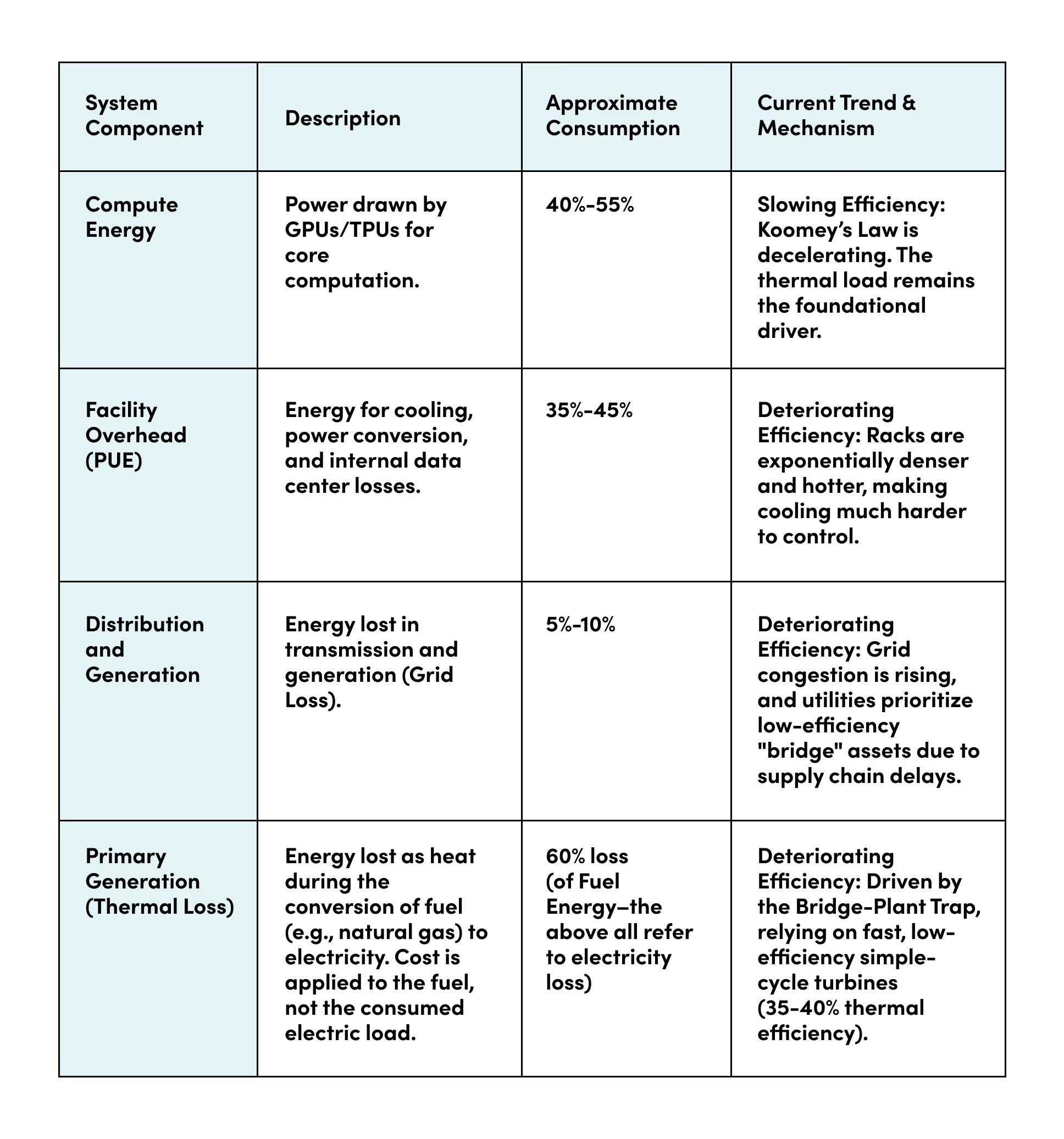
The lesson is clear: The marginal efficiency gains from the chip are not enough to overwhelm the compounding losses across the rest of the energy supply chain. Chips and algorithms are only half of the problem. The solution requires looking at the rest of the system as rigorously as we have looked at algorithms and chips.
The energy economy of AI has entered what might be called a System-Level Rebound, where efficiency at the compute level drives inefficiency at the energy system level. The signs of the demand spike and its impact on the system are plain to see:
- Demand Shock: U.S. data-center demand of 17 GW in 2023 is projected to exceed 130 GW by 2030, requiring the buildout of more than 100 new large power plants in seven years.
- Speed Over Optimization: Hyperscalers now prioritize speed to power over cost or sustainability. Interconnection queues have ballooned by over 200% year-on-year.
- Structural Capex Lock-In: Every short-term fix (extra transformers, emergency aeroderivative turbines, ad hoc cooling) becomes long-term infrastructure. Once built, inefficiency calcifies, guaranteeing that total system energy continues to scale exponentially with compute, even as individual components become more efficient.
The rebound ensures that the constraints from cooling, distribution, and generation will overwhelm the dwindling efficiency gains from hardware and algorithms. The suddenness of this demand shock is made more poignant by how stagnant energy growth was in the decades leading up to the AI buildout. The system is structurally unprepared for this non-linear acceleration
IV. The Evidence of Systemic Slowdown
The systemic buffer that once kept compute sustainable is collapsing under pressure from four measurable factors:
1. Hardware Efficiency: Koomey’s Law is Losing Momentum
The legendary Koomey’s Law (computational efficiency doubling every 1.5 years) has flattened dramatically since 2015. Today, the doubling time for computational energy efficiency has slowed to around 2.3 years. This is primarily attributed to the end of Dennard Scaling, a decades-long trend that allowed manufacturers to increase transistor density without a proportional increase in power. This deceleration is not temporary and is constrained by fundamental thermodynamic principles (like the Landauer limit) that determine the absolute minimum energy required to compute. This points toward the eventual end of these gains.
2. Facility Efficiency: The PUE Plateau
Power Usage Effectiveness (PUE), the industry’s metric for data-center efficiency (Total Facility Energy/Compute Energy), tells a story of rapid initial success followed by painful stagnation. Pre-cloud data centers operated with PUEs near 2.0 (meaning 1 Watt wasted for every 1 Watt used for compute). The cloud boom drove this down sharply to a best-in-class average of 1.2 by 2018.
Today, however, PUE has stalled globally around 1.6. This failure to improve is not benign: as chip density rises, the cooling challenge has changed from a linear problem to an exponential one, with internal losses from cooling and power conversion eating a larger share of energy. GPUs optimized for AI deliver enormous performance, but are becoming hotter and hotter engines. Nvidia’s H100 draws up to 700 watts; high-density data-center racks now exceed 100 kW, with projections nearing 1 MW by 2030. The implication for the AI buildout is catastrophic. If the industry achieves its projected 130 GW IT load by 2030, the PUE plateau at 1.6 means the industry will waste over 52 GW of power on cooling and overhead (78 GW total overhead at PUE 1.6 vs. 26 GW overhead at PUE 1.2). To put that in perspective, the 78 GW of total overhead power capacity required just for cooling and conversion is roughly equivalent to the peak summer electricity demand of the entire state of Texas.
3. Transmission & Distribution: Losses that Don’t Shrink
The physical process of moving power from the plant to the plug is inherently inefficient, typically resulting in 5-6% of all U.S. electricity disappearing in transit. Grid loss is directly impacted by distance, density, and critically, the quality and age of equipment (substations, transformers).
Today, the AI buildout is actively pushing this loss rate higher. Despite efforts to move behind-the-meter, the concentrated, high-density demand from hyperscalers is immediately exacerbating local grid congestion. This rising congestion increases current flows across existing infrastructure, which consequently drives up thermal losses within the aging system. Moreover, the massive supply chain bottleneck for critical, high-efficiency components like Large Power Transformers (LPTs) (most major suppliers have four-year backlogs) forces utilities and IPPs to patch the system with refurbished or older, lower-efficiency hardware to meet deadlines. This strategic necessity sacrifices long-term efficiency for short-term speed to meet urgent near-term AI demand. We believe this will cement longer term systemic inefficiency into the grid itself.
4. Generation Efficiency: The Bridge-Plant Trap
To meet surging, immediate AI demand, power providers are forced away from optimal, high-efficiency solutions like Combined Cycle Gas Turbines (CCGT), which face five-year backlogs and supply chain bottlenecks (discussed in detail in our last newsletter). Instead they are using faster-to-deploy, lower-efficiency options like aeroderivative turbines or refurbished simple-cycle gas units. These assets are thermally inefficient (35-40% efficiency) compared with CCGTs (55–60%). This short-term scramble for capacity locks in lower efficiency, higher emissions, and higher future costs over a power asset’s multi-decade lifespan.
V. Strategic Implications: The New Investment Thesis
Behind every token is a stack of software, hardware, and physical energy infrastructure, the latter of which is being strained to its limits by compounding token growth. We must address the physical layer head-on. We highlight four immediate strategic shifts necessary for investors and founders to manage this new reality, which we believe offer significant opportunities for new companies. (This is admittedly high level, and we will dive deeper into each of these in subsequent newsletter posts). The strategic shifts outlined below focus exclusively on the physical energy chain and do not address the essential, ongoing work in chip and model efficiency.
1. High-Velocity Supply Buildout
The AI demand shock requires the power sector to pivot from slow, multi-decade planning to rapid, industrial-scale deployment. This category focuses on accelerating the speed and efficiency of deploying new power and transmission assets.
- Infrastructure Bypass Solutions: Developing pre-fabricated modular power solutions, solid-state transformers, and advanced utility-scale batteries to circumvent supply chain bottlenecks for critical grid components.
- Supply Chain Investment: Investing in the manufacturing capacity for critical power infrastructure components (e.g., turbine blades, generators, transformers) and securing supply chains for key materials (e.g., lithium, copper, and rare earth minerals).
- Grid Modernization & Optimization: Creating durable power electronics and grid-enhancing technologies (GETs) that improve the flexibility, reliability, and capacity of existing transmission lines, enabling faster interconnection for new generation.
- Power Infrastructure Enablement: Investing in technologies and processes that enable grid infrastructure and power plants to be built faster and more efficiently, often using standardized or modular designs.
2. Data Center Facility Resilience
This focus area tackles the data center's most immediate physical challenge: heat management and maximizing the utility of every electron. These solutions improve data center efficiency and ensure BTM assets contribute to local stability.
- Thermal Management: Investment in solutions like liquid immersion and direct-to-chip cooling, and high-efficiency UPS/PDUs to stabilize facility overhead (PUE) against rising chip density. There are also “extreme” thermal management companies focused on building data centers in environments that are less susceptible to heat constraints (underwater, space, etc).
- Stranded Energy Recapture: Focus on heat exchangers and campus-integrated cooling systems to convert waste heat into reusable energy, maximizing thermodynamic efficiency.
- On-Site Flexibility: Solutions that enable data center batteries and BTM generation to provide localized resiliency and participate in demand flexibility programs.
3. Frontier Energy Supply & Bypass
To meet long-term energy needs beyond what traditional generation can provide, investment must flow into new, high-capacity, firm, and decentralized sources. These are the "deep tech" solutions that radically increase available supply.
- New BTM Generation: Scaling Behind-the-Meter (BTM) co-located generation technologies like modular nuclear, advanced geothermal, and long-duration storage (LDES) to bypass grid congestion and delivery loss.
- Energy-Agnostic Sites: Developing power-agnostic data center designs that can quickly integrate non-traditional, firm power sources, accelerating the speed-to-market for new supply.
4. Digital Infrastructure: Planning, Visibility, and Flexibility
This category focuses on integrating software and data to solve the system's structural planning and efficiency challenges, benefiting both grid operators and data center developers.
- Grid Infrastructure Data Solutions: Companies that provide high-granularity, node-level data mapping and competition analysis of grid capacity, interconnection queues, and future power prices. This is critical for optimal data center siting and project financing (e.g., replacing manual transmission studies with data products).
- Predictive Resilience: Software tools, including advanced Load Management Systems (LMS) for utilities, that use AI to forecast demand, predict grid downtime, and optimize transmission flows, enabling proactive control and reducing system losses.
- Intelligent Load Management & VPPs: Energy-aware schedulers that enable temporal routing, aligning compute demand with instantaneous energy supply and price. This includes platforms that turn large, schedulable AI load into a valuable grid asset by developing Virtual Power Plants (VPPs) that aggregate flexible load and enable BTM capacity to actively export surplus power back to the utility.
In our next issues we’ll break down each of the four opportunity areas outlined above. As always, if you are receiving this it means we respect your opinion and encourage your feedback. If you have any thoughts or are working on solutions to the problems we discussed, we’d love to hear from you.
.avif)
Investing in the reinvention of cybersecurity
We are at a crucible moment in cybersecurity, one in which AI is changing everything. Just last week, Anthropic caught a near-successful cyber espionage attack that was 80%-90% executed by AI agents. These AI agents ran many parallelized attacks at thousands of requests per second, the kind of speed and sophistication a human would only dream of. The world is getting scarier, and CISOs wake up every day confronting this reality.
At the same time, AI is a new technology platform that presents internal risks. Top-down mandates from C-suites and boards mean that AI experimentation is ubiquitous, creating new threat vectors. Additionally, new hardware and configurations in the data center mean that the physical infrastructure to protect is different too, necessitating new solutions.
This change is scary, but also exciting. For too long, cyber has been bogged down in the SPM craze—“posture management” and dashboards. Of course, visibility is necessary, but the dashboard sprawl has become comical. A CISO’s main problem is no longer blindspots, but rather an excess of data. Alert after alert, and security teams seemingly get farther from actual solutions. In the words of a CISO I know well, many tools are just “more software for software.”
The evolution of the market in this way makes sense. Some visibility-focused startups have become category-defining, generational companies. In pursuit of the next Wiz, VCs have over-funded visibility. Despite some successes, most of these companies have contributed to the most fragmented, sprawling, and redundant stack in the history of cybersecurity.
AI has the potential to break this pattern by automating workflows, reducing costs, and finding better signals in the noise. We see this happening across all security categories, from identity to data to endpoint, and have made investments accordingly. The time to build in cyber is now—to give security leaders less, not more; to think of cyber from a blank slate with AI at the center; to use the data the SPMs of the last decade have generated to deliver unique value.
And New York is a great place to build. Although Primary is much bigger than we once were and we now invest globally, the firm began with a bet on New York. A bet that New York is the greatest city in the world, with the highest density of customers and talent, and that founders should be here. This is true for cyber. New York is home to the largest Israeli community outside of Israel, where a disproportionate number of cyber companies are born. And, as the center of the financial world, New York is home to some of the biggest, most sophisticated cyber customers in the world.
We are seeing the gravity around New York strengthen, as companies like Wiz, Cyera, and Axonius have all relocated their headquarters here. Today, there are thousands of security operators in this city, and that number is growing. Undoubtedly, many of these operators will start great companies of their own. We believe we are on the verge of an explosion of the New York cyber ecosystem.
Today, I am humbled that my promotion to Partner is being announced to the outside world. Primary is a deeply special organization for me. I first met the team when I was 25, before going to business school, having spent my prior years working on a startup in NYC. As a born and bred New Yorker who knew how hard the earliest days of startup building were, Primary stood out. “Startups are hard; founders deserve better” has been and is always at the core of what we do, and our ability to execute on that truth and deliver value for founders has grown exponentially since I joined the firm.
I am especially excited about leading the cyber practice for Primary, at a time when security is so existential and great upstarts so needed, and in a place that is poised to become a hotbed for cyber activity. We are working on a lot of interesting things here, and have big dreams. We do not invest in many companies—I will make maybe two investments a year—but the companies we do invest in will be big swings, and we will try to help them in a differentiated way unmatched by any seed firm on the planet.
The challenge of building a cyber seed investing practice is real, but we believe our strategy and positioning is unique. If you are reading this, and intrigued to learn more about our approach, please get in touch. Today I am kicking off a search for an associate to help me with these efforts. This person will be my partner-in-crime, and together, we will define the strategy and investment decisions of the cyber practice at Primary.
The reinvention of cyber in an AI age starts with startups, and amazing customers, advisers, and investors who help them on their journey. If you want to be a small part of this transformation, let’s talk.
.avif)
The Biological Computing Company raises $25M Seed
The Biological Computing Company (TBC) is ready to tell the world what they’re building. Founders Alex Ksendzovsky, CEO, and Jon Pomeraniec, COO, have led the company to use living neural networks to develop and optimize AI architectures in a commercial setting. This investment pushed the boundaries of our compute thesis for three reasons: one, Alex and Jon live in that founder sweet spot of brilliant, on a mission, and wildly different; two, their tangible results are the stuff of sci-fi but very real; and three, it’s exactly what we’re looking for — the belief that radical breakthroughs in compute are needed to meet AI’s demand for efficiency, performance, and scalability and that outlier founders with perspectives born of unique life experiences will build that future.
To understand TBC from first principles, we start with the fact that the brain is a million times more energy efficient than the best silicon today. It operates on roughly 20 watts of power to deliver an exaflop of computational power. You’d need 120K watts of power for NVIDIA’s Blackwell to deliver the same throughput.
For decades, neuroscientists have tried to translate the brain's functionality into digital systems. What if, instead of translating the brain, we let neurons compute on their own? If we can harness the computing power nature intrinsically provides us, we can unlock capabilities that silicon alone cannot.
These facts have been driving Alex and Jon for two decades. In the early 2000s, Alex was studying philosophy of mind in college and saw a visiting professor demo a robot powered by a neuron. He immediately intuited the potential to extract the immense power of the brain for computation. Since then, Alex and cofounder Jon – both neurosurgeons from UMD and Penn – have had a decades-long partnership through medical school, surgery roles, and research positions. After making rapid progress in their research around the brain’s computing capabilities in 2021, as covered by Fortune’s Term Sheet, they started The Biological Computing Company to focus on building computers for the future – out of neurons. This is not neuromorphic or “brain-inspired” chip design. This is harnessing the intrinsic and evolutionary power of the brain for compute.
The Biological Computing Company is building an organic computing platform that connects real living neurons with modern AI, making frontier models more stable, scalable and dramatically more efficient. TBC is able to harness intelligence, connecting neurons to electrodes, which then demonstrate superior efficiency to silicon for specific computational tasks. With its first product, TBC is showing a 23x retained improvement in video model efficiency – their team encodes real world data into living neurons, then decodes the neural activity into richer representations that have been mapped to state-of-the-art AI.
TBC is also using biological compute to extract principles from living neural networks, informing the development of novel AI architectures. In doing so, the company is not only augmenting today’s models, but shaping how future models will be built. This marks the first true commercialization of biological computing – and a critical step toward a world where biological and digital compute operate together.
We’re proud to have led The Biological Computing Company’s $25M Seed round, joined by Builders VC, Refactor Capital, Wonder Ventures, E1 Ventures, Proximity and Tusk Ventures. This is entirely new technology and we don’t know exactly how the market around it will develop. We believe in founders shaping the arc of history by doing something that people previously thought to be impossible. We look forward to supporting them in their journey. If you are interested in building at this frontier, TBC is hiring.
.avif)
Etched’s Series A to revolutionize AI hardware
"Move fast. Speed is one of your main advantages over large competitors."
This quote from Sam Altman encouraged us to venture into the daunting battlefield that is the semiconductor industry and lead Etched’s seed round about 15 months ago.
And it is speed of execution that gives us confidence in the future of superintelligence that Etched will enable. Indeed, we believe they will set a world record for fastest time to tape out for such a complex chip. This is fitting for a company building a system that aims to be an order of magnitude faster than best in class hardware today.
Today, Etched is announcing a $120 million Series A to bring the same vision they pitched over a year ago to reality.
Hardware, not software, is the biggest bottleneck to truly magical AI experiences: artistic masterpieces like the next Titanic or Beethoven’s 9th produced by AI; agents that perform tasks on the web at the speed of thought, planning and booking honeymoons and preparing memos. What is impossible today will be possible tomorrow, but only with better hardware. To understand the Etched thesis, we encourage you to check out a post from the team at Etched discussing their bet.
The Etched team epitomizes the greatness of Silicon Valley, right down to the 'silicon.'
The CEO, Gavin Uberti, is brilliant, mature beyond his years, visionary, committed to the craft of being a founder, obsessed with the details, and insanely passionate. We are believers in him, and think that what Sam Altman is to software in AI, Gavin will be to hardware. You can listen to his podcast on Invest Like the Best with Patrick O’Shaughnessy, whose firm Positive Sum is co-leading this round with us, here. Gavin is joined by his cofounders, Robert Wachen and Chris Zhu, both equally remarkable in their own rights. This year, they became one of the first teams to collectively receive the Thiel Fellowship.
The founders are joined by a powerhouse roster of semis professionals who are all driven to break the rules while leveraging their expertise. Mark Ross, the CTO, was previously the CTO at Cypress Semiconductor, which eventually sold in 2019 for almost $10 billion. Ajat Hukkoo, the VP of Hardware Engineering, was at Intel for nine years and Broadcom for 14 before joining Etched. Saptadeep Pal, the Chief Architect, cofounded Auradine. The bench at Etched goes deep and every single person on the team is driven by an ethos of speed.
Most silicon teams are composed of people from the same networks and companies. Etched is the opposite of that: people with different skills and perspectives who want to be part of something special and change the world. It’s a team that embodies the creativity and optimism that makes startups exciting—a group of engineers, coming together with intense, uncanny ambition to build something that industry insiders believe is impossible. This is the only way that radical progress ever happens. This is how we get to superintelligence.
Today, more than anything, we’re proud of the team at Etched and humbled to be a part of their journey.
We’re also excited to be collaborating with such an excellent group of investors, including not just Positive Sum, but also Hummingbird, Two Sigma, Skybox Data Centers, Fundomo, and Oceans as well as angels like Peter Thiel, Thomas Dohmke, Amjad Masad, Jason Warner, and Kyle Vogt.
Interested in joining this stellar team? Check out the more than a dozen open roles here and help build the future of superintelligence.
.avif)
Why we doubled down on Inspiren
Senior living communities are at the heart of one of the most important demographic shifts of our time. An aging population, rising care costs, and persistent staffing shortages are forcing operators to do more with less—without compromising safety, dignity, or quality of life for residents. Yet most of the tools available today are point solutions: basic fall detectors, clunky emergency call buttons, or fragmented EHR systems that fail to keep pace with day-to-day realities.
Inspiren is changing that.
Their AI-powered hardware and software integrates real-time motion awareness, staff coordination, emergency response, and resident engagement into one cohesive ecosystem. From preventing falls to accelerating emergency response to improving care planning, Inspiren is redefining how senior living communities operate—while delivering measurable ROI to operators.
From Fall Prevention to Full-Stack Care Coordination
When we led Inspiren’s Seed round, the company had already built a best-in-class fall detection device. But CEO, Alex Hejnosz, and founder, Michael Wang, were thinking much bigger. They envisioned a full “intelligent ecosystem” for senior living, one that combined multiple hardware devices with a single software brain to give operators unprecedented visibility and control.
That vision is now a reality. In the past year, Inspiren has expanded from its core device to a comprehensive hardware and software product suite:
- AUGi for in-room activity sensing and fall detection
- Sense for high-risk bathroom coverage
- Staff Beacon for staff location and workflow optimization
- Help Button for residents to request help without wearing a pendant
- Inspiren HQ and Inspiren Mobile App, an AI software suite to give operators and staff real-time insights into the overall health of their communities
This unified approach does more than replace outdated systems—it collapses the need for multiple vendors into one platform, eliminating integration headaches and increasing staff efficiency. Dedicated clinicians partner closely with communities, ensuring clinical insights are communicated and applied in ways that maximize care quality, outcomes, and staff support. And, most importantly, keeps residents safer.
Why Now
The timing for Inspiren couldn’t be better. Over 10,000 people turn 65 every day in the United States. The senior living market is fragmented, underserved, and under increasing operational pressure. Regulatory scrutiny around resident safety is increasing, while financial risk from early move-outs and under-documented care is pushing operators to modernize.
At the same time, Inspiren’s combination of AI-powered sensing and integrated software is hitting an inflection point in cost and capability:
- Affordable hardware means mass deployment is now possible.
- AI-powered embedded workflows make adoption easy and ROI immediate.
- Regulatory and operational tailwinds are pushing toward data-driven, documented care.
In a market where speed of deployment is critical, Inspiren’s ability to get devices “on walls” faster than anyone else is a decisive advantage.
Why We Backed Inspiren—Again
We’re doubling down in Inspiren’s $100M Series B led by Insight Partners because we believe they are building the category-defining operating system for senior living. Our conviction comes down to four key beliefs:
- The market is ripe for a platform that replaces fragmented point solutions with an integrated, AI-driven ecosystem.
- Inspiren has proven product-market fit with industry-leading retention, rapid ACV expansion, and clear ROI for operators.
- The economics work at scale, with a recurring software model, short payback periods, and a massive market opportunity.
- This team can execute, having consistently delivered growth and product velocity ahead of plan.
As the aging population grows and care demands intensify, senior living communities will need more than incremental tools. They’ll need a system that makes care safer, faster, and more efficient. We believe Inspiren is poised as the market leader in this space.
We’re proud to continue our partnership with Alex, Mike, and the entire Inspiren team. The future of senior living is intelligent, connected, and compassionate — and Inspiren leading that future.
.avif)
AI-powered design review catching errors pre-construction
Bad design is one of the most persistent, overlooked, and expensive problems in construction. Change orders caused by coordination issues, missed specs, or incompatible designs aren’t just costly—they’re preventable.
In the U.S., hundreds of billions of dollars are spent on construction every year. Projects are chronically delayed and over budget, and with interest rates where they are, new development has become even more difficult in many markets. The majority of change orders could be caught in the pre-construction phase, but today’s review process is slow, expensive, and imperfect.
Large developers often outsource drawing reviews to third-party firms, paying hundreds of thousands of dollars for reports that take 6–20 weeks to deliver—and still contain errors. These delays and oversights ripple through every stakeholder, from architects to subcontractors, costing valuable time and eroding margins.
LightTable solves this. By applying AI-powered coordination and peer review, they can eliminate up to two-thirds, improving project IRRs by 3–4 points. For real estate owners, this means delivering projects faster, on budget, and with fewer costly surprises. For architects and subcontractors, it means less time revisiting old projects to fix preventable mistakes.
The Right Wedge: Peer Review
We backed LightTable in 2024 based on a simple premise: peer review today is manual, expensive, and error-prone—and AI can do it better. Starting with coordination issues across disciplines creates a powerful wedge to expand into broader design optimization and collaboration.
Three things gave us conviction:
- Acute pain: Developers feel the cost and time impact most directly.
- Adoption leverage: They can push better tooling across architects and engineers.
- Workflow ownership: Controlling the design review process opens the door to downstream automation, from value engineering to inventory-aware specs.
Since funding in November, LightTable has signed product development and design partnerships or pilots with five of the top ten developers in the U.S., including Hines, The Related Group, Greystar, Mill Creek, and Alliance. These pilots are already driving real-world feedback and product iteration, setting the stage for enterprise contracts with annual values that could reach seven figures.
Built With—and For—the Industry’s Best
LightTable’s go-to-market strategy is rooted in deep collaboration. Through these design partnerships, the team is running real projects and building in lockstep with enterprise users.
Paul Zeckser, Dan Becker, and Ben Waters didn’t just set out to build better design tools—they’re rethinking how buildings get designed from the ground up.
Paul, a product-first leader with sharp commercial instincts, spent over a decade shaping HomeAdvisor before leading product at Sealed. He’s known for turning big product visions into real market wins.
Dan, a seasoned AI and simulation engineer, founded a startup that was acquired by DataRobot and helped enterprise teams adopt AI. Frustrated by how slowly legacy players like Autodesk move, he decided to build LightTable: an AI-native company already shipping faster than most incumbents can prototype.
Ben, a trained architect that has worked at SOM and Gensler, knows and has lived the pain of coordinating large drawing sets, only to see RFIs and Change Orders pile up. He was convinced AI could transform this archaic practice of human-only review and deliver massive ROI for builders.
Together, they’re the team with the perfect set of backgrounds to build for speed—and for a smarter, more intuitive future in design.
Why We’re Excited
LightTable is starting where the pain is most acute—pre-construction peer review—and building a platform that could become the coordination layer for the entire industry. The combination of early traction with top developers, a pragmatic and valuable product, and a sharp, fast-moving team makes this exactly the kind of founder-led business we want to partner with.
We’re proud to be backing Paul, Dan, Ben,and the team as they redefine how better buildings get built, long before anyone breaks ground.
.avif)
The gas turbine bottleneck reshaping energy infrastructure
Electricity costs are rising fast. One midstream energy CFO in Texas told us his company’s rates have climbed from $0.35/MWh in 2021 to nearly $0.70MWh today. “This is getting ridiculous,” he said. “We used to say the price at the pump decides elections. Going forward, it’s going to be the price at the meter.”
Similarly, an executive responsible for the data center buildout at Microsoft asks, “If every producible watt is already committed for the next five years, where can I get more watts?”
That question has become the defining obsession of this moment. AI companies, hyperscalers, and industrial manufacturers are all competing for the same scarce resource: firm, dispatchable electricity. Yet, turbines, the single most important piece of equipment required to make that power, are suddenly the most scarce.
There are effectively only three relevant manufacturers that can produce large-scale gas turbines: GE Vernova ($162B market cap), Siemens Energy ($91B), and Mitsubishi Heavy Industries ($84B). These machines sit at the center of the modern power plant. They are the hardware that converts fuel into motion and motion into electrons. Today, they are booked solid for years. GE, Siemens, and Mitsubishi are each reporting order backlogs that stretch roughly five years, with many delivery slots already sold into the next decade.
Rumors are circulating in Washington about just how acute this has become. A contact close to the Department of Energy’s new venture fund (a kind of “In-Q-Tel for energy”) told us the administration is even considering whether to pressure allies with outstanding GE turbine orders to release them back to U.S. buyers. It sounds extreme, but that’s the level of urgency building around this bottleneck.
What a Gas Turbine Actually Is
A gas turbine is, at its core, an air compressor, a combustion chamber, and a spinning shaft. Air is compressed, mixed with fuel (usually natural gas) and ignited. The expanding gases turn the turbine blades, which drive a generator to produce electricity. In a simple-cycle setup, that’s the whole process. In a combined-cycle plant, the hot exhaust is captured to make steam and power a second turbine, pushing overall efficiency and reducing emissions.
These are enormous machines. A single heavy-duty turbine can weigh more than 400 tons, stretch nearly 50 feet long, and generate anywhere from 100 to 400 megawatts, enough to power a mid-sized city. Smaller aeroderivative models, adapted from jet engines, are used for distributed or peaking power. Each large turbine costs roughly $50-100M depending on its class and configuration. It is elegant, brutally engineered machinery, and the workhorse of global baseload power.
How We Got Here
The roots of the shortage go back two decades. In the early 2000s, gas plants were being built everywhere. Then the 2008 crash hit, followed by another glut in the mid-2010s. Orders evaporated. OEMs shut factories, laid off skilled labor, and merged their supplier bases. The “painful overbuild” became a corporate cautionary tale as the turbine market crashed in 2018.
By the late 2010s, renewables dominated investor attention. Gas turbine divisions were treated as cash cows, not growth engines. Capacity stayed flat even as demand for electricity quietly began to climb again. Then came AI.
Starting in 2023, data-center power requirements exploded. Hyperscalers that once drew tens of megawatts suddenly needed hundreds. Natural gas looked like the fastest, most practical bridge to new capacity, but the world only had three major manufacturers left, and none had invested to scale. With the fresh memory of 2018 and some uncertainty about how much energy the AI buildout would actually require, they weren’t rushing to ramp capacity again.
Siemens Energy now reports a €136 billion backlog, the largest in its history. GE Vernova has roughly 55 gigawatts of gas orders in its queue and plans to expand from about fifty to eighty heavy-duty units a year by 2026. Mitsubishi Power says it will double production, but is already sold out into 2028. Even if all three deliver on their expansion plans, total output might rise only twenty to twenty-five percent—nowhere near enough to meet demand.
Anatomy of a Shortage
Every layer of the supply chain is fragile. The high-temperature blades and vanes inside the turbine are cast from exotic nickel alloys by a few companies such as Howmet Aerospace ($76B market cap) and Precision Castparts (acquired by Berkshire Hathaway for $37B). The massive forged rotors that hold everything together are produced by a handful of plants worldwide, including Japan Steel Works. The heat-recovery steam generators that make combined-cycle plants efficient are backlogged. Transformers, switchgear, and control systems are just as scarce.
The result is a perfect storm of concentration and pricing power. One energy CFO told us that total project capex costs have doubled in just fifteen months, from roughly $1,000/kWh to more than $2,000/kWh. “It’s cartel pricing,” he said. “There’s nowhere else to go.” Reuters now cites installed combined cycle gas turbine costs moving from ~$1,000/kW to $2,000–$2,500/kW on recent projects, driven by turbine scarcity, HRSG/transformer backlogs, and EPC/labor constraints. Some developers are scouring Alberta and the Gulf Coast for refurbished turbines from the 1990s because new ones are unavailable. Others, including major industrial conglomerates, are buying units on spec simply to guarantee they have equipment for future plants. Koch Industries is rumored to be doing the same.
Implications for the AI Buildout
Natural gas was supposed to be the fast path. Today, its build timelines look a lot like those of emerging nuclear small-modular-reactor projects. It’s no surprise that Microsoft, Google, and others are signing enormous power-purchase agreements with nuclear and geothermal developers such as Oklo, Kairos, TerraPower, and Fervo.
A chief strategy officer at one hyperscaler told us he’s signing these LOIs freely, while assuming most will never reach operation. Even among those that do, he expects only a fraction of the current terms to survive to commissioning. But that hardly matters. For hyperscalers, the act of signing unlocks investment flows, de-risks sites, and signals seriousness to regulators. It’s a rational strategy in an irrationally tight market: spray capital at every potential source of electrons, then back the few that deliver.
Our Perspective
The turbine shortage is not just an isolated equipment problem. It exposes the fragility of the entire industrial stack: the transformers, EPC labor, HRSGs, and switchgear that all depend on long, brittle supply chains. Turbines just happen to be where the pressure shows first.
For startups, there are enormous opportunities across this landscape. Predictive-maintenance networks for turbine fleets. Software that helps EPCs and utilities coordinate procurement. Financing models that let developers pre-buy critical equipment. Materials or manufacturing breakthroughs that reduce lead times. Even the idea of a fuel-agnostic turbine that runs on gas today and integrates with a nuclear reactor tomorrow feels less like science fiction than a commercial inevitability.
Still, solving this likely won’t be as simple as building another “Anduril for turbines” (though we’d entertain it). Heavy industrial capacity takes years, patient capital, and government partnership to stand up. The payoff is profound. Whoever helps unjam these bottlenecks will sit at the center of the next trillion-dollar buildout and power the world’s compute.
We’ll continue exploring these supply-chain chokepoints in future issues, from turbines to transformers to the EPC networks that knit them together. As always, we’re early in our journey into energy and learning in public. If you’re building, financing, or operating anywhere in this bottleneck, whether you make turbines, HRSGs, or just want to power the next wave of AI, we’d love to hear from you.

Why We Invested in Lyric—Again
Supply chains weren’t built for the world we live in now.
Pandemics, geopolitical risk, climate shocks, volatile demand, and an AI-fueled productivity race have put operators under more pressure than ever. But while everything around them is changing, the software they rely on hasn’t kept up.
Legacy supply chain tools like SAP, Blue Yonder, and Coupa were built for static environments. They offer rigid templates, brittle implementations, and expensive services arms that struggle to adapt to real-world variability. Even Gen 2 “smart” platforms like Palantir lean heavily on forward-deployed engineers to tailor models to each customer, resulting in long timelines, high cost of ownership, and limited reach.
In a world where operational agility is the difference between growth and chaos, the software that powers our supply chains can’t be static. It has to be composable, context-aware, user-extendable and fast.
In 2023, we led the seed round in Lyric because we believed the services-heavy playbook for enterprise software was breaking down, especially in supply chain. We saw a world where bespoke AI tooling was finally colliding with business reality: long-tail complexity, fragmented data, and a crippling reliance on forward-deployed engineers. Lyric offered a new path: a composable platform that could absorb complexity without defaulting to custom work. We were honored that a sophisticated repeat founder like Ganesh Ramakrishna opted to partner with us on what we do best: seed-specific operational partnership.
Today, we’re proud to double down in Lyric’s $44 million Series B alongside Insight Partners, VMG Catalyst, Permanent Capital, and other insiders.
Why? Because Lyric isn’t just delivering on the original thesis—it’s blowing past it.
The Product Problem Nobody Solved
Ganesh Ramakrishna knows this world inside and out.
Before Lyric, he built Opex Analytics, a services business that delivered custom data applications to Fortune 500 supply chains. But every win came at a cost: each solution was a one-off. The team shipped bespoke code for every engagement.
That’s the problem with most enterprise AI today. It generates project-level IP useful for one customer, once. Not product-level IP that scales across use cases and companies.
Ganesh started Lyric to change that.
Lyric is a composable, AI-powered platform that turns operational complexity into decision intelligence. The platform layers domain-aware data infrastructure, a rich library of optimization and ML models, a no-code sequence builder, and intuitive UIs, all wrapped in agentic AI tools that accelerate development and deployment.
It doesn’t just solve problems. It productizes the solutions.
From Six Months to Six Hours
What does this mean in practice?
At a major beverage company, Lyric started with just two use cases: out-of-stock forensics and production planning. These weren’t problems the customer’s existing stack (Palantir, Blue Yonder, Oracle) could solve. But Lyric could. The first few apps saved $8 million in value. Soon the customer had built 20+ apps on their own with no consultants involved. Today, Lyric powers more than $40 million in ongoing ROI inside that enterprise.
At another global CPG, Lyric replaced a $2 million, six-month failed implementation with a working solution in four weeks. That app saved $1 million per quarter and led to a wave of expansion across planning, logistics, and risk analytics.
The POC Factory deserves special mention. Lyric can go from raw data to a full-featured production-grade application in as little as six hours. Customers aren’t pitched with decks or mockups. Instead, they’re handed a live app tailored to their business. That experience doesn’t just accelerate sales. It sets a new bar for customer expectation.
It’s no surprise that Lyric’s go-to-market motion, which until recently was entirely founder-led, has scaled with remarkable efficiency and unprecedented ACV expansion.
The Platform Is the Product
Lyric’s true innovation is about speed and scale. Most enterprise AI platforms still operate like bespoke consultancies. They promise flexibility, but that flexibility is serviced, not shipped. Lyric’s composable architecture flips that model. It allows customers to build once and scale infinitely. Applications are modular, models are extensible, and integrations are already in place across the dominant enterprise data and planning systems.
What we’re seeing now is the platform unfolding across use cases far beyond what it was originally built for. Customers who began with core supply chain planning and network design are now solving for fleet and workforce optimization, predictive maintenance, sustainability forecasting, warehouse layout, and more. These weren’t on the roadmap a year ago, but because Lyric’s platform is composable by design, these apps aren’t exceptions. They’re natural extensions.
This is how platforms grow. Not by narrowly optimizing a single workflow, but by adapting to the evolving needs of the enterprise. Lyric isn’t just flexible software. It’s infrastructure for operational intelligence.
What’s Next
Lyric now has the team, product, and momentum to scale into the broader vision it was always meant to fulfill. With seasoned GTM leadership in seat, the company is ready to go from founder-led selling to full GTM scale. The POC Factory remains a superpower, dramatically shortening the distance between interest and impact, and will continue to be a cornerstone of the buyer experience.
Under the hood, Lyric is pushing aggressively into agentic AI. New copilots are being trained to help customers test scenarios, build workflows, and deploy models even faster. As the product expands, so does the community: more customers are building their own apps, repurposing existing ones, and contributing to a growing library of reusable solutions.
Most importantly, Lyric’s market is expanding. What began as a bet on supply chain planning is now becoming a horizontal platform for any operationally complex, data-rich decision in the enterprise. In a world where cost structures are shifting, AI tooling is democratizing, and operational resilience is a board-level priority, we believe Lyric has the chance to define a new category.
Lyric isn’t just rewriting how enterprise software is built. It’s redefining how real-world decisions get made. We’re proud to be along for the ride—again.
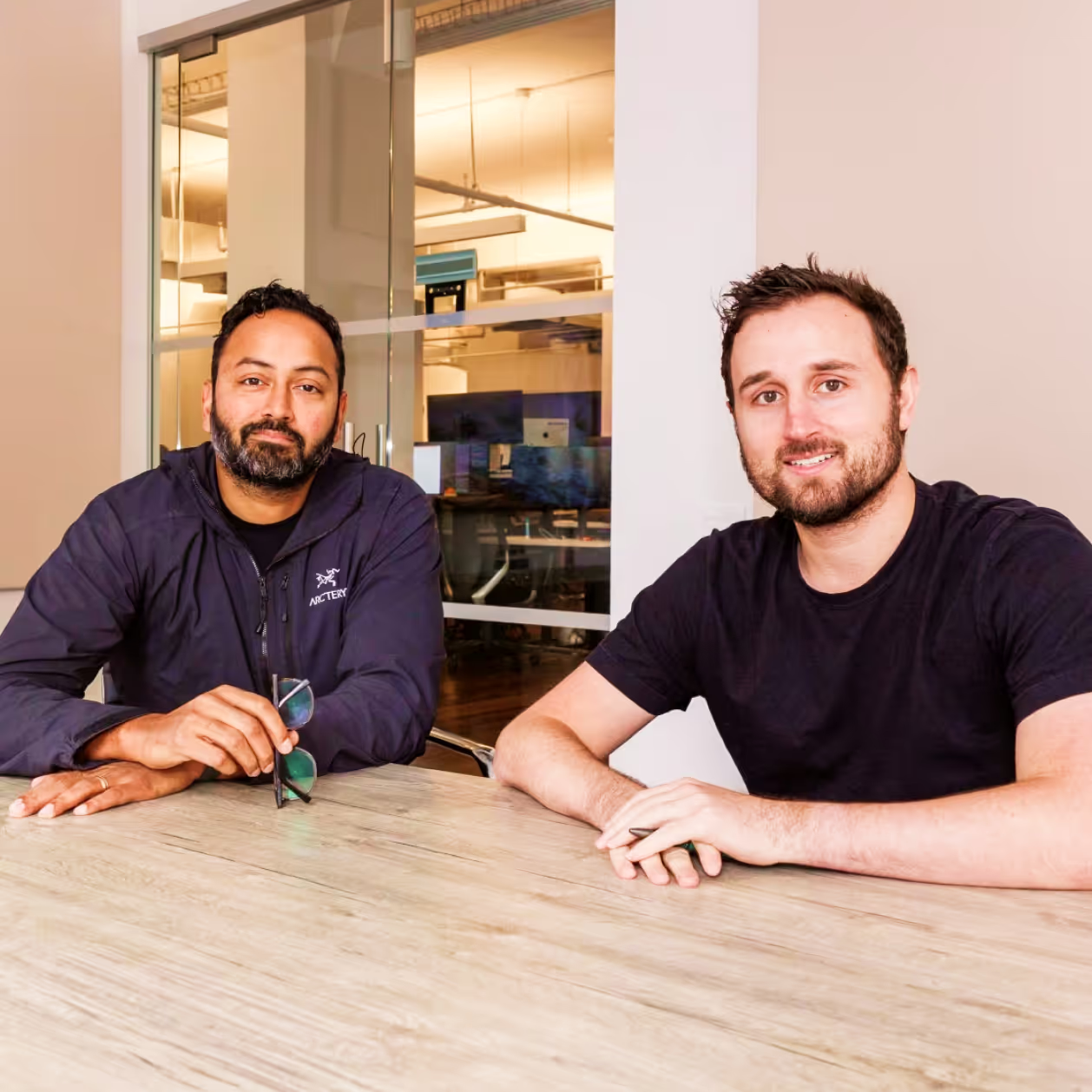
Maybern replaces spreadsheets running billion-dollar portfolios
More and more money continues to flow into the private markets. Today, private funds manage over $13T and continue to grow rapidly—averaging 20% annually since 2018. This explosive growth reflects a fundamental shift in how institutional and private capital is being deployed, with private market capital becoming an increasingly critical pillar of our global financial systems.
As funds grow, so does complexity. The bespoke nature of how deals are structured—both for individual investments as well as agreements with limited partners—means it historically has taken an army of accountants and excel spreadsheets to manage. Fund CFOs are faced with two not-so-great options:
- Try to pay top dollar to grow a large team in-house in the midst of a massive accounting talent shortage and bear all of the associated costs.
- Pay a third-party fund administrator like SS&C ($18 billion market cap) or SEI ($9 billion market cap) 6 or 7 figures annually. and then run a shadow system to double check everything in-house).
The challenges facing fund CFOs today are more acute than ever before. When we spoke to 20+ fund CFOs ranging from $1B first time fund managers to the most sophisticated finance teams with hundreds of billions under management, we heard the same pain points over and over again. Dissatisfaction with fund admins. Poor data quality and access. Lack of visibility into how things are calculated. Multi-day long turnaround times on simple questions. Frequent mistakes. High staff turnover.
All this against a backdrop where pressure is mounting on both sides. On one hand, their Managing Partners are pushing them to be more strategic—i.e. evolve beyond the operations of running the back office and deliver insights on portfolio construction and management, cost optimization, and fundraising strategy, and deliver better insights, more quickly. On the other side, LPs and internal IR teams are asking for faster, more in-depth, and more frequent reporting—leading to a constant time-suck of information retrieval and bespoke analyses.
This shift from operational CFO to strategic CFO is one that we’ve seen play out in the corporate CFO tooling world where software has emerged to streamline and automate day-to-day operational work of finance teams to allow time to be freed up to focus on strategic decision making. Many large winners have emerged from this trend including Anaplan, Blackline, Workiva, and OneStream, just to name a few. Private fund accounting however isn’t governed by standardized GAAP principles. Instead, they’re governed by their limited partnership agreements (LPAs) which not only can take many shapes and forms but are also oftentimes accompanied by negotiated side letters with preferential terms for certain investors. This complexity meant that previous attempts to build software solutions for this problem were either limited to much simpler use cases (e.g. small venture funds) or requiring tons of customization with multi-year implementation timelines.
Enter Maybern
Maybern is revolutionizing private funds with the first true operating system for fund finance. Purpose-built in partnership with the most complex funds managing billions in AUM, Maybern's core product centralizes and automates essential operations, saving finance teams hours of headache. More importantly however, the software becomes the single source of truth for all fund flows regardless of the complexity of the underlying legal structure. The core engine, designed for maximum flexibility, adapts to each fund's unique structures and workflows, handling even the most complex edge cases.
What makes Maybern particularly special was the decision to start with real estate private equity—arguably the most complex segment of the market. By solving for the most challenging use cases first, they've built an incredibly robust and flexible platform that can handle virtually any fund structure or requirement without writing a single line of custom code. They’ve quickly leveraged this advantage to win the hearts and minds of CFOs across traditional private equity, growth equity, and private credit.
There is no team that is better suited to tackle this problem. The Maybern cofounders Ross Mechanic and Ashwin Raghu initially met at Cadre, a tech-enabled private equity platform for individual investors. There, they built the internal system that allowed Cadre to multiply AUM without needing to scale headcount. Upon our first meeting with Ross, it was clear that he was deeply obsessed with this problem and determined to change this market. Although an engineer by training, he’d both personally read hundreds of LPAs and set out to learn everything there was to know about fund finance before coming to realize that it was possible to build software that could address all the edge cases and complexities, it just wouldn’t be easy. Since then, Ross and Ashwin have assembled a team of world-class engineers and fund finance specialists to tackle a problem many thought was unsolvable.
When we spoke to early customers, it became clear that Maybern would fundamentally transform how funds are run. Fund CFOs are very rarely effusive, so hearing effusive praise of the solution’s immediate transformation of internal operations and the deep expertise and credibility of the team suggested that this was clearly something special. With an internal buyer in house, it only made sense for us to put Maybern in front of our CFO, MIke Witowski, who previously had spent time at one of the largest fund admin providers. In the span of one meeting, Ross and Ashwin managed to transform his wary skepticism into astonished enthusiasm. It was at that moment that we knew this was something special.
As the private markets just get bigger and more complex, Maybern is at the center building a true enterprise grade central nervous system for fund operations. Soon, the most sophisticated private funds will run on Maybern. We’re thrilled to be leading the Series A and to be partnering with the team on this journey.
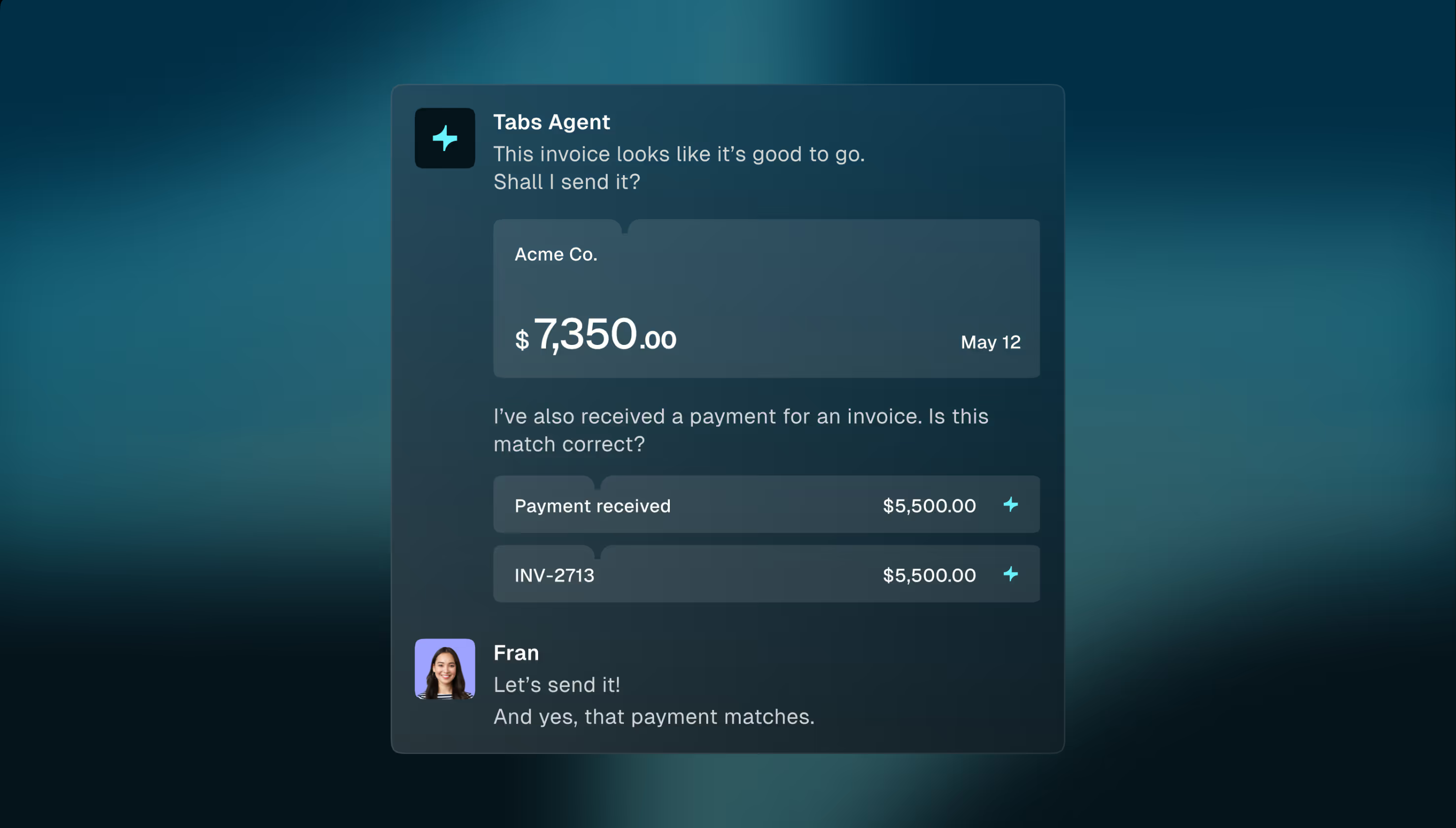
The AI-native revenue platform for modern finance
Revenue collection is the biggest opportunity in the CFO stack, and Tabs is poised to own it. CEO and Co-Founder Ali Hussain is fierce in all the right ways: urgent and thoughtful, yet a true servant leader. Alongside co-founders Deepak Bapat and Rebecca Schwartz, and an extraordinary team of passionate builders, Tabs is creating one of the most promising vertical-AI companies in New York City.
Today, we’re excited to announce our continued support of Tabs, the AI-native revenue platform for modern finance teams, as a part of its $55 million Series B led by Lightspeed Venture Partners. Tabs is automating the revenue engine for the AI-Native CFO, powering fast growing companies like Cursor, Statsig, and Cortex.
Accounts receivable, the all-important task of collecting revenue, is breaking free from the ERP. There are incredible decacorns associated with every layer of the CFO stack—Ramp for spend, Rippling for payroll, Bill.com for AP—but no company owns AR. The ERP is unbundling as enterprises are modernizing, with 50% of CIOs expecting to upgrade their ERP in the next two years. The ERP historically dominated the CFO stack, but lengthy implementations, expensive pricing, brittle architecture, and antiquated product experiences created an opening to build best-in-breed solutions for each category.
We believe revenue is the biggest prize in this unbundling. Revenue collection sees the biggest flow of money. It commands the most time from experienced, senior members of your team. Given the complexity and criticality of revenue, the market opportunity for Tabs swells to over $1 trillion given in senior labor spend required to manage revenue and billing operations at companies of all sizes.
Tabs transforms AR from a manual, ops-heavy burden into an automated revenue engine. By making contracts—not CRMs or spreadsheets—the system of record, Tabs enables CFOs to say “yes” to growth, experimentation, and new monetization models without getting trapped in their legacy ERP.
The Finance Stack Wasn’t Built for the AI Era
Accounts receivable has historically been a burden finance teams haven’t been able to engineer themselves away from. Legacy approaches to AR force companies to map CRM and billing data through tools like NetSuite or Stripe, creating endless edge cases. Contractual deviations—discounts, custom usage, multi-year contracts—becomes a painful manual exercise, ballooning the size of finance ops teams. It could take three days to reconcile contracts in an Excel doc with what’s in your CRM, manually cross-reference materials, feed that data back into your ERP, then automate a billing flow. The painful result is delayed collection of revenue.
AI has created an incredible opportunity to transform AR, improving accuracy on contract parsing, reducing time spent on reconciliation, and making the platform flexible to new pricing models. AI is the unlock that enables Tabs to convert a contract into cash. By treating the contract—the same artifact auditors already rely on—as the source of truth, Tabs eliminates manual reconciliation, using AI to collect unstructured contracts and automatically turn it into revenue.
Pricing innovation makes this shift even more urgent. AI-native companies are experimenting with consumption billing, usage-based pricing, and hybrid models at a pace legacy systems can’t support. Even if you solved the data mapping problem, introducing a new pricing model renders it useless in moments. Traditionally, this made the CFO the brake on sales creativity, prioritizing revenue clarity over pricing innovation. Tabs changes that: finance becomes a team of “yes,” with revenue systems that adapt as quickly as sales. For CFOs navigating the AI era, this flexibility is crucial to keeping up, as every company knows its pricing will evolve, and AR must keep pace.
The result with Tabs is faster closes, leaner teams, and higher confidence for both finance and auditors.
Contract-to-cash and beyond
Tabs is built for this moment. Its wedge is contract-to-cash automation: ingesting messy contracts, extracting commercial terms, generating invoices, chasing payments, and recognizing revenue with minimal human involvement. Tabs’ ingestion engine transforms static PDFs into bill-ready logic, while Slack-native workflows and API-first integrations embed directly into how finance teams already operate. Tabs isn’t just digitizing invoicing—it’s reimagining the entire revenue cycle.
Billing and revenue often require senior team members tackling mundane tasks. Their work also exists across many solutions, referencing the contracts, CRM, ERP, payments processor, and other systems to recognize revenue. This cross-functional workflow that requires domain expertise makes it perfect for agentic automation, freeing up teams to do higher value work. Tabs makes it possible to automate everything from edge cases and revenue rules that used to require armies of finance professionals.
CEO Ali and the Tabs team believe the future of finance looks like this: lean senior teams powered by swarms of AI agents managing revenue at scale. From your first dollar to your billionth, the platform automates billing, collections, revenue recognition, audit, and reporting – with an auditable trail across the CFO stack.
That vision unlocks more than AR. With the launch of Tabs Agent, its Slack-native AR agent, Tabs is taking the first step toward building a true agentic revenue platform.
Why we invested
Since incubating Tabs, Ali and his team have blown past every target, quarter after quarter, while shipping products at remarkable speed. With $55 million in fresh funding led by Lightspeed, Tabs is positioned to lead the shift away from ERP-bound finance and toward an AI-native, best-in-breed revenue platform.
At Primary, we believe Tabs will be one of the defining companies of the AI era—a generational compounder that fundamentally reshapes the economics of finance. That’s why we’re proud to deepen our partnership in this $55 million Series B. Tabs isn’t simply automating AR—it’s creating the revenue operating system for the AI era, unlocking a trillion-dollar labor market and turning CFOs from bottlenecks into accelerators. We’re proud to back Ali, Deepak, Rebecca, and the entire Tabs team again for this next phase of their product.
Tabs was incubated at Primary Labs. If you’re interested in learning more about incubations, becoming an Operator-in-Residence, and building with us, please reach out to labs@primary.vc.

Scaling for the AI era: Fund V
Primary has, from our beginnings, never looked like a traditional VC firm. My co-founder Ben and I always liked it that way, and as we’ve scaled, we’ve leaned ever-harder into those differences. Today, I’m thrilled to share that we have taken the next step in scaling our firm and in breaking the norms of our industry as we announce our fifth set of funds. At $625M, this represents the largest standalone seed firm in the market and a ringing endorsement by our LPs of our ambition to build the biggest, most impactful, and best performing seed firm on the planet.
Today, Primary leads pre-seed and seed rounds across tech sectors, backing exceptional founders from San Francisco to Tel Aviv. We practice the craft of seed investing at institutional scale. On our way to 80 full time employees, we are led by a team of eight exceptional, sector-focused investing partners, each running their own strategies and partnering with the very best founders in their sectors: Financial Services, Healthcare, Vertical AI, Infrastructure/Compute, Cybersecurity, Consumer, GTM Tech, and the Industrial Evolution. Our partners bring deep insights, extensive networks, and curious, prepared minds to their craft.
Super-charging our investing work is an Impact team, led by a C-suite of seasoned operators, that delivers operational support unequaled at any stage of venture. And tightly aligned with both teams is PrimaryLabs, our incubation engine, which in recent years has launched many of the most exciting companies in our portfolio. In aggregate, Primary is a team with more scale, more muscle, and more ability to drive genuine results in support of founders than any in the market.
At 10x the size from our first fund, we are beyond what Ben and I imagined when we began working on Primary. We were never remotely interested in building a typical venture capital firm. We joined forces because we wanted to build something that changed the way the industry operated, putting the founder at the center. Our most important firm value has always been “Wear the Founder’s Shoes.” Guided by that, we listened to founders and invested in the capabilities they most valued across talent acquisition, revenue generation, and capital raising.
As our early investments began to bear fruit – 9 of the 25 investments in our first fund reached unicorn status and another two achieved cash exits north of $500M – our conviction grew. The unique way we made operating resources available to founders was making a difference. With conviction came ambition to push further, for we knew that our model would get even better with scale. As we’ve scaled, we’ve resisted the temptation that unfortunately defines our industry: using new management fee resources not to execute better for founders, but to further line the pockets of the very investors whose incentives now drive them away from seed and towards larger/later deals. Instead, we’ve grown our team and capabilities in line with the growth of our funds.
This year our team will make hundreds of hires, drive tens of millions of dollars of revenue pipeline, and support dozens of new financings for our companies. As we all race to find and earn the right to work with the founders who are driving the AI revolution, Primary is showing up with more capability and more expertise than ever. And at a time when many firms are struggling to raise capital, our existing LPs have doubled down on our strategy and several amazing, mission-driven institutions have joined us as LPs for the first time.
We are eleven years into an amazing journey at Primary. Every year we relearn the original lesson of venture: success is all about the founders with whom you partner. Our journey has been defined by a remarkable collection of founders and the successes they’ve delivered for our LPs. Our mission has been to support them with everything we’ve got. We feel truly blessed that the unconventional strategic bets we made early on have resonated with founders and paid off in earning us their partnership.
We sit today with a unique market position in the midst of what is by a vast margin the most exciting and important moment in the history of information technology. And we’re not stopping building. We never will. We’re rapidly reinventing everything about how we operate for an agentic future, building new products, new technologies, and new capabilities internally, all in service of continuing to offer something even better in support of world-class founders (more coming here soon).
We are eternally grateful to the LPs who have entrusted us with their capital and given us the right to continue to add our own dent to the universe in service of founders. Fund V is bigger than ever, and we fully expect it to be better, as well. We can’t wait to meet the founders defining a new generation of innovation and magic in our world.

Our compute thesis: Etched and beyond
In January 2023, semiconductors were not the rage. NVIDIA was worth $360B. Memory was a sleepy commodity. Hyperscaler capex totaled $130B+, relatively flat from the year prior. Approximately 100k H100-equivalent compute systems were deployed globally, with few having ever heard the term “H100” before.
We were post the ChatGPT moment, but the gears of the semiconductor supercycle were only beginning to churn.
Today, NVIDIA is worth over $4.5T. Multi trillion parameter models demand staggering memory capabilities, driving sky high DRAM prices and scarce supply. Hyperscaler capex in 2025 surpassed $400B and is expected to grow to $600B in 2026. As of Q3 2025, more than 3 million H100 equivalent systems are training models and running inference. Executives now brag about their secured GPU shipments as they compete in an economy increasingly organized around AI.
Back to early 2023.
Our belief was that this was about to change. AI demand was set to explode, and the world did not yet have sufficient compute to meet the need. Scaling laws suggested that no amount of computation would ever truly be enough to deliver the magical experiences AI could unlock. A demand tsunami was coming.
We intuited that a window of opportunity was opening for entrants to capitalize on the moment. In February, I shared this view with the Wall Street Journal: “There’s new openings for attack and opportunity for those players because the types of chips that are going to most efficiently run these algorithms are different from a lot of what’s already out there.”
That same day, I met Gavin Uberti, the CEO and cofounder of Etched.
Gavin had pitch perfect understanding of what was about to happen: transformer dominance would expand; the GPU bottleneck would intensify; inference would become the all-important battleground; and the power of purpose-built hardware would become clear.
We led the Seed round in Etched in March 2023 and have since worked with Gavin and the team as they (as they like to say) build the hardware for superintelligence. This experience combined with studying the broader compute supercycle helped crystallize our conviction.
Our Compute Thesis
Our compute thesis is simple. Alpha exists at seed for compute investing. Every major technology shift requires a rebuild of its underlying infrastructure. As compute drives intelligence, demand for computation is growing exponentially, forcing a massive capex buildout across silicon, power, networking, and cooling. Fundamental bottlenecks are emerging. Incumbents are being pushed beyond incremental improvement. New opportunities are opening for founders taking first principles approaches to rearchitect how computation is produced and scaled. Yet the majority of seed investors shy away from compute deals.
We’ve noticed that fewer VCs spent time in the compute market, but wanted to quantify it. We analyzed the past decade of M&A across software infrastructure (defined as Dev Ops, Dev Tools, Data, etc) as compared to compute (semiconductor value chain). Since 2015, software infra saw 8,500 M&A transactions, while compute saw 1,300. Despite 15% the deal count, the resulting value creation in compute was $705B, compared to $587B in software infrastructure. It’s the power law on top of the power law – fewer opportunities but far bigger outcomes.
We believe our thesis will only grow in strength thanks to the token exponential. Consumer adoption is accelerating as models improve and new use cases emerge. AI is moving from occasional interaction to daily workflow. Swarms of agents are running continuously in parallel. Enterprise infrastructure is migrating from CPU-based machine learning to GPU-based LLMs. Beyond knowledge work, AI will expand into science, robotics, security, entertainment, and products we have not yet imagined.
The simplest evidence is personal. AI is not just pervasive in my life. My usage is accelerating rapidly. My wife and I just had our second baby; ChatGPT was around for the first but now Chat is like a doctor/therapist in our pocket. At Primary, Gaby and I are in deep debate with Claude around our compute thesis. The firm is restructuring our workflows around AI tools in real time. Our token usage today is easily a hundred, if not a thousand times, greater than a year ago at this time.
And underneath it all sits the same constraint: compute. So it should come as no surprise that we think Jensen is directionally correct when he suggests a $3 to $4 trillion buildout may arrive this decade alone.
The Bear Case
Of course not everyone is a Jensen bull. Michael Burry, the seer of the housing bubble, has $1.1 billion in short bets against NVIDIA and Palantir – and he's not alone. The bear case: infrastructure spend won't yield equivalent value. Anthropic and OpenAI will make over $60B in revenue, backed up by over $600B of hyperscaler capex. Google spent $24B in capex in Q3 2025, only to make $15B in their cloud business. Enterprise revenue is at risk – OpenAI, Anthropic, Google, Microsoft, and Palantir all want the entire enterprise wallet. Even early winners like ServiceNow are trading back at 2023 prices as the market sorts winners from losers.
Naysayers are pointing to signs of "bubble behavior": circular revenue deals where NVIDIA invests into OpenAI which buys NVIDIA hardware; depreciation concerns as chip cycles accelerate; unsustainable spending with OpenAI committing to nearly $1T in compute while burning $9B a year; and questionable valuations across asset classes, with sketchy pricing practices and stressed debt markets.
The behavior – irrational exuberance, circular revenue, fantastical projections – all just screams bubble. You can hear the echoes of the dot.com bubble when people speak of tokens as proof of value. Or the telecom overbuild. Or the 2008 financial crisis with the funky debt.
The lynchpin to the bull case is simple: AI needs to deliver value. We believe it will, and then some.
In Defense of the Bull Case
The historical differences that defend Jensen's bull case matter:
- 2001: Overbuilt fiber sat at 5% utilization. Today, every GPU yearns to run at capacity. Even a 1% increase in utilization can be a billion dollar revenue opportunity.
- 2008: Money flow built on unpayable consumer debt with no cash generation. Today, hyperscalers with $500B+ annual free cash flow invest in productive infrastructure. Meta, Microsoft, Google, Amazon, SpaceX are good debtors.
OpenAI went from $2B, to $6B, to $20B in revenue in the last three years. Anthropic went from $1B to $9B in 2025 and is on track for $30B this year. This is with only 10-20% global consumer usage, no ad monetization, and barely cracking the enterprise opportunity.
Circular revenue becomes problematic when no value is created. Nvidia invests in OpenAI and Coreweave, then sells them GPUs with usage guarantees. But this reflects genuine scarcity and real demand – Nvidia captures value at multiple points in an actually expanding market, not recycling dollars in a closed loop.
And perhaps most importantly, geopolitical competition removes the option to slow down. There's consensus we cannot cede AI leadership to China. That requires more compute.
An Unprecedented Opportunity for Value Creation
There maybe should be a rule in investing that you're not allowed to say, “this time things are different.” But ... the all important word in that sentence is “time.” We are undoubtedly in bubble territory. I got into tech in 2010 and, for 12 years, I heard talk of bubbles. And then the bubble burst. The value creation in that time was astronomical, and it will be de minimis compared to what is taking place now. Said another way, we believe years of demand, endless innovation, and cash-rich companies financing the build point to a fact that things are different this time, for now.
We believe the next phase of compute will require more than iteration. It will require step functions. In some cases, discontinuous jumps in architecture, efficiency, and system design that incumbents are not economically or culturally positioned to lead. In moments like this, the opportunities emerge not because incumbents are asleep, but because they are rationally bound to the status quo. In moments like this, the bottlenecks move faster than the incumbents.
The Founders Making Building the Future
Ultimately, this thesis is brought to life by founders ambitious enough to build where the stack is hardest. The ones we are most excited to back combine deep technical realism with a willingness to challenge what the system has accepted for decades.
A new generation is showing up. Semiconductor and computer architecture programs are surging, and young builders want to rebuild the physical foundations of the modern economy. They bring brains, audacity, and an AI native intuition for where the world is heading.
The teams that win, though, will pair that first principles ambition with seasoned builders who know how to ship silicon, scale systems, and execute in the real world.
Since 2023, we have taken a high conviction approach to investing behind this view. We have backed the teams at Etched, Atero (acquired by Crusoe), Haiqu, and several more in stealth across memory, alternative computing, and other layers of the stack.
Compute is the limiting factor in a world of accelerating intelligence. The token exponential shows no signs of slowing, and the resulting pressure continues to expose structural cracks that incumbents alone cannot repair. History suggests that moments like this create rare openings for new entrants.
If you are building in compute, now is the moment. We want to meet you early, and partner with you as you shape what comes next.

A journey from incubation to industry leadership
Last week, Ollie announced that it is being acquired by Agrolimen, a large Spanish based multinational company focused on consumer goods. Ollie redefined dog nutrition with high-quality, human-grade, refrigerated food tailored to each pet’s needs. Anticipating the rise of pet humanization and the fresh pet food category, the team built a trusted brand centered on clean ingredients, balanced cooking processes, and visible health outcomes—from improved digestion to shinier coats. Ollie’s personalized, minimally processed meals and its deep connection with consumers helped it become a standout leader in the $66 billion U.S. pet food market. Ollie was not only an innovator in the pet food industry but also for us as a Primary as it was the very first business we incubated.
The original idea for some of the most well known startups came from surprising places. Twitter was born out of another startup called Odeo when a then employee by the name of Jack Dorsey had an idea of a status-update/SMS service. Or when Steward Butterfield was building a multiplayer game called Glitch that flopped but the internal communication tool they built didn’t which then became Slack. Even my first company, Community Connect, which ran some of the first social networking sites including BlackPlanet.com was inspired by a conversation that I had when I was an investment banking analyst working with the founder of a company that we were trying to take public. The founder of that company had a thesis that online communities which were primarily in closed online services such as AOL were eventually going to migrate to the Web. This comment pre-dated Facebook by almost a decade and sparked me starting my company. After I sold Community Connect, I realized that I would actually be better at generating startup ideas as an investor versus when being a founder. When I was a founder, I wasn’t studying business models all day. I was laser focused on my business. I realized that ideas sometimes spawn from pattern recognition and being an investor allowed me the luxury of studying and seeing so many business patterns. The story of Ollie is an example of this pattern recognition journey.
When we first started Primary in 2015, two hot start ups in New York City were Blue Apron and Plated delivering meal kits so people can be better homecooks . Both companies started in 2012 and were growing quickly which inspired a number of other similar companies that had successful exits such as Freshly (acquired by Nestlé for $900 million) and HomeChef (acquired by Kroger for $700 million). The key insight from these wave of meal kit delivery companies was that people wanted a more convenient option for cooking for themselves and their families. This insight reminded me of when I first moved back to New York after college.
In the late 90s, I was living in a one bedroom apartment in midtown Manhattan with my dog that I brought back with me from college. There used to be a little old italian woman that lived in the building that used to hang out in the lobby. This woman would sit there every morning with her miniature doberman sitting on her lap and would love to chat with the residents as they would come in and out of the building. One morning I was coming in from taking my dog for a walk when she asked me with an Italian accent “Do you love your baby?”. I responded “Yes, I do.” which then she asked me “How old is she?”. I told her she is 3 years old. I then asked her how old her dog was. She then responded “my baby is 18 years old”. I surprisingly asked “18 human years??”. She said “Yes! My secret is that I cook for my dog!”. She then went into detail of how she cooked her dog a human meal balanced with fresh meat and vegetables for every meal. I listened but in the back of my mind I thought she was just a kooky woman and didn’t think much of it beyond just being amused.
Years later my dog passed after going through a number of health issues. I really did love my dog and I tell people that losing a pet is devastating as you do feel like it is to be, what people now call, a pet parent. One day as I was remembering my dog which got me thinking of my old neighbor and if there was any real logic in cooking for her dog. I went down the rabbit hole from a number of Google searches and then a number of books about the pet food industry. I was shocked! What I learned was most pet food is absolutely terrible made from unhealthy ingredients and way over processed. My old neighbor was right!
As an investor, you are looking for solutions that are not incrementally better by at least a 10x better product and experience than what is out there. A pet food brand made up of human grade ingredients, gently cooked, well balanced for your furry loved ones that is shipped to your doorstep instead of you having to cook yourself met that 10x better criteria. I wrote a memo for what was then called “Project Milo” and presented it to our team meeting at Primary in 2015 which is the first year of the firm and our newly minted $60 million seed fund. The team, especially my co-founder and Partner, Brad, saw my conviction in the idea and without reservation said we should incubate this.
I recently told this story this past year at an Ollie’s all hands offsite that was held in Nashville. Over 150 Olllie employees were in the audience when I told this story. A woman that worked in our customer experience team came up to me after and thanked me for starting the company as she told me that her dog had so many health problems until she started feeding her Ollie which inspired her to work at the company. I told her that she shouldn’t thank me, that I need to be thanking her and the rest of the folks in the room. I may have been the spark that started the Ollie journey but it was really the hard work and dedication of everyone in that room and in Ollie’s past that built Ollie into a $250 million business that has served millions of pet parents. It has been an honor to have been that spark and to have served on behalf of Primary as an investor and board member but the real heroes of the Ollie journey are Nick Stafford, the CEO, and the Ollie leadership team. They have delivered on the mission of redefining dog nutrition and have done it with care and excellence. The journey was far from easy as they had to innovate every part of the business from the manufacturing, supply chain and logistics to the digital experience. And they did this through incredibly uncertain times including challenging fundraises and the pandemic. The team always believed in the mission and for that the customers responded. Thank you Nick and team. Your work and dedication is so appreciated. And congratulations to Agrolimen for acquiring a terrific business. I look forward to you carrying the Ollie brand forward.

The $30M bet on AI-powered go-to-market execution
Today’s “modern” go-to-market motion often feels anything but modern because it is fundamentally broken for both sellers and buyers. Commercial teams struggle to navigate growth and efficiency trade-offs, and buyers invariably feel those trade-off tensions in underwhelming customer experiences. While AI promises transformation, to date it has largely delivered only incrementality. Buyers and sellers are drowning in point solution experiments that don’t materially move the needle. Nobody wins.
Growth commands a premium over profitability even in the tightest market conditions, so SaaS companies are always charging hard at top-line ARR growth, even if that means sacrificing quality and efficiency along the way. Everyone loves to talk about the eye-popping growth of the AI darlings, but we live in a tale of two cities and in the non-AI-native world where top-line ARR growth has been compressed, companies have been forced to pay more attention to their bottom lines, meaning all eyes are on efficiency. Metrics such as “APE” (ARR/FTE) are the talk of the town.
More often than not, getting more efficient means cutting costs. But the reality for sales-led businesses is that 50-80% of their sales and marketing burn is headcount, so when they push to make teams more efficient, it’s usually the buyer who suffers: slower response times, reduced access to answers until they can prove they are fully “qualified,” and so forth. Buyers are consistently underwhelmed and frustrated when evaluating new solutions because the process is so disjointed for them: schedule a meeting with a BDR only to get minimal information while they evaluate you, wait an entire day for an account executive to sync with a solutions consultant on technical questions before circling back, etc. As the old sales adage goes, “time kills all deals,” and many deals are lost before a qualified lead is ever even logged in the system purely on account of the bumpy buyer experience.
Even high-growth or mature sales teams with plenty of resources haven’t delivered much better for their buyers. The larger commercial teams become, the wider the distribution in team performance and quality, thus weakening the efficiency of the overall funnel and rate-limiting growth (while still disappointing the end customer).
The product-led growth (“PLG”) movement proved that it is possible to operate in a leaner capacity while still delighting customers, but “product-led” was the operative part of that equation. We believe that AI-led growth will democratize this potential to every shape, flavor and size of company in a way that benefits buyers and sellers alike. This is why we’re excited to introduce 1mind and announce their $40M in funding following their recent $30M Series A led by Battery Ventures. We were privileged to lead 1mind’s $10M seed round in the spring of 2024, and are excited to double-down with our support as 1mind enters their next chapter of growth.
Today, go-to-market (“GTM”) executives are inundated with pitches for AI point solutions and co-pilots. Siloed tools lack the efficacy of a horizontal solution (i.e. a sales-facing AI would be much more helpful to a prospect if it was also trained on customer support questions, internal knowledge bases, etc.) and broader, more horizontal LLMs don’t offer the level of accuracy CROs require. And at the end of the day, humans are inherently rate-limited in how fast they can read, digest and act on information provided by co-pilots. 1mind deploys human-like AI to GTM teams to augment and ultimately replace full-time employees. As Jacco van der Kooij wrote in a recent Winning by Design research paper, “the best use of AI is not to improve people's performance through co-pilots but to create disproportionate improvement by using AI to optimize the process entirely and replace the seller.” GTM teams are hungry for a consolidated approach purpose-built for them.
We aren’t talking about agents or AI wrappers. 1mind’s superhumans have faces, voices, personalities, knowledge, motivations and a GTM brain. They have their own AI-optimized virtual desktops that allow them to do anything a human can do on their computer, including joining impromptu video calls to give presentations or demos. 1mind promises the power of a salesforce that never sleeps, learns at lightning speed, and evolves continuously.
Amanda Kahlow, 1mind’s founder and CEO, was previously founder and CEO of 6sense, the pioneer of B2B account-based marketing and intent data. After taking some time off following that incredible journey, Amanda sprung back into action when she identified another category-creating opportunity to transform how B2B companies grow, through what she’s coined as AI-led growth, or AiLG. As Amanda regularly says, 6sense was to find buyers and 1mind is to close them. Sachin Bhat, Amanda’s right hand and 1mind’s CTO, is an experienced enterprise technologist and former founder who most recently spent 5 years scaling complex global engineering and data teams at Rippling.
We believe that Amanda’s reputation and reach make her uniquely suited to usher GTM teams into the next (AI-powered) era of growth and that the formidable commercial-technical duo of her and Sachin will build the definitive GTM platform and accelerate AI adoption across all flavors of commercial and customer teams.
Indeed, sales is just the beachhead: 1mind’s vision is to be all-knowing for an organization, with targeted use cases that run the gamut from top of funnel qualification all the way through to ongoing technical support. 1mind will become the brain, face, and voice of commercial and customer organizations. And as 1mind executes its horizontal, end-to-end play, we believe they will be well-positioned to box out other categories of software, including training and enablement software, internal knowledge management tools, demo automation software and more.
No one tells a company’s story better than its customers, and 1mind’s reviews are off the charts. To date the team has successfully partnered with incredible brands such as Hubspot, Nutanix, Owner, Seismic New Relic and Boston Dynamics, and 30% of customers expand to new use cases within 90 days of going live, and several of 1mind’s customers have joined the cap table.
AI-led growth is the future of go-to-market. There will always be things humans will do better than AI, but there are many things AI will consistently do better than humans, and we’re excited to live in a world where that is celebrated and encouraged. As Amanda says, “if you are worried about your AI hallucinating, have you asked yourself whether your sellers hallucinate?”
It's exhilarating to imagine SaaS companies no longer need to think about account prioritization or ticket deflection because AI does the heavy lifting for them, never mind the resulting implications for buyer satisfaction. If you’re a revenue leader committed to true transformation in your go-to-market organization, we encourage you to engage with 1mind’s superhuman (Mindy) today.
.avif)
Rethinking EHRs in an AI-first World
Since 2020, >$30Bn has flowed into verticalized EHRs, largely through PE transactions. Think athenahealth ($17B), Inovalon ($7.3B), ModMed ($5.3B), WellSky ($3B), NextGen ($1.8B), Nextech ($1.4B), Therapy Brands ($1.3B), and Experity ($1.3B). These deals rarely show up on VC radars, but they signal two important things. First, across most specialties, clinicians are still running core workflows on systems built more than a decade ago. Second, the largest software outcomes in healthcare over the past decade are generally not venture-backed!
At Primary, we’ve been more broadly thinking a lot about what the future of application software looks like and how AI will reshape SaaS. There’s already plenty of debate about systems of record becoming systems of action. This piece is not to debate that future. Instead, we want to imagine a future where existing systems of record are paired with, or in some cases replaced by, true systems of action. In healthcare, EHRs are the most natural place to start. We will be posting a handful of pieces on this theme in the coming months that go deeper on the market, the product, and potential business models shift enabled by AI.
To set the stage — taking on specialty EHRs is not for the faint of heart. The process of ripping out and replacing any system of record is brutal. Most providers genuinely dislike their EHRs, but they live inside them every day. The change management alone is enormous, and the perceived risk often outweighs the promise of incremental improvement. The standard venture playbook has been to build a point solution on top of an existing system of record, earn trust, and then slowly eat away at the core platform before (hopefully) making the swap. But, watching how the “AI scribe wars of 2025” are unfolding makes us skeptical that this will work at scale. Incumbents are willing to copy anything that starts to matter. See Epic, Athena, and many more examples.
Epic is the most egregious example of how quickly momentum can be shifted. For years, the Abridge-Epic partnership was the engine behind Abridge’s breakout growth. Epic’s Workshop program effectively created a sanctioned, first-of-its-kind path for Abridge to build deep integrations, co-sell alongside Epic, and access early customers inside the Epic network.
Earlier this year, Epic shut down their Workshop program right before announcing its own competing scribe product. The message was unmistakable. And now, we’re seeing the same dynamic emerge across other multi-product EHR platforms. As incumbents roll out their own native AI features, they not only close off third-party distribution pathways, but also undercut startups on price. Even if Abridge continues to ship a meaningfully better product, incumbents will always have structural advantages in distribution and pricing power. To be clear, we’re rooting for Abridge and the entire startup scribe category. At the same time, it’s hard to look at the market dynamics and not believe that a disproportionate share of enterprise value will ultimately accrue to the platforms that already sit at the center of clinical workflows.
This raises a harder question: what does it actually take to build durable value in this market? One possible answer is not to sit on top of the EHR at all, but to become the system that coordinates and executes work end-to-end. In practice, that does not mean waving away the complexity of being an EHR. Any credible “core operating system” must either natively include or tightly integrate the fundamental components of an EHR. The difference is not whether you store records, but whether the system is designed primarily to document work or to actively move it forward. Seat and documentation-based pricing in today’s EHRs reinforces incremental change, while AI-native systems will likely require pricing tied to outcomes or productivity.
Another possible answer is to actually build an EHR. Building a modern EHR today is easier now than at any point in the last decade. Development cycles are faster, infrastructure is cheaper, and interoperability standards and data export requirements have improved in certain parts of the market. More importantly, legacy systems are reaching the limits of how far they can be stretched. Many have layered decades of workflows, pricing models, and incentives that make meaningful re-architecture extremely difficult.
This is why we’re interested in exploring the question, “Are AI-native and agentic EHRs a good place to invest?” From what we’ve seen in the market, it’s very difficult for existing systems to contort themselves far enough to truly redefine how work gets done. At best, the incumbents can deliver incremental improvements or integrated point solutions (i.e. scribe). At worst, they simply bolt on decades-old workflow solutions without meaningfully shifting productivity.
AI now makes something else possible: systems of action that interpret context, decide what should happen next, execute tasks, and close loops on behalf of users. Perhaps you pair that with a business model that undercuts incumbents on price and taps into new revenue streams, and you can imagine a product that is ten times better at a tenth of the cost. As one physician put it, “Imagine if I could just focus on my patients and everything else was handled?” For clinicians and patients, that is not a marginal improvement. It is a step change.
So what are the right market dynamics?
As we consider this market, we are not here to argue that the venture opportunity lies in unseating Epic or Cerner. The hospital market is structurally protected by switching costs and cost fallacy. Epic, in particular, also benefits from being private and unconstrained from quarterly earnings pressure, allowing it to reinvest aggressively for the long term. The more compelling opportunity sits in ambulatory care, where the market remains fragmented and shaped by a long tail of legacy EHRs that have not reinvested as aggressively as Epic.
Across the 38 medical specialties and 89 subspecialties, most non-hospital owned clinicians still use vertical EHRs built more than a decade ago. The UX and UI are often akin to digital paper and hide deep architectural limits. Practice management, RCM, patient engagement, imaging, intake, analytics, and documentation sit under one brand, but rarely function as a single system.
If you ever want an unfiltered readout of how providers feel about their EHR, spend an evening on r/medicine or any specialty subreddit. You will find endless threads written by clinicians complaining about clunky interfaces, “note bloat,” billing workflows, and general “why does this thing hate me?!” energy. There is no shortage of pain.
But, finding real opportunity for systems of action means looking past generic frustration and into the structure of each specialty. So far, four dynamics stand out.
- Provider independence. A specialty must have enough non-hospital-owned practices to create a real market for software adoption. In many fields, consolidation into health systems removes purchasing autonomy entirely. Specialties like dermatology, ophthalmology, GI, pediatrics, PT/OT, urgent care, and behavioral health still have meaningful populations of independent or PE-backed groups that make their own tech decisions. These are also the environments where a new operational layer can be evaluated, purchased, and deployed without multi-year IDN procurement cycles.
- Competitive dynamics. Every speciality has multiple EHRs built for them, but not all markets are created equal. As examples, mental health has over 35 different verticalized EHRs, while specialties like dermatology are dominated by one software solution (ModMed with ~85% market penetration).
- Workflow complexity. Systems of action shine where messy, cross-system work dominates. Imaging coordination, pathology loops, protocol-driven care, prior auth, referrals, lab results, patient messaging, scheduling changes, and multi-party communication all fit this pattern. As we consider expanding the scope of an EHR, the ability to take on this work can meaningfully expand TAM.
- Administrative burden. In many practices, the true bottleneck is staff capacity, not clinician capacity. Intake, eligibility, benefits checks, documentation prep, coding, edits, denials, and follow up consume enormous time. Vertical EHRs may provide screens, but not relief. Similar TAM expansion dynamics are also at play here.
If a true venture-scale opportunity exists, it likely sits at the intersection of these factors, paired with a credible strategy for reducing switching costs. That may come from better data portability, improved migration tooling, purpose-built adapters, or even direct economic incentives to offset the pain of change. AI may not eliminate switching costs, but it can meaningfully compress them. In our view, an AI-native EHR is most compelling in a specialty that has a large base of independent providers, a more fragmented incumbent EHR landscape, and a higher degree of workflow and administrative complexity.
What we’re still figuring out
We’re far from having all the answers. A few key questions we’re still working through that we will explore in subsequent pieces:
- How do you reduce the switching cost for providers as much as possible? AI could be the key to “why now” here on the technical side, but is that really enough?
- What are the dynamics of an EHR product that is truly 10x better than an incumbent?
- Do you need to lean into business model innovation to make this feasible for a provider and investable for VC? Ex. providing the EHR software for free and monetizing on the back-end via pharma services, RCM, or owning other workflows
- What are the speciality “ontologies” that are most automatable and what will require a human in the loop?
If you are building in this world, we would love to chat. We deeply believe the next generation of vertical EHR companies will not look like the last one. Be on the lookout for additional pieces that go deeper into AI-driven business models and product.
Additionally a huge thank you to Brendan Keeler, Nikhil Krishnan, and JP Patil for their thoughts on this piece!

Why we invested in Valerie Health
When we first met Pete Shalek and Nitin Joshi, it was immediately clear that they were not setting out to build another point solution. They were starting from first principles and asking what it would take to rebuild the operational backbone of independent healthcare practices. That ambition immediately resonated with us. Independent practices are the foundation of American healthcare, yet they are increasingly burdened by the administrative complexity that has reached crisis levels.
Across the U.S., providers now spend more than one trillion dollars each year on administrative costs. That is close to one quarter of total healthcare spending. Much of this cost is a direct result of outdated workflows, manual processes, and fragmented software that was never designed to communicate with each other. The administrative load is no longer just an efficiency problem, but rather a structural force that drives burnout, reduces access, and erodes the viability of independent practice ownership.
The AI Front Office for Healthcare
Valerie Health is building a full-stack, AI-native front office for independent practices. Their approach is simple to describe, yet incredibly difficult to execute. The company becomes an extension of the practice and takes responsibility for the innumerable workflows that make a practice run. Think: intake, referral management, scheduling, messages, paperwork, and countless small but essential tasks that collectively consume the majority of staff time.
Valerie’s agents handle this work end to end. They integrate with existing systems inside the practice, coordinate across channels, and manage workflows that currently require a human to shepherd across multiple tools. By doing so, Valerie delivers something the industry has long promised but never achieved. It creates immediate, measurable lift for practices without the friction of a lengthy implementation of major workflow change.
Their flagship products focus on intake, referrals, and scheduling for specialty care. These processes are among the largest administrative pain points for both staff and patients. Valerie’s ability to streamline them is already unlocking meaningfully better patient experiences and dramatically lighter workloads for front office teams. As the platform expands into more specialties, the implications become even more profound. A modern operating layer for independent practices does more than just save time. It enables smoother care coordination, greater patient access, and a more sustainable economic model for the physicians who anchor our healthcare system.
Why This Team
Pete and Nitin bring a very unique combination of healthcare depth, technical excellence, and operational rigor that is rarely found in one founding team. Pete previously founded Joyable, a mental health startup, sold it, and then served as Chief Product Officer roles at AbleTo and Stellar Health, one of Primary’s portfolio companies. His understanding of provider workflows runs deep and is grounded in years of building software that directly impacts care delivery. When he left Stellar, we immediately told him we wanted in on whatever came next.
Nitin co-founded Uber Health, scaling it from zero to more than $100 million in ARR. He is both a technical founder and a systems thinker who knows how to build products that work at scale in highly regulated environments. Before Uber Health, he spent time as an engineering manager at Stripe where he honed his craft in building resilient, high throughput systems.
Together, they combine product intuition, healthcare expertise, and engineering leadership. It’s hard to imagine a better pairing for a company that must deeply understand provider operations while also building a highly sophisticated automation engine.
Why Now
Running an independent practice has never been more challenging. Reimbursements are tightening, wages are rising, competition from scaled platforms is increasing, and administrative requirements continue to grow. Yet, AI has reached a point where it can reliably handle structured and unstructured workflows at production quality.
This creates a rare moment where technology can change the trajectory of an entire class of providers. Valerie is not retrofitting AI into an older product. They are building an AI-native company that is purpose-built for the workflows that define practice operations. Valerie sits squarely in one of the strongest tailwinds in healthcare. Providers need operational leverage and cannot hire their way out of the problem. AI can finally deliver that leverage.
After co-leading Valerie’s Seed with General Catalyst, we are so excited to now double down in Valerie’s Series A and welcome Redpoint to the team.
We believe Valerie has the team, technology, and timing to define this category and we're thrilled to be their partners.

Capturing revenue contractors leave on the table
Bobyard uses computer vision and AI to turn messy construction drawings into fast, accurate takeoffs and estimates—freeing contractors to bid on more work, with more confidence, and less overhead. Primary is proud to be the lead investor in Bobyard's seed round and are excited to continue to support founder Michael Ding and the team as they announce their $35 million Series A, led by 8VC.
The bottleneck between drawings and bids
Every construction project starts with a plan set. Before anyone can break ground, someone has to turn those drawings into quantities of material, labor, and equipment, then into a scope of work and a bid.
For mid-sized and large general contractors, that work falls to large teams of full-time estimators both on and offshore. For smaller firms, it often lands on owners and project managers who are already buried in work and hate the idea of counting items page by page with archaic software.
Takeoff work is slow, error-prone, and constrained by people, not demand. The construction industry is already short on estimators, and that gap is widening. Even as employment growth stalls, thousands of estimator roles need to be filled each year just to keep up. Contractors feel that constraint every time they want to bid a new job and realize their estimating team is tapped out.
Legacy takeoff tools help a bit, but they still expect humans to “teach” the software where everything is on the drawing: tracing rooms, placing shapes, counting symbols by hand. They facilitate the workflow; they do not do the work.
Bobyard flips that around.
Why now: computer vision that actually does the takeoff
Bobyard’s core product is an AI-native takeoff engine that has helped contractors increase the number of bids they do over 5X. With Bobyard, contractors upload a PDF, select the legend, and run analysis. Under the hood, dozens of computer vision models—trained specifically on construction drawings—spin up in parallel to:
- Detect symbols and count them
- Measure linear footage
- Segment and measure areas
- Parse text and notes
Instead of forcing estimators to drag polygons over every planter bed or conference room, Bobyard’s proprietary models recognize each distinct region, size them, and calculate quantities automatically. First-pass accuracy is already in the mid– to high–ninety percent range for the initial trades, with more than ninety percent of the work fully automated.
On top of that, Bobyard handles scope-of-work generation and estimation: material and labor costs, templates, markups, and exports that plug into existing workflows. It is a complete workflow from drawing to bid.
The impact for customers is straightforward: takeoffs that used to take dozens of hours can be turned around in a fraction of the time, with better consistency and fewer misses. That lets each estimator support more bids, say yes to more opportunities, and grow revenue without adding headcount.
Meeting Michael Ding: from math olympiad to front office painkiller
We met Bobyard founder and CEO Michael Ding through Pear VC’s accelerator.Mar Hershenson knew about our thesis and deep connectivity across the built world and flagged him as one of the strongest founders to come through their program.
Michael grew up in the Bay Area, started coding at six, competed in math olympiads, and graduated valedictorian from one of the most competitive high schools in the region. At Stanford, he focused on computer science and AI, but his real education came from the field: in three months, he spoke with about 250 general contractors to understand how they actually estimate work.
He did not do this from behind a desk. He cold emailed. He called. He stood at Home Depot at 7 AM and talked to contractors one by one. Aside from proving a level of obsession we look for in Founders, those conversations also pointed to the same pain time and time again: takeoffs and estimates were the bottleneck.
Only after validating demand did he start building. In roughly a month, with occasional help from a roommate, Michael reproduced and improved on the capabilities of well-funded AI takeoff competitors. From there, he began training models trade by trade—starting with walls, paint, flooring, windows, doors, and hinges, and pushing into more complex categories over time.
What stood out to us:
- He is extremely structured in how he learns and decides what to build.
- He combines deep technical ability with real hustle on sales and customer discovery.He moves fast, but is careful about accuracy and reliability—exactly what you want in software that controls millions of dollars of bids.
A big, underestimated market hiding in the “front office”
On the surface, takeoffs and estimating might look like back-office work, but in reality is the key unlock to revenue.
In the U.S. alone, construction companies spend billions each year on estimator labor. Many large GCs also outsource a significant portion of estimation to lower-cost markets. Smaller contractors sacrifice nights and weekends to get bids out the door. That is all “hidden spend” on the same underlying task: turning drawings into numbers you can sign.
Long term, we believe Bobyard can become the operating system that connects drawings, takeoffs, bids, and, eventually, more of the construction value chain. The team is quickly expanding into all major construction trades, and takeoff is the foundational data layer that unlocks every other piece of preconstruction.
We are excited to support Michael from this early stage as he and the team build toward that vision—and as Bobyard becomes the default way contractors turn plans into projects.

Rewiring Cost Containment in Employer Healthcare
Employer healthcare spend is at an all-time high—up ~50% since 2017—despite tens of billions invested in digital health. Over the past decade, large venture-backed companies have been built in navigation, MSK, metabolic, and behavioral health. More than $60 billion has flowed into the category since 2015. Hinge Health’s IPO this year, alongside scaled players like Maven Clinic, Included Health, and Omada, shows how much capital and talent have poured into attacking high-cost categories. Yet, even with public market liquidity for some of these companies, costs for employers continue to rise, and member engagement remains low.
We believe AI represents the biggest opportunity we’ve seen in over a decade to break this cycle. The rise of AI-native infrastructure changes the cost equation, the engagement equation, and the speed at which new models can scale. For the first time, it’s possible to unify fragmented point solutions, personalize the member experience at scale, and deliver true navigation and cost containment tools at a price point that works for the mid-market—not just the Fortune 100. GenAI and LLMs reduce service costs, enable real-time data orchestration, and power incentives tailored to the individual. The result: a new system architecture that engages people earlier and shifts behavior in ways that were cost-prohibitive just a few years ago.
Our belief is that a large part of the issue has been structural—the explosion of point solutions has created siloed member experiences. Companies focus on engaging with patients in their specific swim lanes and do little to think about a patient’s holistic journey or shift their overall health journey. Meanwhile, “navigation” layers often lack the data integration and consumer orientation to deliver durable results.
What we’re hearing in the market
Over the past few months we’ve spoken to over 100 benefits leaders, brokers, operators, and actuaries, and a few consistent themes keep coming up:
The status quo isn’t working
The average employer has 6-10 point solutions with no unified layer to orchestrate them. Employees are confused. Adoption is low. True ROI is rarely there.
Costs are rising fastest, especially in the mid-market
Premiums continue to rise, with many employers reporting 10–20% YoY increases. In some regions, the cost of family coverage is projected to reach ~$50,000/year by 2030—exceeding average wages in many industries. At the same time, spend is highly concentrated: A relatively small set of high-need members can drive tens of millions in annual costs, leaving employers exposed to volatility they can’t predict or plan for. This financial pressure is increasingly pulling CFOs into benefits decisions and amplifying the demand for ROI that is clear, defensible, and immediate.
Broker buy-in is the key to employer adoption
Brokers control access to most employer accounts, and they won’t champion solutions unless the ROI for their clients is clear, defensible, and easy to explain. The offerings that break through will be the ones that deliver measurable savings and engagement without adding operational drag.
How AI changes this
From studying the largest first-generation employer-market companies, three constraints stand out: engagement is the holy grail, human service teams drive high costs, and data is siloed. GenAI tackles all three:
Engagement
AI-native navigation personalizes outreach across chat, text, and voice, sustaining member interaction over time
Human cost
Conversational AI resolves most routine questions and routes members to the right care, freeing staff for complex cases
Data silos
Real-time data layering unifies claims, labs, and SDoH, enabling early steerage and targeted incentives
These shifts make it possible for a $2-3 PEPM product to match the impact of $15+ PEPM service-heavy platforms, unlocking mid-market and SMB segments that were previously out of reach.
Rewriting the Cost Containment Playbook
If V1 was defined by fragmented point solutions, V2 will be defined by solving navigation. Navigation is the key unlock for cost containment—and for the first time, it’s possible to do so at scale and at a cost point that works beyond the F100.
The goal isn’t to invent another point solution, but rather to create a system architecture that connects the existing ones and intervenes earlier in the patient journey. The essential elements are:
- A centralized AI interface as the member’s front door to benefits and care decisions
- Steerage to high-value providers and contracted bundles
- Configurable plan design levers like waived co-pays or financial nudges to guide behavior in real-time
The individual tools aren’t new, but the infrastructure and cost structure that supports them is. AI should reduce the marginal cost of navigation to close to zero, allowing for scalable personalization and earlier intervention where traditional models struggled to show savings.
Open Questions We’re Exploring
- What does it take for AI to be trusted as a front door for high-stakes navigation?
- For a mid-sized employer, what is the minimum operational, technical, and organizational setup required to actually get a positive ROI from AI-driven navigation / cost-containment?
- Can this replace today’s bloated benefits stack or does it end up becoming just another layer?
Why We’re Spending Time Here
This feels less like a new trend and more like a second chance to get cost containment right – especially for the part of the market that’s been neglected and underserved. Lower delivery costs, flexible plan design, and smarter back- and front-end infrastructure offer a path beyond fragmented point solutions toward something integrated and effective.
We’re continuing to explore and would welcome conversations with others thinking about this space!
Reach out to sam@primary.vc or hannah@primary.vc
.avif)
The data moats that unlock billion-dollar fintech outcomes
As investors, our job isn’t simply to assess whether businesses are working today, but to prosecute whether they can create durable, long-term value (ideally as large and standalone companies!). We often debate whether a business has a meaningful moat, which we define as a structural – and ideally compounding – advantage one company enjoys relative to its peers.
While discussions around moats have always been a central feature of our internal debates, they’ve become the topic as we’ve watched (a) AI businesses scale at historically unprecedented rates and (b) virtually every venture-investable category become saturated the moment it’s deemed obvious to investors. We’ve also observed that most of our conversations – both internally and externally – end with a comment around data as key to long-term defensibility.
We’d like to add more fidelity to the idea of data as a moat. As investors who study financial services companies for fun, we believe an elegant way to do so is by examining how financial data and network businesses (our favorite subset within financial services) become self-reinforcing, monopolistic market juggernauts – largely by orienting their businesses around a unique and compounding data asset. While revenue ramps are steeper and competition is fiercer in 2025, our view is that the market forces that govern which companies ultimately endure remain the same
Approach
We started by asking: if we study the origins of financial data businesses, can we (a) reverse engineer their paths to juggernaut-dom and (b) reconcile those paths with venture capital as a funding source tuned for hypergrowth (vs. slow-and-steady growth over years or decades)?
After speaking to founders and builders of some of the most consequential financial data businesses, our hypothesis is that the next great, venture-backed data and network business won’t start off looking like pure-play data businesses. Building a valuable data asset simply takes too much time.
Instead, we find that the successful venture-backed companies invert the sequencing: they begin as valuable software businesses in their own right, and only later earn the right to “flip” into data business territory once they’ve amassed a critical, valuable data asset. In short, data businesses tend to work best when they represent the end state – the Next Act of Next Acts.
Data Assets & Businesses: The Holy Grail
All of the largest businesses in financial technology have proprietary data assets at their core. Each of these companies operates in an effective monopoly (or oligopoly) in their respective categories.
Exhibit 1: Incumbent Financial & Data Network Businesses

But if these are such valuable businesses, why are there few historically venture-backed companies in this comp set? There’s many potential explanations but we asked ourselves — are data businesses structurally incompatible with the startup game?
The Pragmatic Challenge of Data Businesses
The issue with data businesses is that they either:
- Were built so deliberately (think consortium models) by industry insiders that they hit critical mass on market participants from day one; OR
- Became behemoth data businesses by (near) complete accident
On Consortium Models
The card networks are the best example. Mastercard began as the Interbank Card Association — originally a group of regional banks reacting to Bank of America’s refusal to provide Marine Midland Bank with a BankAmericard regional license. The formation of Visa — fka the International Bankcard Company (IBANCO)—was a “counter”-consortium in reaction to the looming threat of Mastercard.
While some venture-backed startups have looked to launch “consortiums” of sort – the ownership structure required to truly align participant incentives in this model is fundamentally at odds with how startup cap tables look.
On ‘Happy Accidents’
Accidental behemoths are perhaps even more challenging, as their existence implies that building and funding a data business from the get-go requires founders and investors to bet on something smaller and less exciting before any real economic value accrues. Some examples:
- Native Distribution + Corporate Balance Sheet. MSCI—a $43 billion market indices business that powers $15 trillion of AUM—started as a free set of stock indices published initially by Capital International (CI) in the ’60s and later by Morgan Stanley (MS) in the ’80s... hence the name MSCI. It took 10+ years of close-to-free distribution for MSCI to monetize its indices at scale.
- Deep-Pocketed Individual. Bloomberg—a business last valued at $23 billion when it bought out Merrill Lynch’s remaining stake in 2008—started as a bond calculator designed with Merrill. When Michael Bloomberg left Salomon Brothers with a $10 million buyout, he rolled $4 million of that to start Bloomberg in the ’80s.
- Long-Enough Time Horizon. Moody’s—an $86 billion credit ratings business—started as a financial publishing (i.e. books) business, whereby John Moody would assign ratings to railroad businesses. It took 70+ years for Moody’s to chart a path to becoming the credit ratings juggernaut it is today. In fact, the debt capital markets that they serve today weren’t a thing until the the high-inflationary era of the late ’70s.
This works when done within the “comfort” of a large corporate balance sheet, deep-pocketed individual, or long-enough time horizon that does not align with a 12-18 month fundraising cadence and a 10-year fund cycle.
Charting a Path to a Venture-Compatible Data Business
Although the historic paths of building juggernaut data businesses fundamentally do not lend themselves to startups, the wrong conclusion to draw would be to avoid them entirely.
What if there’s a way to be highly intentional about building and investing in the next great data business?
There are a handful of venture-backed “hero companies” that we believe have earned the right to scale and monetize a data asset:
Exhibit 2: Venture-Backed “Hero Companies”

Early observations from studying these businesses lead us to a strong set of beliefs. Namely, to build a great, venture-backed financial data asset business one has to start with a strong standalone software wedge. Then, with enough market capture and scale, a player can earn the right to 10x TAM through the monetization of a critical data asset.
There are some critical flywheels and strategies that can help accelerate this journey:
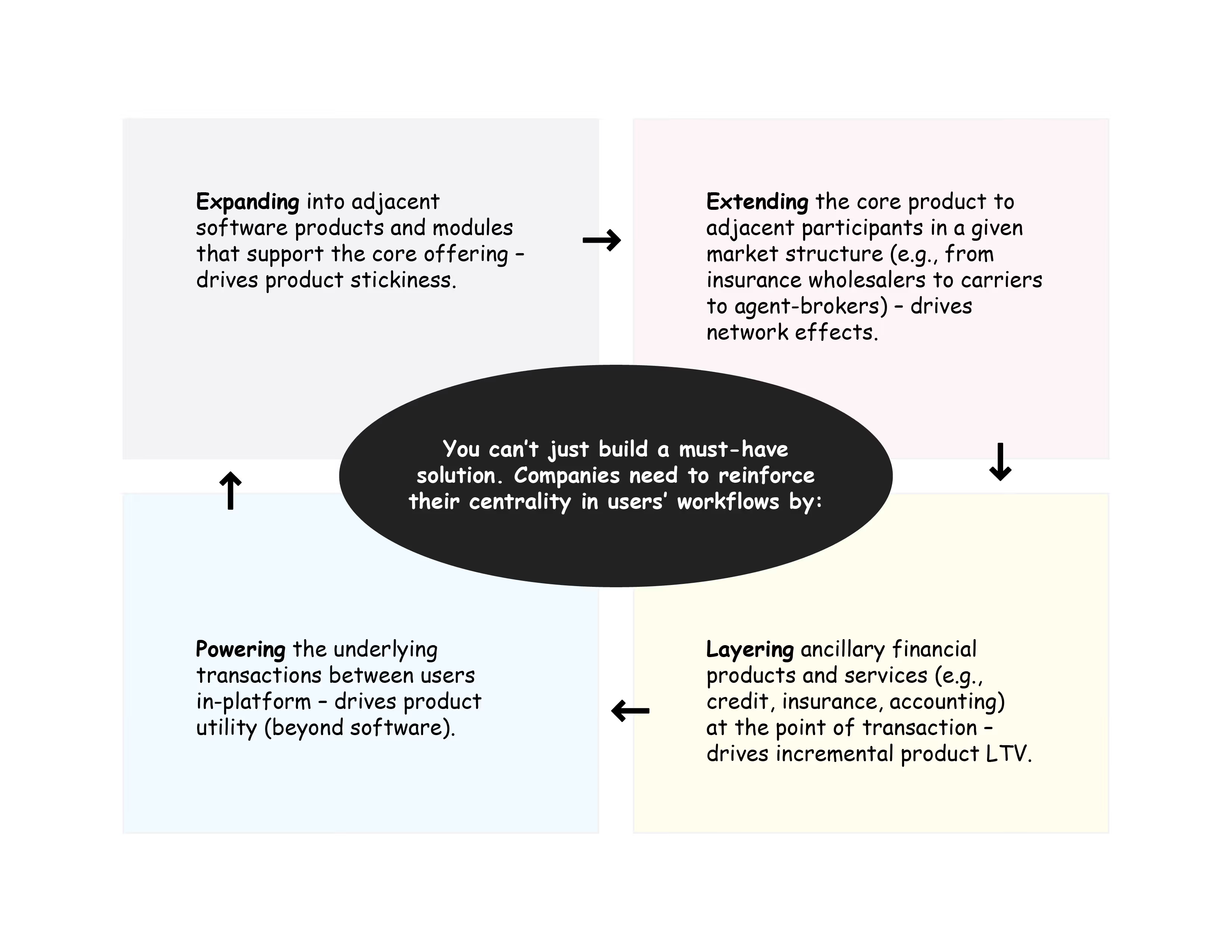
As the cost of developing software trends lower thanks to AI, better product and distribution is at best a medium-term differentiator. Building towards a core proprietary data asset around the software can become a tenant of true long-term defensibility.
Building an Eventual Venture-Backed Data Business
Distilling what we’ve learned, our current operating framework for building a data asset necessitates:
- Scale and Patience. Folks grossly underestimate the critical mass at which a business can start to monetize a data asset, which is also a function of the time to reach readiness. Only now 12+ years down the road do established players (e.g. Plaid) have the scale and penetration to truly take this path.
- A Good Enough—Ideally Great—Standalone First Act. The above implies that getting to the end state is virtually impossible without a great core business. The core must be a scalable, high-margin business from the start capable of getting to a $1B outcome. The data asset play is a force multiplier that unlocks the $10B+ outcome but the strong core business must come first.
- An Unconflicted Value Proposition. The data asset cannot be in conflict with the core customer or value delivered as this introduces existential risk to the business. We believe this is why even if a business shouldn’t explicitly operate as a data business from day 1, there needs to be a sense of intentionality in foundation building ASAP.
So What?
Amassing a critical data asset is a wonderful way to build and sustain a moat – so much so that we believe this style of company-building should extend far beyond financial services! We’re excited to spend time with founders who not only (a) can solve a pressing customer pain point with software today, but also (b) have the end-state foresight to use that software to capture data that can generate tremendous downstream value over time.
%20(1).avif)
Payment rails built for AI agents
Agents are fundamentally breaking the business model of the web. Internet traffic is undergoing a massive shift – away from human visitors to scrapers, bots, and agents. In some cases, bots are visiting a webpage 60,000 times for each visitor they refer. It’s clear that ads that rely on human attention are no longer going to cut it.
As AI agents continue to get smarter and more sophisticated, we’re clearly rapidly entering an era where we see a cambrian explosion of AI agents across verticals that are discovering services, making decisions, and coordinating with other agent based services.
If only they had a way to pay and get paid.
Enter Circuit & Chisel
Circuit & Chisel is building the payments infrastructure that will power the emerging AI agent economy. Its ATXP enables instant, nested, delegated, and extremely low cost micropayments between AI agents — something that today’s traditional payment rails are structurally unable to support.
While there’s plenty of digital payments options available today, they suffer from a goldilocks problem: none of them are just quite right for what the emerging agentic ecosystem needs. Digital card rails? Great for large ticket transactions, too expensive for small ones. Subscriptions? Doesn’t align with the cost structure of delivering agentic services. We’ve yet to have the “app store” moment of the agentic era. ATXP is that missing link.
ATXP makes it easy to embed functionality into any Model Context Protocol (MCP) server that enables agents to:
- Discover and pay for tools and services independently
- Manage complex, multi-party transactions
- Delegate payment decision making up the chain when necessary
But don’t take our word for it – check out their docs and start building here.
Two major tailwinds on a collision course
Many of these themes are ones that have been explored on and off at different points along the history of the internet. Today however, we’re seeing the convergence of two massive tailwinds: 1) the rise of the agentic economy and 2) stablecoins going mainstream.
With $240 billion in circulation and regulatory clarity now arriving via the GENIUS Act in the U.S. and MiCA in the EU, stablecoins have emerged as a modern alternative to card networks. Adoption by traditional financial institutions is off to a blistering pace, lighting up new nodes on a global network quickly. As the ecosystem matures and costs of transacting have dropped, stablecoins have become the ideal medium for high-velocity, small ticket payments that don’t make sense to run over traditional card or ACH rails.
This ecosystem is developing at a breakneck pace with many existing and emerging players all vying to be the underlying medium of transacting. ATXP is designed to support multiple payment methods and blockchains out of the gate, abstracting away the messiness of figuring out the right pathway to transacting into a simple SDK.
Meet the founders: Stripe Crypto’s Skunkworks breakout
The ability to deeply understand and expertly traverse three domains – AI developer tooling, traditional payments, and stablecoin infrastructure — is exceedingly rare. The team, led by Louis Amira and David Noël-Romas, brings the perfect combination of traditional fintech experience coupled with unique insights into this nascent space.
Louis and David worked together at Stripe spearheading crypto and AI efforts through the volatilities of the last crypto cycle. Louis, as the company’s first external crypto hire, was tasked with evolving Stripe’s financial infrastructure and spearheaded crypto and AI ecosystem partnerships. David, as Head of Engineering for Stripe Crypto, was the brain behind many of Stripe’s core crypto infrastructure initiatives. From our first meeting, it was exceedingly clear that they had years worth of earned insights and knowledge on exactly how to architect a solution that would bridge the gaps that exist in the landscape today.
Why we backed Circuit & Chisel
We’re backing Circuit & Chisel because we believe in a future where AI agents transact autonomously on behalf of people, companies, and each other. Louis and David have seen the gaps in traditional payments up close. They know how to earn trust in regulated environments, scale developer ecosystems, and move quickly in crypto-native communities. They’re not just shipping product — they’re imagining and shaping the future of commerce and payments.
We’re thrilled to be partnering with them on this journey alongside our friends at ParaFi. If the future of the internet runs on AI agents, Circuit & Chisel will be the proverbial wallet in their pockets.
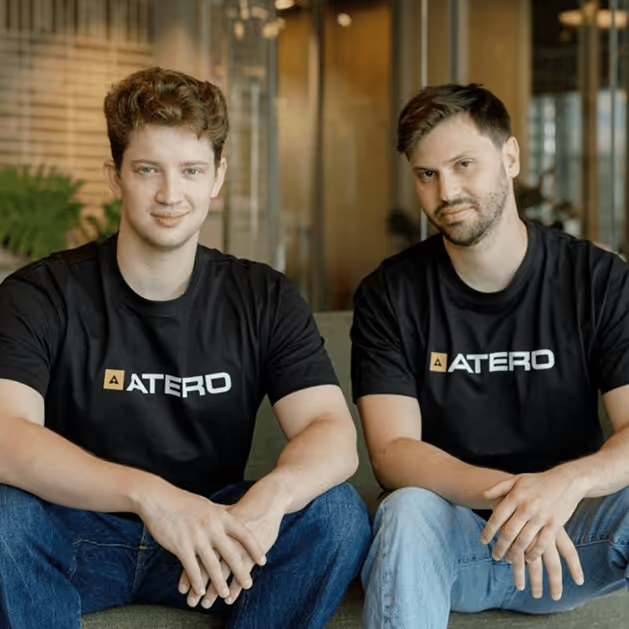
Why we invested in Atero—and why Crusoe agreed
We are thrilled to announce that our portfolio company Atero was acquired by Crusoe. We led the seed round in Atero just over a year ago, and the team has achieved remarkable things in the time since – culminating with this exciting news. We never were able to celebrate them coming out of stealth until now, and this is quite the way to make an entrance!
In the Spring of 2024, we found ourselves down a rabbit hole of AI workload orchestration. The general idea was: AI workloads are becoming so important, but they are run quite inefficiently. Existing orchestration software, namely Kubernetes and Slurm, were not built for these workloads at all. As a result, orchestration is an inefficient part of the AI stack, and given the cost of these workloads, a place for potentially massive cost savings with better stability, speed, and overall performance. We were so excited about this idea that we wrote two blog posts about it in March and May of 2024.
A reader of our newsletter re-introduced us to Alon Yariv after reading these two editions. We had previously met Alon when he was building his last startup, and we knew he was a special talent. His new idea, inspired by learnings from his last startup, aimed to make GPUs much more efficient by orchestrating AI workloads in a better way, with a specific focus on memory optimization. Given the rabbit hole we were down at the same time, this immediately caught our attention.
Alon would go on to build an incredible team of technologists, including Omer Landau, Ben Chess, and Eyal Salomon. In a short period of time, they did what no one else has done for memory optimization on GPUs – the output and speed of this team’s R&D efforts was nothing short of amazing.
In Crusoe, the Atero team finds a perfect home. Atero will help optimize Crusoe’s inference platform and continue to provide Crusoe with a completely vertical solution for serving AI. We are thrilled for the team on the acquisition, and excited for all they will accomplish in the future. Most importantly, we want to extend a massive thanks to Alon, Omer, and the team for letting us play a small part in this awesome journey.
And last but not least, one person in particular deserves a special shoutout: Roy Katznelson. Roy introduced us to Alon originally and then re-introduced us to Alon when he began building Atero. Thank you, Roy. This journey would not have been possible without you.
Congrats to all involved, most importantly team Atero. We cannot wait to see what comes next!

Cell and gene therapy's infrastructure build-out is starting
For more than a century, modern medicine has been defined by how effectively we manage disease – by controlling symptoms, slowing progression, and extending longevity. Cell and gene therapy (CGT) breaks that paradigm: treatments designed not to manage illness, but to eliminate its biological cause entirely.
This is a profound inversion of how healthcare has long operated. Instead of drugs designed to manage/ control symptoms over time, we’re seeing one-time interventions that can correct the underlying cause of disease, sometimes permanently. These therapies replace chemistry with biology, turning our cells and genes themselves into medicine.
To bring this to life: that shift can mean an end to years of pain crises, transfusions, or cycles of chemotherapy – the quiet, relentless toll of living with a disease. It means children with sickle cell waking up without pain for the first time in years, or a cancer patient finally hearing “no evidence of disease” after years of treatment.
But for all the excitement, CGT remains brutally hard to deliver. The science is advancing faster than the infrastructure, reimbursement models, and operational systems needed to support it. If a single treatment can eliminate the need for lifelong management, every surrounding system, including manufacturing, payment, delivery, regulation, must be rebuilt to keep up.
At Primary, we’ve been spending increasing time here, understanding the systems that must emerge to make this moment scalable and sustainable. Every new therapy approved by the FDA brings not just a clinical breakthrough, but also a logistical, operational, and financial challenge to make that breakthrough deliverable in the real world. The opportunity ahead lies in solving these system problems.
The Market at a Glance
Today, CGT spend is roughly $6 billion globally (~5% of specialty drug spend), led by autologous CAR-T and gene replacement therapies for hematologic cancers and rare diseases. The global pipeline, however, tells a very different story: more than 2,000 therapies are now in development, spanning oncology, rare disease, neurology, and autoimmune disorders. In the first half of 2025 alone, nearly 500 new cell therapy assets were initiated globally.
The category’s growth trajectory mirrors that of biologics in the early 2000s, but with higher complexity and steeper operational demands. Most forecasts project a $120-190 billion market by 2033, growing at a CAGR of 18-25%.
And perhaps most importantly, these therapies are starting to move earlier in the care pathway.
CAR-T and bispecifics, once reserved for relapsed or refractory patients, are now being tested, and in some cases approved, as first- or second-line options. Gene therapies that once targeted ultra-rare diseases are expanding into more common conditions like sickle cell disease and muscular dystrophy. Over the next decade, we’re going to watch as CGT shifts from the last resort to the standard of care for dozens of conditions.
Why It’s So Hard – and Where We’re Focused
The promise is extraordinary, but the current delivery model can’t meet the demand. Today, treatment is predominantly confined to academic medical centers (AMCs) because they have the physical infrastructure, trained staff, and 24/7 coverage these therapies require. We heard from multiple AMCs including MSK, Yale New Haven, and Boston Children’s that they are already capacity-constrained. As indications expand and move earlier in the pathway, an AMC-only model will only continue to bottleneck access. Scaling CGT safely will require shifting appropriate volumes into qualified community oncology and community hospital settings – with the right technology, protocols, and financial rails.
1. Technology & Data Infrastructure
It’s still incredibly hard to make and move these therapies. As a pharma leader we spoke with put it, every patient dose “travels through a chain of collection, modification, release, and reinfusion – often across continents – and a single break collapses the process.” Community sites described using little beyond their EMR and spreadsheets to track that process, with no unified system connecting apheresis, manufacturing, and infusion.
We’re interested in: Platforms that unify manufacturing, logistics, and clinical workflows into a single chain-of-identity record, automated QA and exception management, interoperable data layers connecting manufacturing, clinical, and outcomes data, and AI-driven coordination tools that compress timelines and prevent errors
2. Access & Delivery Infrastructure
Even when the product is ready, most hospitals aren’t. We heard from community oncology leaders that standing up a program can take 12+ months and a seven-figure investment for cold storage, apheresis space, trained staff, and inpatient coverage when necessary. A director of cellular therapy operations at a regional cancer center noted that even with rising demand, staffing is the primary constraint: “You can’t just hire nurses; they have to be cell-therapy trained and FACT-ready.” Without better training pipelines and remote-monitoring support, they can’t expand capacity safely. A pharma leader echoed that “patients want to stay with their community oncologist, but most clinics don’t have the infrastructure or FACT accreditation to receive or monitor these therapies safely.”
We’re interested in: accreditation-as-a-service models that simplify compliance, scalable workforce training and credentialing platforms, and patient monitoring technology that allows qualified hospitals and health systems to safely identify and manage CRS and ICANS in real-time, infrastructure that facilitates partnerships between community oncology centers and nearby hospitals for inpatient support and coverage.
3. Financial & Reimbursement Infrastructure
The economics are compelling but still operationally fragile. Community oncology leaders emphasized that CGT is one of the most attractive areas for expansion – it allows practices to retain patients, capture meaningful drug margin, and position themselves as preferred sites for next-generation therapies. Yet the rails to support that growth are incomplete. Payer approvals remain slow and inconsistent, revenue recognition is delayed, and the indirect costs of staffing, accreditation, and inpatient coverage can erode profitability on a per-case basis.
We’re interested in: automated platforms that operationalize outcomes-based contracts and risk-sharing, annuity or milestone-based payment models that align cash flows with realized benefit, and pooled-risk structures that make these therapies accessible without catastrophic exposure for smaller payers or employers
Why We’re Spending Time Here
As CGT moves from experimental to standard of care, the center of gravity is shifting. Value will no longer accrue only to the scientists discovering new molecules. It will move to the companies that make these therapies manufacturable, reimbursable, and deliverable at scale.
The next generation of category-defining healthcare companies will be built at the intersection of biology, infrastructure, and operations. If you’re working at that intersection and helping biology meet system design, we’d love to connect.
Reach out at sam@primary.vc or hannah@primary.vc.

AI agents need systems of work, not record
Context
A year ago, Chris Paik controversially wrote about The End of Software, arguing that it’s easier than ever to build software so there’d be a Cambrian explosion of new tools.
We’re not quite there yet but any early stage investor will tell you that it sure feels that way. Categories where a couple years ago you’d see 2-3 players now easily have 10-15 new entrants. Play the tape forward from here, and the markets shrink, prices compress, and spaces commoditize.
So the question remains – is there enduring venture scale value left in the application layer?
Where Value Was Created in the SaaS Era
As investors, we all know how hard it is to go up against an incumbent – especially if it requires a “rip and replace” of existing systems. No matter how crappy the customer service or the UI/UX looks, inertia is a powerful force. Better products lose everyday.
While provocative, Chris’ argument misses the mark of how challenging it is (and has always been) to build true enterprise-grade software. It requires:
- Performance at scale - the ability to handle truly large workloads across a large user base with little to no downtime
- Compliance & security - robust access management, detailed audit trails, adherence to data security standards / best practices
- Change management & ecosystem lock In - integrations into other business systems, data lock in (esp true for systems of record), and an ecosystem of trained (oftentimes officially certified) employees, consultants, and integrators that raise switching costs
- Customization & configurability - long implementation cycles that tune a baseline product to the exact needs of the customer
Even through the 2010s, and the “Era of SaaS”, many traditional enterprise heavyweights remained largely “undisrupted” despite many attempts and challengers who built 5x even 10x better products. Looking back at the winners that emerged in this era, there’s a couple of core themes:
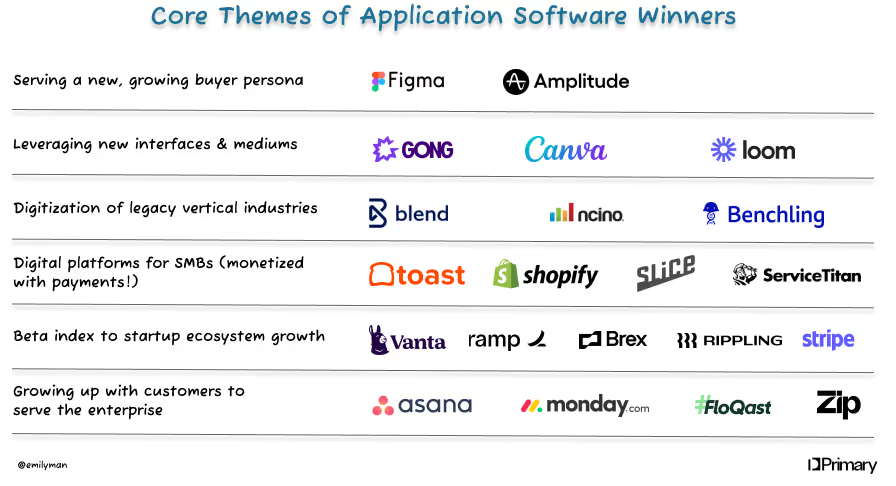
These tailwinds have created $Ts in enterprise value but are largely mature. As a result, in the last couple of years (pre-AI), new entrants were increasingly forced to attack narrower customer segments or smaller niches to compete.
The AI Era Changes the Paradigm
AI changes this. The stage is now set for a new generation of truly enterprise grade AI-native software winners to emerge. These companies have the opportunity to completely reimagine workflows and categories from first principles and ultimately finally unseat the old guard.
Here’s how:
- GenAI erodes traditional software moats: GenAI loosens many of the traditional characteristics of SaaS stickiness. With AI, it’s easier to extract critical data, quickly customize settings, and integrate into an existing ecosystem of tools. Spaces that traditionally would see 6-12 month implementation periods requiring a massive IT lift to get a new system live will see those shrink.
- “Systems of work” will eat “systems of record”: If the atomic unit of the SaaS era was the record, the atomic unit of the AI era will be the work. AI agents have the ability to handle messy unstructured data and navigate complex decision making. Capturing that “process” of how and why a decision is made contains 10x more information than what decision was made. In this world, “end-to-end process” data becomes more valuable than “final decision” data. Owning the rails of the ‘sausage making’ becomes more valuable than the completed ‘sausage’.
- AI allows for building 100x better outcomes: many SaaS 2.0 challengers were prettier, faster, and cheaper, but at the core, fundamentally the same. Incremental ROI led to indifference. New enterprise AI solutions can unlock jaw dropping experiences and value that is orders of magnitude stronger than their predecessors.
- “Selling work” taps into a net new budget pool: No longer tethered to “seats”, this category of enterprise AI companies can directly replace human capital and tap into budget earmarked for people – whether that’s internal headcount or outsourced services. It also opens up downmarket segments by expanding attainable ACVs and opening up segments that were previously “not worth it” for system of record type companies to sell into given cost to serve + lower contract sizes.
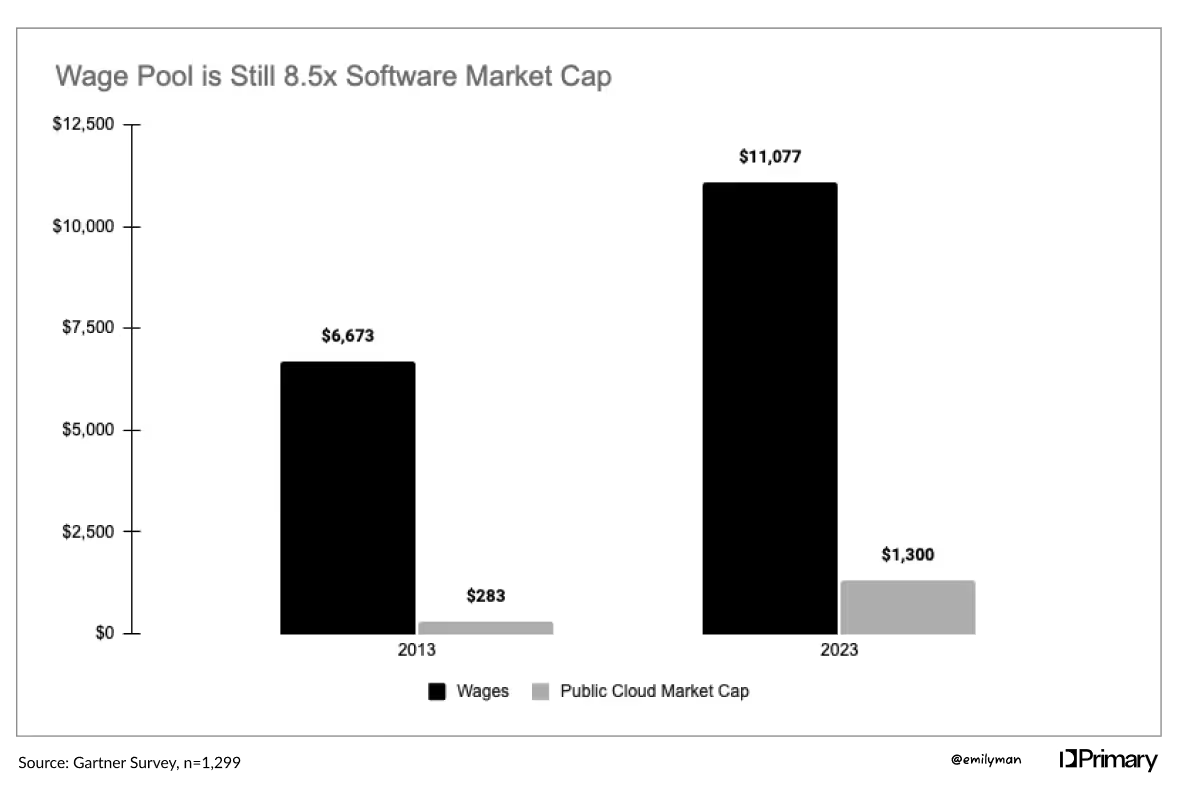
Winners in the AI-Native apps won’t just replace software, they’ll also replace:
- Spend on existing software tools (not sufficient on its own)
- Outsourced spend (e.g. BPOs, consultants, third-party providers)
- Internal white-collar headcount (the holy grail)
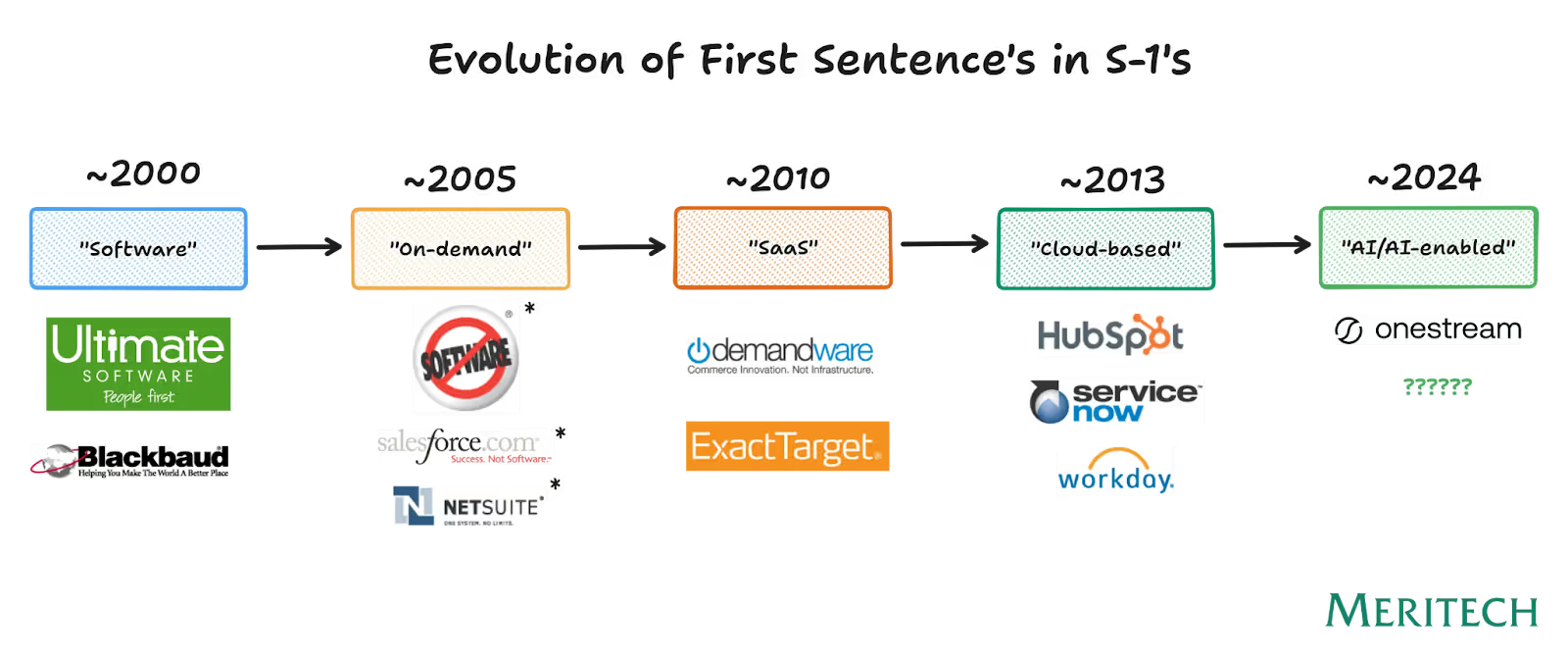
Source: “SaaS Isn’t Dead (Yet) and AI Could Make it Bigger”
Why Startups Win
Objection 1: So why is this not a giant race to the bottom?
The answer lies in the capture of reasoning logic: how decisions are made, not just what decisions are made.
The last generation of solutions focused on outcomes (e.g. issue refund or not). Now, with more and more work being taken on by agents, the process by which decisions are made is infinitely more valuable (e.g. see request >> analyze customer inquiry data >> cross check against internal policy >> apply human judgment >> make decision).
Put plainly, the capturing of how and why decisions are made natively in the workflow is the key. End-to-end feedback loops helps agentic products continue to make better decisions in the context of the customer they serve. This customer-level fine tuning of preferences and decision making, when done right, creates stickiness and lock in.
This is really just another form of data capture. Historically logs and actions were captured for audit and explainability purposes but now how a decision is made is becoming equally as important as what decision is made. This means that many categories are a land grab to capture reasoning logic and lock up customers quickly.
Objection 2: But don’t the incumbents have an inherent distribution advantage? Aren’t they just going to win?
Another common criticism of AI upstarts – i.e. why isn’t Figma the AI Figma?
In some categories this will be true: scaled winners of SaaS 2.0 that are nimble and capable enough to deliver an AI-native experience have an upper hand.
This is not true across all categories. AI-native startups can win in a couple of scenarios:
- Going upstream into the “system of work”: many legacy “system of record” solutions enter at the end of the work being done. These solutions capture the result but not the process to get there.
- Building guardrails for non-deterministic processes: LLMs are inherently non-deterministic. Harnessing their power while also developing the appropriate guardrails for accuracy and consistency is a new skill set that many traditional modes of software development are not well equipped to handle.
- The good ol’ innovators dilemma: traditional software monetization is tethered to seats and the expansion of those said seats. Agentic efficiency oftentimes runs counter to the core cash cow creating organizational conflict and difficulties prioritizing.
There’s parallels that can be seen from the shifting of software from on-prem to cloud (h/t to our friends at Sequoia)
Twenty years ago the on-prem software companies scoffed at the idea of SaaS. “What’s the big deal? We can run our own servers and deliver this stuff over the internet too!” Sure, conceptually it was simple. But what followed was a wholesale reinvention of the business. EPD went from waterfalls and PRDs to agile development and AB testing. GTM went from top-down enterprise sales and steak dinners to bottoms-up PLG and product analytics. Business models went from high ASPs and maintenance streams to high NDRs and usage-based pricing. Very few on-prem companies made the transition.
The ways “AI-Native” applications are designed, implemented, and tested will all have to change. For many incumbents, the cultural and structural leaps will be insurmountable.
Three ways the pie grows
There are three buckets of opportunity that we see in the application layer:
- Democratizing access downmarket: By selling work vs. tooling, AI agents make services and functions that previously were inaccessible to smaller organizations affordable and easy to access for the mid-market and SMBs. For example, phone answering/customer inquiry, scheduling, customer support, inventory management, etc.
- Vertical-specific use cases: Industries that require deep specialized knowledge have historically been unpenetrated by software solutions and have instead relied on expensive, highly-specialized labor. Previously, selling SaaS tools into these segments was considered too niche and markets too small. Agentic workflows that replace high-cost basis white-collar work and marry that with deep vertical and functional knowledge can make niche markets venture-scale
- Productizing the “messy middle”: Workstreams that previously lived across systems and modalities (emails, spreadsheets, voice, etc) can now be codified into agentic workflows that the last generation of RPA tooling was not flexible enough to unlock. Because agents can tie together structured and unstructured data sources they’re able to finally productize the “work” that historically was manual.
- Going head on with incumbents at enterprise scale (bundled): Each functional department is being reimagined with an AI-Native solution. While we’ve seen strong early market traction in customer-facing functions (e.g. sales, marketing, support), there remains a lot of low hanging fruit in traditional “cost centers” that historically were not prioritized in terms of budget, IT resources, or attention to 10x those functions.
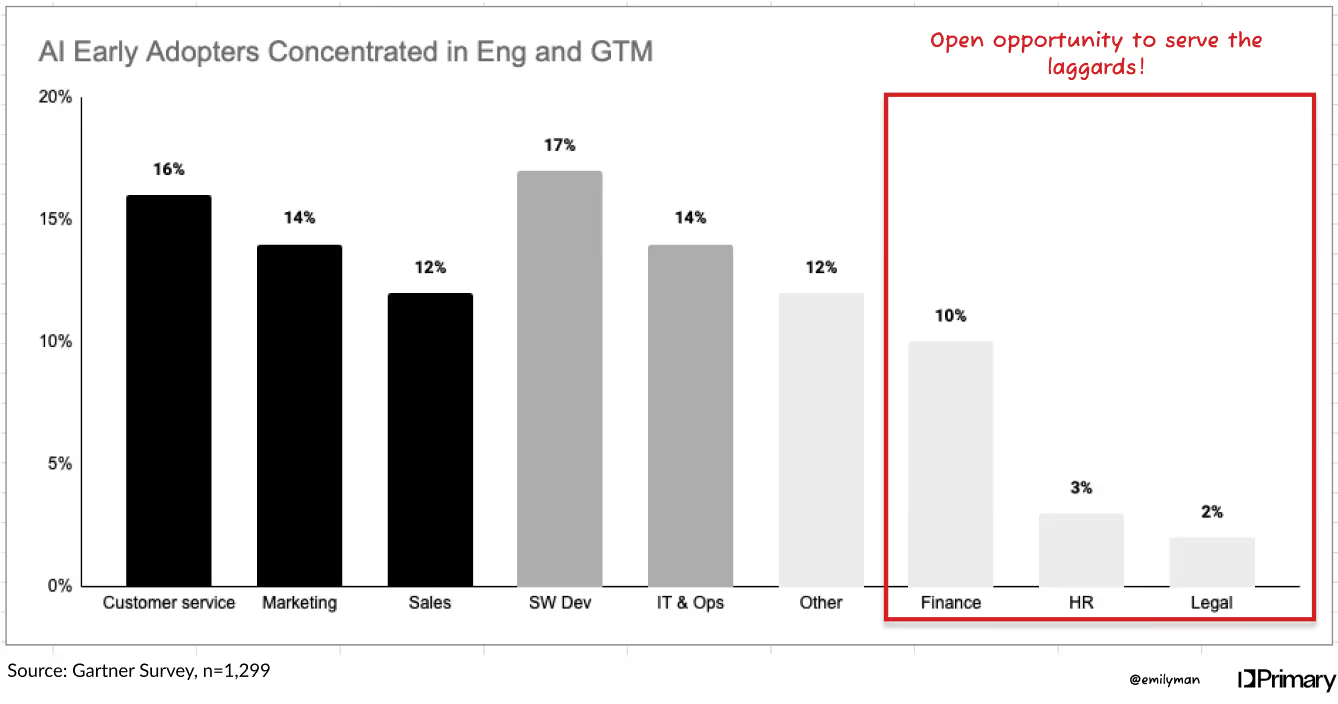
Why “Enterprise”?
This window of opportunity is largely specific to enterprise-grade applications because enterprises still need functional best of breed solutions. In the enterprise, enduring value will come from the intersection of:
- Lowering of traditional enterprise software moats
- 10x improvement in value and ROI calculations
- Relatively high implementation costs (with the “FDE” quickly becoming the hottest job category)
- Continued need for enterprise grade permissioning / access management / compliance features
While there are many SMB and mid-market pain points that are very much worth tackling, the value creation drivers in those segments differ significantly from enterprise. More on that soon.
What are we looking for?
- Low NPS incumbents: Either a) software markets where there is a large, universally-hated incumbent and the pain of rip & replace historically fended off new entrants OR b) services markets where spend (and varying quality) largely outpaces value delivered
- Enterprise-grade core product: while this may require longer upfront build times, having a truly enterprise grade product will be a necessary criteria to be a contender for market winner. While we will not rule out companies that start in the mid-market to get a product to market – we need to see an end vision (and the product chops) to eventually serve enterprise
- Capture of end-to-end workflows: Most importantly, the product must be set up to capture and learn from full cycle feedback, strengthening the “agentic reasoning” architecture over time. Solutions that do not capture “outcomes” will be non-starters.
- Early enterprise credibility teams: the ability to get an enterprise customer to take a leap of faith on an early market entrant and product is nearly a moat itself (e.g. Brett Taylor at Sierra, Amanda Khalow at 1mind). We’re looking for teams that occupy the intersection of being 1) AI-native and 2) Day 1 credible with enterprise buyers. Given the long lead and deployment times, unfair advantages are needed to get the first points on the board.
We are at a juncture in time where every piece of software is being reinvented for the agentic era. The journey will not be easy— build times will be long, and revenue growth will be lumpy. But the long term path to value creation is clear. Here are specific areas that we’re actively looking to invest in:
- “Offices of G&A”: Every horizontal middle/back office function (finance, IT, HR/payroll, benefits, legal, audit/risk, compliance, investor relations, etc) can be totally reinvented. Is there room for an AI-Native Workiva / Auditboard or next-gen Jira?
- Future of work 2.0: Collaboration and productivity software that is designed for a hybrid human + AI agent workforce. As the balance shifts over time, new tooling will be needed for coordination of activities whether that is agent <> agent or agent <> human, particularly when it comes to cross-functional work.
- Vertical “systems of work”: Are there more industries with a defined universe of buyers that are overdue for their own “Veeva” that to date have been retrofitting horizontal solutions for their needs? We’re actively looking for solutions across insurance, energy, government, and more that are creating the “systems of work” that add intelligence to core systems of record.
If you’re building the next-generation of enterprise AI, I’d love to hear from you.
AI for DevOps at scale
Kubernetes is the 10,000 pound gorilla of infrastructure. It is ubiquitous—over 60% of enterprises today manage 10 or more Kubernetes clusters—and the underlying backbone of so much of how enterprises run their applications. And yet, despite consistent efforts to make Kubernetes manageable, in 2025 it remains an unsolved problem. It is an esoteric system that has become a mess to operate.
This is the case because the enterprise Kubernetes environment is more complex than ever: sprawling with massive scale, sometimes hundreds of clusters that require upgrades, dependency management, and a control plane to manage how everything is tied together. Enterprises often have dozens of highly skilled engineers just tasked with keeping Kubernetes operable.
Moreover, the hyperscaler clouds have never been properly incentivized to create the optimal control plane and experience around Kubernetes, so their products are subpar. They are by definition tied to their own cloud, with a lack of the product vision required to build something that properly solves all the intricate issues that pop up when managing a Kubernetes fleet.
Enter Plural. CEO Sam Weaver and CTO Michael Guarino have been working on removing the headache from Kubernetes upgrades and dependency management for years. They have the intense product understanding, Kubernetes expertise, and now, AI to supercharge the product and 10x the experience.
Plural delivers AI automation for DevOps at scale. Plural reads a scaled Kubernetes environment, gives prescriptive insights and recommendations around when and how to manage upgrades, and sits alongside a DevOps professional as they address issues.
Today we’re celebrating Plural’s $6 million seed round, which we led with participation from Company Ventures and Capital One Ventures, bringing total funding to $12 million. We are excited to be joined in this round by Capital One Ventures, which has an incredible track record of backing industry-defining companies while also being an early customer to some of the world’s most iconic infrastructure businesses like Snowflake.
Plural has from the beginning been focused on enterprise functionality and scale. The company’s first customers are some of the biggest financial services and cybersecurity businesses in the world, that entrust a startup with the all-important job of managing a high-stakes Kubernetes environment.
Some of our favorite infrastructure investors often say that it takes time for infra solutions to take hold—because they are essential building blocks of a company’s foundation, the trust and time required to adopt is high. However, when an infra solution clicks, it is magic. You become an essential part of your customers’ operations and success. You become indispensable.
We are seeing this happen with Plural, and it’s fun to watch. Now is the time to truly build DevOps automation at scale—the pain is severe and the tech is ready. Plural is the solution to this longstanding and frustratingly unshakable problem.
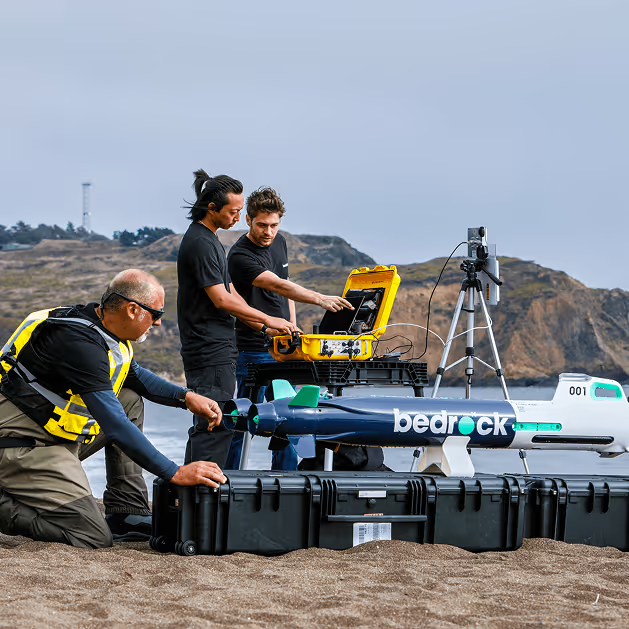
The future of ocean intelligence
One of the next decade’s most important infrastructure markets isn’t in the cloud or on land, but on the ocean floor.
Today, we’re excited to share that Bedrock Ocean has raised $25 million to accelerate its mission of mapping Earth’s final frontier: the ocean floor. We have been investors with Bedrock since co-leading their seed round, and are proud to participate again alongside a stellar group of new partners led by co-leads Costanoa Ventures, Harmony Partners, and Katapult, alongside Autopilot and Mana Ventures plus other longtime believers like our friends and existing co-investors at Northzone, R7, Eniac, and Quiet Capital.
This funding comes on the heels of a breakout year for Bedrock, with commercial traction across multiple market sectors in the U.S. and field deployments that customers describe as “the best data we’ve ever seen”—often in conditions where traditional survey vessels would refuse to operate.
A new foundation beneath the sea
Bedrock is building the most comprehensive, scalable, and environmentally responsible ocean floor dataset ever assembled. Its vertically integrated approach combines custom-built autonomous underwater vehicles (AUVs) with a cloud-native data platform called Mosaic™, enabling survey turnaround in a matter of weeks instead of a year.
To understand how transformative this is, it helps to look at the status quo. Traditional subsea surveys require hundred-million dollar ships, cost approximately $100,000 per day to operate, and carry five-year-plus backlogs. They burn tens of tons of CO₂ daily and blast sonar from the surface, causing ecological damage. Bedrock, by contrast, can deploy battery-powered AUVs in hours, complete surveys in days, and upload data directly to the cloud—at a fraction of the cost and with minimal environmental impact.
In short: it makes deep sea data fast, cheap, and green. And like anytime something gets faster and cheaper, that is poised to open up massive new market opportunities on the ocean floor.
Why now? The infrastructure moment has arrived
The subsea opportunity is no longer theoretical. It’s an $8 billion market just in survey spend—and that’s before factoring in new categories like subsea data centers, carbon capture, and national security.
NATO is forming task forces around subsea infrastructure security. There are also use cases around energy, telecom, environmental monitoring, deep sea mining, defense, and more.
As one example, the U.S. has over 450 gigawatts of offshore wind in its pipeline through 2050. Offshore wind projects alone require 20+ surveys per development cycle, across bidding, planning, construction, and operations. Several of the largest wind developers in the world are already engaging Bedrock for next-generation, marine-mammal-safe survey capabilities.
A team with the right pedigree and persistence
We first met founder/CEO Charlie Chiau in 2020. What stood out was not just his technical depth—Charlie started building subsea tech nearly 20 years ago at DeepFlight and then worked at SpaceX—but his obsession with building for scale.
Bedrock’s team of thirty-five includes top talent from Google, SpaceX, NASA, Cruise, and L3Harris, and it has already achieved in four years what most defense contractors need decades (and hundreds of millions of dollars) to do:
- A full-stack AUV fleet, now in Gen 2
- A cloud platform that makes ocean data accessible and interoperable
- Hardware built in-house in four to six weeks
- Compliance with IHO’s most stringent global accuracy standards
Even prior to this round, the team had already reached unit economics that would turn any hardware CFO’s head. Now, with additional capital, Bedrock will:
- Expand data acquisition across U.S. and global coastlines
- Scale manufacturing capacity to meet surging survey demand
- Advance full autonomy in the field—from deployment to delivery
- Enable over-the-horizon fleet operations with minimal human input
Data is the real wedge
Perhaps most exciting is Bedrock’s multi-client data model. Unlike legacy survey firms that deliver hard drives once and move on, Bedrock can make the same dataset available to multiple buyers—turning each mission into a flywheel of recurring revenue. It’s not just a better way to survey; it’s a fundamentally better business.
Mosaic is poised to become the foundational ocean intelligence platform for developers, governments, researchers, and regulators alike. The ability to license high-resolution ocean floor data—collected sustainably, processed in real time, and accessed in the cloud—will unlock use cases we can’t yet predict, just as satellite imagery did on land.
Where we go from here
What started as a next-generation survey company is now becoming a data infrastructure platform for the ocean. That’s why we invested.
We believe the Bedrock team is building a new category at the intersection of robotics, data, climate, and infrastructure—one that will underpin critical decisions across energy, defense, and the environment for decades to come.
We’re proud to back Charlie, Brandon, and the entire Bedrock team as it builds a living digital twin of the ocean—an enduring foundation of intelligence, resilience, and prosperity for generations to come.

Rebuilding mining’s risk model with AI
The next decade will be defined by our ability to secure the critical minerals that power the modern economy. Electrification, national security, supply chain resilience, and the compute to power the AI revolution all hinge on a reliable, domestic pipeline of metals like copper, nickel, and rare earth elements. And yet, mineral exploration—the first step in that supply chain—is still painfully slow, inefficient, and risk-laden.
Today, discovering a new mine can take over a decade and hundreds of millions of dollars. Even then, the odds of success are brutally low: fewer than 1 in 1,000 greenfield exploration projects ever become productive mines. Despite the enormous capital flowing into energy transition, the mineral discovery process has barely changed in 50 years.
That’s why we invested in ExploreTech.
ExploreTech is building the first exploration platform designed for speed, precision, and repeatability—using AI not to find “treasure maps,” but to fundamentally change how the subsurface is understood and de-risked.
From Venture to Veins: A Shared Risk Curve
Mining, in many ways, mirrors the venture capital lifecycle. Exploration-stage projects are like pre-seed startups—high risk, uncertain potential, and heavily reliant on talented founders and conviction-based capital. As drill data accumulates and the resource potential is validated, these projects raise more capital and trade at higher valuations, eventually graduating into development-stage assets (akin to growth rounds) and then into producing mines (the IPO equivalent).
But unlike startups, where early-stage investing has evolved into a mature asset class, early-stage mining investment remains a cottage industry. Exploration companies are often microcaps listed on the TSXV, have been largely capital-destructive over the last decade, and are financed in piecemeal rounds with minimal technological edge. There is no Y Combinator of mining—and no Sequoia.
What exists on the other end of the mining lifecycle, however, shows what’s possible when risk is well understood. Royalty and streaming companies like Franco-Nevada and Wheaton Precious Metals have built some of the most capital-efficient businesses in the world. Think of these as the IPO investors of mining. Franco-Nevada, with a market cap of over $32 billion, has just over 50 employees. Wheaton, valued at around $38 billion, operates with a similarly lean team. These companies don’t operate mines—they finance them. In exchange for upfront capital to help construct or expand a mine, they receive royalties (a percentage of the mine’s revenue) or streams (the right to buy a portion of the mined metal at a fixed, discounted price). This model gives them commodity arbitrage upside without capex intensity or operational exposure. They are also providing capital to projects that are over 10 years old with already discovered and quantified deposits, which means their underwriting is based on a very well understood portion of the geologic subsurface and is far less risky than an early stage exploration project. Their success underscores a powerful idea: when the subsurface is well-understood, the capital markets work. The challenge is bringing that kind of clarity to the start of the process.
The challenge—and opportunity—is to enable the same underwriting rigor at exploration, the front end of the risk curve.
AI as the Risk Engine
This is where ExploreTech comes in.
They offer a radical improvement in how early-stage fieldwork is conducted and interpreted. The team’s AI models—trained on geophysics, geology, and historical outcomes—guide field teams toward the most statistically promising places to drill, based on real-time data collection and a proprietary “geologic Monte Carlo model.”
This doesn’t produce a magic answer. But it does reduce the number of holes needed, the capital spent, and the time wasted to discover and quantify a deposit. Instead of drilling fifty holes over ten to find out if a resource exists, ExploreTech aims to get there in five holes and two years.
The results so far are compelling to say the least. ExploreTech has made seven drill recommendations to date—all seven have hit mineralization at the predicted location and depth. In one recent case, it predicted copper would be found 600–650 feet below the surface and 1,200 meters away from any previous drilling. Giant Mining, their partner, found it exactly where the model said it would be.
This kind of accuracy can change the fundamental risk-return profile of early-stage mining. It’s the equivalent of knowing, with high probability, which startups will graduate from seed to Series A—and which should never have raised at all.
Why Now
The timing for a company like ExploreTech couldn’t be better:
- Copper demand is expected to double by 2045 if net-zero targets are to be met (IEA).
- National security concerns around rare earths and battery metals are pushing governments to re-shore supply chains.
- Billions of public dollars are being deployed to catalyze domestic mineral production.
- GPUs and cloud compute have made subsurface modeling at scale newly possible.
In other words: we need to discover more minerals, faster—and we finally have the tools to do so.
Why We Backed ExploreTech
We invested in ExploreTech not just because it has promising technology and a great team (though it does—Stanford Mineral-X alums with field experience at Rio Tinto, Freeport, and Glencore). We invested because we believe in their vision to remake exploration as a rigorous, data-driven discipline.
If successful, the ExploreTech team won’t just improve discovery timelines—they’ll make early-stage mining investable in a way it hasn’t been before. Their approach could open the door for a new class of institutional capital to back the assets that unlock the energy transition.
We’re proud to be early partners to Tyler, Alex, and the ExploreTech team. This is about more than finding the next mine. It’s about rebuilding the discovery engine itself.
.avif)
Opportunities in supply chain tech—a challenge that could define post-pandemic innovation
The team here at Primary strongly believes that the global supply chain challenges we’ve endured over the last three years present an incredible opportunity that will support multiple category defining businesses—each one of the opportunity sets above represents tens of billions of dollars of market potential.
Here, we’ve outlined the key areas we’re thinking about, and that we’ll explore in more depth for subscribers of this newsletter. Expect further thinking and perspectives including case studies, market maps, interviews with thought leaders, and more. Let us know if you have ideas, suggestions, or questions!
We have seen no shortage of founders pursuing ambitious solutions to these problems and we are eager to meet more. Please send any founders our way, and remember, there is no such thing as too early for us!
Why supply chain tech is primed to define meaningful innovation in the coming years
If the Global Financial Crisis helped to kick off a decade-long boom in fintech, we think of the pandemic and its immediate aftermath as the Global Supply Chain Crisis. As we all saw, the shock that Covid-19 brought to global supply chains was truly unprecedented, shutting down factories and constraining supply, sending the costs of global shipping skyrocketing, and in many markets driving unprecedented new levels of demand. Maersk, the world's largest shipping company, tripled gross margins and 5x’d EBITDA in a single year. On the other hand, large companies went under, employees got laid off, and supply chain leaders had no answers. And then Russia invaded Ukraine in February of 2022, sending shock waves through global supply chains once again.
These multiple body blows showed how brittle our supply chains had become. Just-in-time was a brilliant idea until it wasn’t, right? The reality is that with global supply chains stretched and tweaked as tightly as they’ve been, driven by a relentless drive for efficiency, dangerous shocks appear likely to be as much a part of modern global commerce as hurricanes are to Florida and wildfires to the American West. Companies of all sizes need to optimize their risk exposure and responses to these inevitable shocks.
To build more durable supply chains, companies first need to diversify their supplier and transportation provider networks
This may seem simple and obvious, but doing so at scale comes with transaction costs that have historically made supply chain diversification infeasible. There’s good reason these supply chains were overly optimized previously, after all.
Imagine you are the Chief Supply Chain Officer of Walmart, with an already enormous network of suppliers and logistics companies to make and move your products. Materially increasing the diversification of your network would likely mean working with a larger number of lower quality partners and SMBs, who are less sophisticated and don’t meet all of your procurement requirements. Working with companies like these will result in manual work, lower quality service, and an overall increase in cost.
Squaring this circle – finding paths to making supply chains more diversified and durable while not adding mountains of operational complexity and additional risk, presents a massive new challenge. We believe it's a challenge that only technology can answer. This push for diversification and durability is the central opportunity for supply chain tech right now, and we are very excited about it, because we believe it’s the only path forward.
Challenges
After seeing what we saw in the pandemic, we’re betting on a world where supply chain diversification is a top priority for any organization that moves goods at scale. There are lots of reasons why it’s difficult to increase the breadth of a supply chain network, but we bucket them into four problem statements:
- Operational complexity - As the number of vendors in a company’s supply chain increases, and likely the average size and sophistication of those vendors goes down, the number of manual tasks and opportunities for errors will increase, too.
- Interoperability - As companies adopt more software and start working with more vendors in their supply chain, they will need to build more integrations within their stack and with their vendors.
- Vendor discovery - The push for vendor diversity and redundancy creates a discovery challenge / opportunity. Actually finding and understanding the quality of net new supply chain partners to work with is extremely opaque today, relying heavily on word of mouth referrals.
- Financial infrastructure - Transactions between supply chain partners is still largely manual and prone to errors, fraud (truckers handling piles of cash—what could go wrong?), and other risks. As supply chains become larger and more complex, that will only exacerbate these risks. Enough is enough.
Solution Sets
The above are intentionally very broad ways of categorizing today’s supply chain challenges. We are using them to refine the lens we look through to find the next generation of category defining businesses in this space. We believe that each challenge area calls for solution sets that include multiple potential venture scale outcomes.
- Operational complexity: An opportunity for more SaaS and AI. A large number of tasks related to procurement, sales, operations, accounting, and data science are still largely manual in global supply chain organizations. This problem grows as the companies expand their supply chain networks. At the same time, ERP and Transportation Management System (TMS) utilization has been widespread for decades, but only recently has it started shifting to the cloud. We think that these systems have been great for keeping a digital record of supply chain data, but have only skimmed the service of what can be done to automate workflows related to supply chain management. We have seen a number of companies enter the market that sit on top of or plug into the TMS/ERP to help companies automate tasks associated with supply chain optimization. Within our own portfolio, there’s an exciting new company we’re yet to announce that gives enterprise data science teams a decision intelligence platform, allowing organizations to improve the quality and speed of everyday supply chain decisions with AI. Parade is another product we admire that helps logistics organizations automate workflows related to the management of transportation vendors in their network.
- Interoperability: The need for better data infrastructure. Network expansion, cloud product adoption and IoT proliferation are all driving the need for a data infrastructure overhaul in the supply chain tech ecosystem. As enterprises expand their supplier and transportation vendor networks, they will need to build more and more integrations to operate efficiently with their new partners. Today this task is handled by service providers who build costly peer-to-peer EDI integrations. We see companies like Orderful and Chain.io improving the speed and cost of building these connections, ultimately making it easier for companies to expand their supply chain networks. As the section above highlighted, there will also be a wave of new, cloud-native products that come to market that will need to leverage data from legacy ERPs. Today, these new products struggle to build these integrations, which creates a massive obstacle in their go-to-market timelines. Universal APIs for the WMS, TMS and more will provide the interoperability they need to bring value to their customers faster.
- Vendor discovery: Building the databases to stand up B2B marketplaces. Grounded in our belief that large enterprises will continue to expand their supply chain networks, we also believe they will have to find new ways to discover and assess new vendors. Marketplaces have gained very little ground in this space, and there are only a few reliable databases of suppliers that buyers can trust. We’ve seen products offering quality control/assurance software to help enterprises manage their supply chain vendors. Some of these products also plan to leverage their quality control data and customer traction to build out the supplier/vendor databases needed to stand up a marketplace (we don’t believe you can launch a marketplace from scratch). One great example of this is FactoredQuality, which connects brands to thousands of quality control inspectors and helps them run, monitor and analyze all of their supplier testing and compliance checks. In doing so, FactoredQuality also has a vast amount of data about the quality and performance of their customers’ suppliers and can leverage that to stand up a supplier marketplace for brands looking to outsource manufacturing. Whether or not this is the winning chess move, we don’t know, but we have strong conviction that someone will crack this code and one or more robust vendor marketplaces will emerge.
- Financial infrastructure: Payments, lending, and insurance. Historically, the way money moves through supply chains – from shippers to forwarders to carriers and back again, with stop-offs at ports, chassis pools and rail yards – is as antiquated and ripe for fraud and errors as it gets. There is an already rolling wave of technology making freight payments easier and safer for customers and vendors alike. They also frequently offer solutions that make supply chain operations more efficient. Freight invoice auditing – the act of reviewing all invoices, bills of lading, and receipts associated with a shipment – has historically been an incredibly error-prone manual task undertaken by large accounts payable teams or outsourced firms. Today, companies like Loop are automating the freight invoice audit process and connecting it to a payments platform to streamline the entire AP process. There are also companies that have succeeded by building payments products that actually accelerate the movement of physical assets through the supply chain by eliminating costly and wildly inefficient waiting for payments to clear at various stops in the chain. Relay Payments, for example, automates lumper payments – fees for the labor required to load and unload cargo – in the warehouse, allowing trucks to save time coming in and out of delivery sites while simultaneously eliminating an important source of fraud. Lastly, we’ve become increasingly interested in supply chain insurance. Commercial auto insurance has become a loss leader for most insurance carriers, yet all trucking companies are required to have it. We’ve seen multiple compelling approaches to leveraging IoT and telematics data to improve insurance underwriting processes. LogRock is building a tech-enabled insurance company that offers carriers free compliance software in exchange for their telematics data. Meanwhile, Terminal is building a universal telematics API – something of a Plaid for telematics – and selling telematics data to commercial auto insurers, with the promise of improving underwriting and bending the curve on loss rates.

Why I went from being a founder to backing them
"Welcome to the dark side." I’ve heard this refrain countless times since I became a VC. I get it. There’s something suspect about VCs. We get this position of power, but the entrepreneurs we back are more resilient, ambitious, intelligent, charismatic, and just competent than we are.
When I told my father, who was a CEO and sat across the table from VCs for decades, I was becoming a VC, he said, "Why would you want to do that?" I’d like to explain.
Before diving in, it's worth noting that my experiences with VCs as a founder were overwhelmingly positive. In 2009, I cofounded my first company (HowAboutWe, acquired in 2014) when the phrase "founder friendly" was trending and VCs were repositioning themselves as service providers. In 2018, when my second company (SelfMade, still trucking) was in the midst of an emotionally taxing crisis, my investors never lost sight of the human element.
Don’t get me wrong. I’ve had VCs obnoxiously ghost me, condescendingly reject me, and arrogantly opine on complex problems. But that’s been the exception. As an angel investor and advisor in many scaling companies, I’ve seen the same thing. Bad behavior is rare and true partnership is normal.
So I did not become a VC to do it better. I became a VC because I love being there for founders and I know how much they benefit from working closely with someone who themselves has been there.
Being there is about being present, responding in the moment to what matters most, connecting on a human level, speaking your truth, listening deeply, and caring, fundamentally, about the entrepreneur and their journey.
If you’ve been there you understand what it takes to build a company. It’s insane.
Prior to being a founder, the five most transformative experiences of my life were: 1) high school sports, 2) theatre, 3) teaching, 4) silent meditation retreats, and 5) political organizing. These experiences forced me to rapidly learn new skills, take huge risks, be vulnerable, and transcend perceived limitations. They prepared me to create a company.
- Sports: grueling competition, pushing yourself to the limits, entering flow, and bonding with a group of people on a shared mission
- Theatre: creative risk taking to create something people love
- Teaching: leading students to do more than they thought they were capable of by convincing them of the merits of the task at hand and providing the scaffolding to help them succeed
- Silent meditation: being at ease and experiencing joy amidst all that is arising
- Political organizing: campaigning for a cause greater than yourself
Company creation is all of this. And then some. You’re at it for many many years, all while under immense pressure to perform and deliver for your team, your investors, and your customers. During ten years and two startups, I learned how to navigate these intensities while staying healthy, true to myself, and obsessively focused on building.
To share this and be there for founders is a joy, and it’s why I became a VC.
What does this look like in practice? It starts with a shared understanding of the basics: cash balance, burn, state of the product and how customers feel, team morale, current blockers, etc. Equally important are strategy questions about the product roadmap, the market, the competition, and fundraising. Eventually, if you’re truly being there, you encounter the complex psychological dynamics founders face such as how to show up, manage anxiety, overcome self-sabotage, and constantly up their game. Delusions and doubts need to be discarded. Confidence and clarity need to win the day. To be supportive at this level takes time and trust. It’s earned through late night phone calls and early morning walks to strategize around hard conversations, company-wide communications, and do-or-die questions for the business.
When a founder takes off and starts operating at a new level, it’s exceptionally rewarding. Being there for founders is a joy when you get it right. It’s why I became a VC and what energizes me in each interaction I’m fortunate enough to have with anyone endeavoring to build a company.

Turning customs complexity Into cash
At Primary, we’re always looking for overlooked workflows that quietly control billions in value—and companies poised to rewire them.
That’s why we’re excited to announce that Primary has led the $5.4 million seed round for Caspian, a company bridging two worlds we care deeply about: tools to help finance teams make better decisions and optimization of global operations. Caspian is modernizing the customs refund process—starting with duty drawback—and in doing so, building the foundation for a much larger platform.
Led by Justin Sherlock and Matt Ebeweber, the Caspian team brings deep customs experience and rare product execution. They helped build Flexport’s most profitable internal tools, and now they’re applying that playbook to an even broader opportunity: unlocking cash, data, and control for companies buried in customs complexity.
The missing layer in finance and logistics
Every year, U.S. importers pay over $110 billion in duties. If those goods are exported, they’re often eligible for refunds. But the system to reclaim those funds—called duty drawback—is wildly outdated. Legacy providers are expensive, opaque, and slow. The process is manual, broker-dependent, and time-consuming.
As a result, more than $10 billion goes unclaimed each year. Caspian is fixing this.
Its software connects to ERPs, shipping systems, and customs data sources to:
- Extract and match documentation
- File compliant claims with U.S. Customs
- Track and nudge for future refunds
The result is a seamless flow of savings—with auditable, real-time insight into landed costs, refund status, and tariff exposure.
Why we led the round
What makes Caspian compelling isn’t just the refund—it’s the data. Drawback is the wedge. From there, Caspian can expand into classification optimization, filing analytics, and eventually a comprehensive trade control layer. Over time, we believe this platform can become the Moody’s of trade compliance, using AI to structure and act on customs data across borders.
We led this round because Caspian is solving real pain with real urgency. Early customers like Pakt Bags, UltiMaker, and Sunday Golf are recovering 6-figure refunds in a matter of weeks. The founding team has lived the problem and built for it before. And the macro landscape—from CBP enforcement to global tariffs—is making this issue more urgent every day.
Caspian gives both finance and ops teams a way to stop leaving money on the table—and start turning customs data into an asset.

The Token Exponential
Machines of Loving Grace by Anthropic CEO Dario Amodei defines the attributes of “powerful AI.” Then he explores what such an AI could herald for biology, neuroscience, politics, the economy and human meaning. As the name suggests, he imagines a glorious outcome for the AI Revolution.
We’re now accustomed to hints of powerful AI: a Nobel Prize for protein discovery, 2M+ new materials discovered, pervasive labor automation (most apparently in software engineering), and the latest reasoning models. For Dario, powerful AI will be a step-function from this: AI that is smarter than Nobel prize winners in all fields, capable of spending years on a single task, accessible through various modalities, able to collaborate effortlessly with other AI, and take action on the world. While avoiding techno-utopian tropes, he explores concretely how this AI could extend life, improve mental and physical health while solving our most vexing psycho-political-economic problems. The essay reflects his optimism about the potential of intelligence and AI to become very, very smart. He envisions powerful AI being akin to a “country of geniuses in a datacenter.”
I took the essay in during a vacation, when the mind is a bit free to wander, and I started imagining what said datacenters would need to be like. The compute required to reach this land of geniuses felt unimaginable or perhaps unreachable, barring fantastical breakthroughs.
With this macro backdrop, we looked to the micro: the token. Satya Nadella said during Microsoft’s latest earnings call: “We processed over 100 trillion tokens this quarter, up 5X year-over-year – including a record 50 trillion tokens last month alone.” If Microsoft continues their pace for five years, they’ll process nearly 1.25 quintillions tokens in 2030.
If we assume Microsoft is 50% of the market (they have OpenAI compute afterall) and growth continues at a 5x clip, we’ll process 2.5 quintillion tokens in 2030. That’s 2.5 trillion million. For the visual learners in the group:

As we were writing this newsletter and getting excited about token exponentials, Google I/O happened. Sundar Pichai had a mic drop moment when this slide came to the screen

Jaw-dropping growth and scale: 480T tokens/month, up 49x! While we knew we were being conservative in our estimates and aggressive on assuming Microsoft was 50% of the market, we had grossly underestimated Google’s introduction of AI into their product suite.
So, let’s make an update. In March, Microsoft processed 50T tokens. Google processed ~400T (480T in April). Let’s say Google plus Microsoft is 50% of the market, processing 450T tokens a month. If we still use a conservative 5x (a 10th of Google growth) year over year growth estimate, we’d grow to 168 quintillion tokens processed in 2030. Our earlier estimate was 2.5 quintillion!
We’ve entered a phase of astounding and accelerating growth in token usage, and we are wildly underprepared.
Compute will try to keep up, but there’s no way. At 100 tokens/second, a single fully-utilized GPU can process 3.1B tokens a year. While this year’s 800T tokens could be processed with 250K GPUs (and NVIDIA is going to ship 4M+ chips), 168 quintillion tokens in 2030 would require 53B GPUs. A 100x improvement in the efficiency of the underlying models or hardware would require 535M GPUs - 100x the number of GPUs NVIDIA will ship in 2025.
Breakthroughs are needed.
Why tokens matter:
The token is the atomic unit of the AI era. At the end of the day, models consume and produce tokens. A token is a word, sub-word, or symbol that the model turns into a number for computation and then back from numbers into readable text, images or sounds. Tokens underpin the economics of AI, with model providers charging on a per-token basis and cost/token being a north-star metric in price compression, especially on inference.
Token throughput per GPU—how many tokens a chip can crunch each second—plus the watts each token consumes, sets the unit economics of inference. Hardware improvements and smarter software have already collapsed the cost of processing 1 million tokens from $180 to $0.75 in 18 months from 2023-24; Sam Altman expects a 10x drop in price every twelve months. Importantly, that’s for the same task and there are powerful forces driving token volumes and costs up that are leaving efficiency gains in tokenomics in the dust.
Fueling the token exponential:
There are four key inputs to token growth, and they are compounding and accelerating one another:
- Human user growth: AI adoption has hit escape velocity and we will see a majority of the human population using AI within five years. Today, ~10% of the world is using OpenAI, but 7.2 billion people have smartphones. By 2030, all new smartphones coming to market will have robust AI functionality.
- Agent user growth: A single person might orchestrate 100 agents acting on their behalf across their personal and professional lives. Machines/service accounts outnumber human identities 82:1 today, and while we don’t see that ratio yet with agents, we’re not far from that world.
- Token load per task: Reasoning models use 20x more tokens and are up to 150x more expensive than non-reasoning models. Prompts themselves are also getting longer – Google’s latest earnings call confirmed their AI Mode queries are twice as long as traditional Search queries.
- Tasks being done by AI: First came copywriting and then coding, but we’re seeing signs of more complex labor automation across legal, accounting, logistics, and finance. Furthermore, media, robotics, and scientific research are all undergoing a process of AI infiltration. Teenagers are now consulting ChatGPT on life questions; my three year old daughter is now accustomed to getting answers to questions from ChatGPT! And Gaby’s dad, seven decades away from Lila, is writing a novel with AI that has 65,000 words already!
These forces will continue to grow because of model improvements, product breakthroughs and the natural process of tech adoption. Perhaps, in the near future, all of these tokens will power a “country full of geniuses in a data center,” if we could get the chips…and the power.
Turning electrons into tokens:
In a literal sense, a GPU and even an entire data center carries out the function of converting electricity into tokens. And AI is already taxing the grid. If the trends we outlined above continue, with 53B GPUs required to process 169 quintillion tokens in 2030, we’d need over 37.5K GW to power them (assuming 700 watts per H100). Today, we have ~1,200 GW of power in the US in total. Right now, about 4.4% of electricity is consumed by data centers. At 37.5K GW, we’d need 100% of a grid that is 30x bigger than today’s infrastructure. Impossible, unbelievable, and in need of radical change.
In early 2023, chip shortages crippled the industry and companies were buying GPUs off black markets. The market stabilized through increased supply, better utlization and improved accessibility resulting in a steady decrease in price per token. These dynamics exposed the power bottleneck.
In response, hyperscalers are purchasing large scale power contracts as existing power infrastructure cannot meet current data center demand. Microsoft is restarting Three Mile Island, Meta is buying geothermal power, and Google is partnering with startups to accelerate nuclear power deployment. Power challenges explain, in part, the success of the neo-cloud. Companies like Coreweave, Nebius, and Crusoe were already in the business of power optimization for bitcoin mining. They’re all now playing the AI token game.
Alleviating the token exponential:
To be clear, there extremely powerful levers to move to keep apace with the token exponential:
- Improved hardware: GPUs are improving (FLOPs/second/GPU improving 1.35x a year), and breakthrough hardware will deliver astounding token throughput.
- Smaller models: Models with fewer parameters that still deliver desired outputs can deliver more tokens with fewer FLOPs.
- Model architecture: New designs like Mixture of Experts, which enable less work per token but the same overall model capacity, will drive efficiency.
- On-device/edge inference: We are moving to a world of local by default and cloud when necessary. This will require both model and hardware improvements, including breakthroughs in model compression, edge-optimized runtimes, and low-power hardware.
- Improved GPU utilization: Currently, utilization rates sit between 30-50%. Tech that virtualizes and orchestrates GPU resources, such as RDMA-based networking and workload scheduling, can enable multiple jobs/users to share GPUs and reduce idle time.
All of this will help. But 462 quadrillion tokens a day is no joke.
The token exponential becomes an S-curve… or a bell curve?
Compute capacity will lag behind token demand for the foreseeable future, but we will hit AI saturation, eventually. Token growth drivers will slow: use cases, model advancements, user adoption and usage rates will all plateau. We’re in an era of radical exuberance that feels both rational and irrational, but the frenetic experimentation and investment will all pass. As Carlota Perez explains in her theory of technological disruption, we’ll eventually reach a steady state, in a new world. At that point, compute will be able to catch up.
While our S-curve envisions token demand climbing for years before compute catches up, Yann LeCun is skeptical. He views today’s transformer models as essentially high-powered guessing machines that cannot, by definition, reason like geniuses; transformer-based intelligence will eventually underwhelm, and we’ll have overbuilt compute. Then perhaps model breakthroughs that are more efficient will emerge. In that scenario, our S-curve falls into a bell-curve.
While no one knows how this will play out, booms and busts are likely. But even quantum leaps in model architectures will require many years (the Transformer came in 2017) to work their way into daily usage. With that runway, the existing backlog of transformer-based workloads will keep today’s GPUs busy, while the industry figures out fresh hardware.
Any ways you cut the deck, we are at the beginning of the AI era, and we need specialized compute solutions.
Opportunities for startups
When we invested in Etched just two years ago, we made a bet that the inference market would grow dramatically faster than expected, making specialized hardware economically essential, nay essential, for AI at scale. While ASICs like Sohu are fundamental to solving the demand problem today, we need more.
To get to a world where powerful AI can build a “country of geniuses in a data center”, we’ll need radical innovations across the entire compute value chain. When people have access to a team of PhDs working for them, digital companions, personalized media, robots, etc. and AI adoption is pervasive, the compute needs will be astronomical. This will require more chips, manufacturing capacity, more energy, more talent, and a ruthless focus on building for the flood that’s coming.
Investing in this space at seed is complex: capital intensive, massive incumbents, unpredictable supply chains, and many moving targets around compute need driven by model architectures and specific use cases. Most VCs stay away. Indeed, US venture funding into the semiconductor industry dropped from 8% in 1995 to 4% in 2005 and sub 1% in 2015. This is starting to change, and we predict it will change radically over the next decade to meet the moment.
We’re looking for opportunities aligned with our thesis that radical breakthroughs are needed:
- New materials: There will be a generation of materials beyond silicon; we’re particularly interested in gallium nitride for power, alternative materials for substrates, and photonics for memory.
- New architectures: New model architectures, like the distillation architectures that accelerated DeepSeek, and particularly architectures best suited for multimodal and physical AI models, are a huge opportunity.
- Infrastructure to reduce the strain on compute: There will be more improvements in interconnection, power accessibility, data center reliability, utilization, and the operation of data centers.
- Compute at the edge: Enabling technology that moves workloads away from GPUs and closer to where data is being collected at the edge will reduce the need for reliance on hyperscaler compute.
- Orchestration solutions: As compute becomes more heterogeneous, and quality of compute varies dramatically depending on how workloads are managed, there will be emergent solutions in workload orchestration.
- Radically novel solutions that don’t fit neatly into any of these buckets: We’re thinking about harnessing energy from the ocean for underwater data centers and putting GPUs in space. Quantum. And technologies that looks crazy today will not in a few years.
Compute will look radically different in a decade if we are to realize the potential of powerful AI, and we’re looking for founders bold enough to take on this daunting challenge. We’re also looking for network nodes who are passionate about this space.
Many thanks to Phil Brown (Meta), Ben Chess (ex-OpenAI), Rob Wachen (Etched), Max Hjelm (Coreweave) and many others who helped shape our perspectives as thought partners for this article.

Critical Mineral Exploration and AI
Through our work in industrial manufacturing and AI infrastructure, we’ve become captivated by the beast that is energy. We’ve watched the Department of Energy roll out ambitious domestic energy goals, while AI companies have quietly evolved into energy companies right before our eyes. The macro trends driving this shift are hard to miss and undoubtedly familiar to many of you: massive increases in domestic energy needs driven by both manufacturing capacity and compute, new industries springing up around the plummeting costs of clean energy production and storage, and, of course, geopolitical forces compelling a reconfiguration of global energy supply chains.
At Primary, our industrial focus has historically centered on supply chain and manufacturing. In 2025, we’re expanding our focus to include energy and developing a thesis for how to approach the sector as seed-stage investors. We’re excited to share this journey with you, as we believe the future of energy will be shaped in part by startups capable of creating tens, if not hundreds, of billions of dollars in value.
Throughout 2025 we’ll be expanding our networks with experts across mining, batteries, utilities, power, chemical engineering, and more, digging deep and learning as much as we can. And each month, we’ll share our learnings and insights along the way. We’ll never become true experts across these sectors, but we’ll strive to be their most curious students. If you’re receiving this email, it’s because we deeply value your expertise and perspective. We’re seeking your feedback, criticism, and insights to refine our understanding and thesis.
Starting at the Core: Mining Exploration
This first issue focuses on the literal foundation of the energy transition: mining exploration. Over the past six months, we’ve spent time with leaders at mining majors, startups innovating in mineral exploration, and other stakeholders. We’ve developed a clear perspective on where startups can win in this space and have even made our first investment in the sector (more on that soon).
Mining exploration is becoming harder, riskier, and more capital-intensive, yet its criticality to our energy transition has never been more apparent. Demand for base metals such as copper, lithium, cobalt, and nickel is projected to skyrocket. For example, the DoE and EU anticipate a 40x increase in lithium demand and the need to double all historic copper mining by 2040. These materials are essential for grid buildouts, battery manufacturing, semiconductors, EVs, and more. While the debate continues about whether to meet this demand through increased mining or innovative recycling, one thing is clear: there is no viable future without more mining.
Despite these projections, base metal exploration is grossly underfunded relative to demand forecasts, and especially compared to more established resource markets like gold, coal and oil. Exploration remains a fragmented, net capital-destructive industry dominated by small, undercapitalized companies. On average, only 0.2% of exploration projects succeed, with hit rates declining as deposits become deeper and harder to find. Most exploration firms raise capital in piecemeal fashion while juggling a patchwork of service providers that survey land, test samples, and provide analysis. Unfortunately, many of these service providers operate on a cost-plus model, incentivizing additional capital deployment regardless of a project’s likelihood of success.
Exploration teams typically drill 10–50 holes in grids over 2–4 years, often wasting tens of millions of dollars on unsuccessful projects. However, the last five years have seen a surge of attention and capital focused on leveraging advanced computational capabilities to improve the odds of discovery, offering the promise of fundamentally altering the risk equation for mining exploration. Companies like KoBold Metals have raised capital on this premise, drawing inspiration from the historical application of computational methods in oil and gas exploration. For decades, oil and gas companies sat on vast troves of geophysical data, much of it undigitized. Today, AI-driven models can analyze this data, helping companies determine where to drill and justify the massive cap-ex required for exploration.
We believe the mining industry is at a breaking point—demand is rapidly outpacing supply, and existing technologies are no longer sufficient to close the gap. Each dollar invested in traditional exploration is yielding diminishing returns, making it clear that the status quo is unsustainable. Unless we accelerate timelines from site identification to production, we risk bottlenecking the energy transition. This urgency creates an opening for startups that can leverage AI and other breakthrough technologies to revolutionize the industry.
Market Breakdown: Emerging Models in Mining Exploration
We’ve observed several models emerging in the mining exploration space, each attempting to address inefficiencies and risks in distinct ways:
- Geophysics Consultants: These service providers comprise teams of geologists and field technicians conducting surveys and analysis. Operating on cost-plus models, they often encourage continued investment in projects, even when the odds of success are low.
- Vertically Integrated AI Exploration Companies: These companies develop proprietary technology to identify mineral deposits and oversee the entire exploration process. While capital-intensive, they hold the promise of capturing more value by owning the discovery and its associated assets. Examples include KoBold Metals and Earth AI.
- AI Survey-Exploration Hybrids: These companies leverage advanced technologies for geophysical surveys and align themselves with customers by taking equity or co-investing in projects. Their focus on deploying capital efficiently incentivizes the development of better technologies. Examples of these include ExploreTech and VerAI.
- Hardware-as-a-Service (HaaS): Companies in this category aim to significantly reduce exploration costs through innovations like automated drilling rigs (e.g., Durin) or surgical extraction methods (e.g., Novamera). Their close ties to capital deployment create opportunities to invest alongside their customers.
- Software Players: Focused on reducing costs and accelerating exploration, these companies digitize processes and offer tools for project management and optimization. Startups like MinersAI and platforms like Seequent and Vrify fall into this category. However, their growth potential is limited by the total addressable market (TAM), the challenge of selling into resource-constrained exploration players, and their lack of direct participation in mining asset upside.
Our Perspective
As seed investors, we’re most excited by AI survey-exploration hybrids and HaaS companies. These models balance innovation with capital efficiency and align with exploration projects to reduce risk and maximize upside exposure. Conversely, software players face TAM constraints, while vertically integrated companies like KoBold Metals are too capital-intensive for our investment focus. Additionally, many experts have questioned whether AI is the true differentiator for these vertically integrated companies, attributing much of their success to their unique access to de-risked projects.
Nonetheless, we believe AI-enabled discovery services will transform exploration by drastically reducing costs and increasing the odds of success. These companies will also be uniquely positioned to invest alongside exploration projects, leveraging their insights to cherry-pick the most promising opportunities. In public markets, asset-light models like royalties and streaming companies (e.g., Franco Nevada and Wheaton Precious Metals) have proven highly lucrative, trading at 30x P/E ratios, compared to mining companies’ 8.5x. However, these firms focus on lower-risk, construction-stage projects. We see an important opportunity for similar models tailored to high-risk, early-stage base metal exploration, and we believe AI will be the key enabler of this new category.
This is just the beginning of our journey into the energy sector. We’re eager to learn from and collaborate with you. What are we missing here? Where are we off base? Where should we be pushing our thinking further? We hope this becomes an ongoing conversation with you all. If you have thoughts, critiques, or ideas, please don’t hesitate to share them.

Vertical AI isn't vertical software with a chatbot
Pros and pitfalls we’ve noticed in the emerging category
“Vertical AI” is one of the buzziest categories in early stage investing. That’s for good reason, with early breakouts including Abridge and EvenUp raising a collective $570 million in 2024. These companies share a similar premise: Do work rather than facilitate work, therefore capturing services spend (13% of GDP), rather than software spend (1% of GDP).
While it’s easy to view Vertical AI companies as the natural evolution of Vertical SaaS in the age of LLMs, we believe that they are fundamentally different from their predecessors. Specifically, Vertical SaaS companies were SaaS companies; vertical AI companies come in multiple different forms, some of which are not pure SaaS. As such, founders need to carefully evaluate which business model is optimal for each market when launching a Vertical AI startup because the business model will inform some of the key risks and core advantages.
What are the categories of vertical AI companies?
Vertical AI companies have a slew of different options when it comes to choosing a business model. With that said, nearly all of these businesses are doing one of two things: they either enable a service provider or are a service provider. There are multiple different business models in both categories.
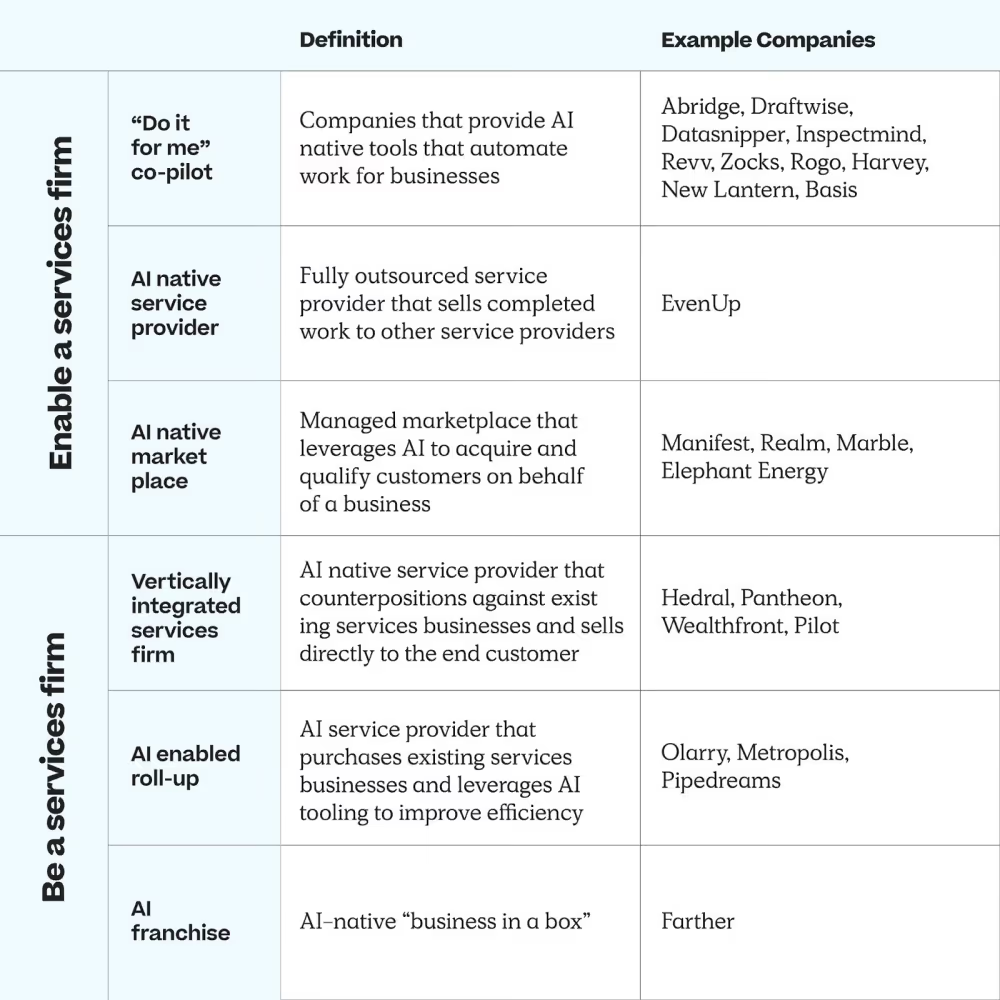
Each of these categories have distinct advantages and disadvantages. In this article we’ll give an overview of how we evaluate each.
Enabling Service Providers
“Do it for me” co-pilot
The AI co-pilot is the most popular business model we are seeing early stage vertical AI companies pursue today. These companies have all the advantages of traditional software businesses: high margin, recurring revenue, sticky (ideally), with seemingly easier sales cycles than their vertical software predecessors.
Co-pilots are especially attractive for companies that serve SMB and SME customers, as the breakouts offer a significantly improved ROI compared to traditional vertical software. These companies are growing quickly by automating work rather than providing incremental productivity gains via workflow tooling. Oftentimes with incredibly fast or immediate time to value. We’ve written extensively about this theme in our SMB Tech Installment of Change Order.
On the other hand, co-pilot business models come with their own set of challenges. We’ve seen these business models have two major challenges:
1. User adoption: Co-pilots that require a significant customer behavior change will likely struggle to drive user adoption. We’ve seen the most hesitancy around two themes:
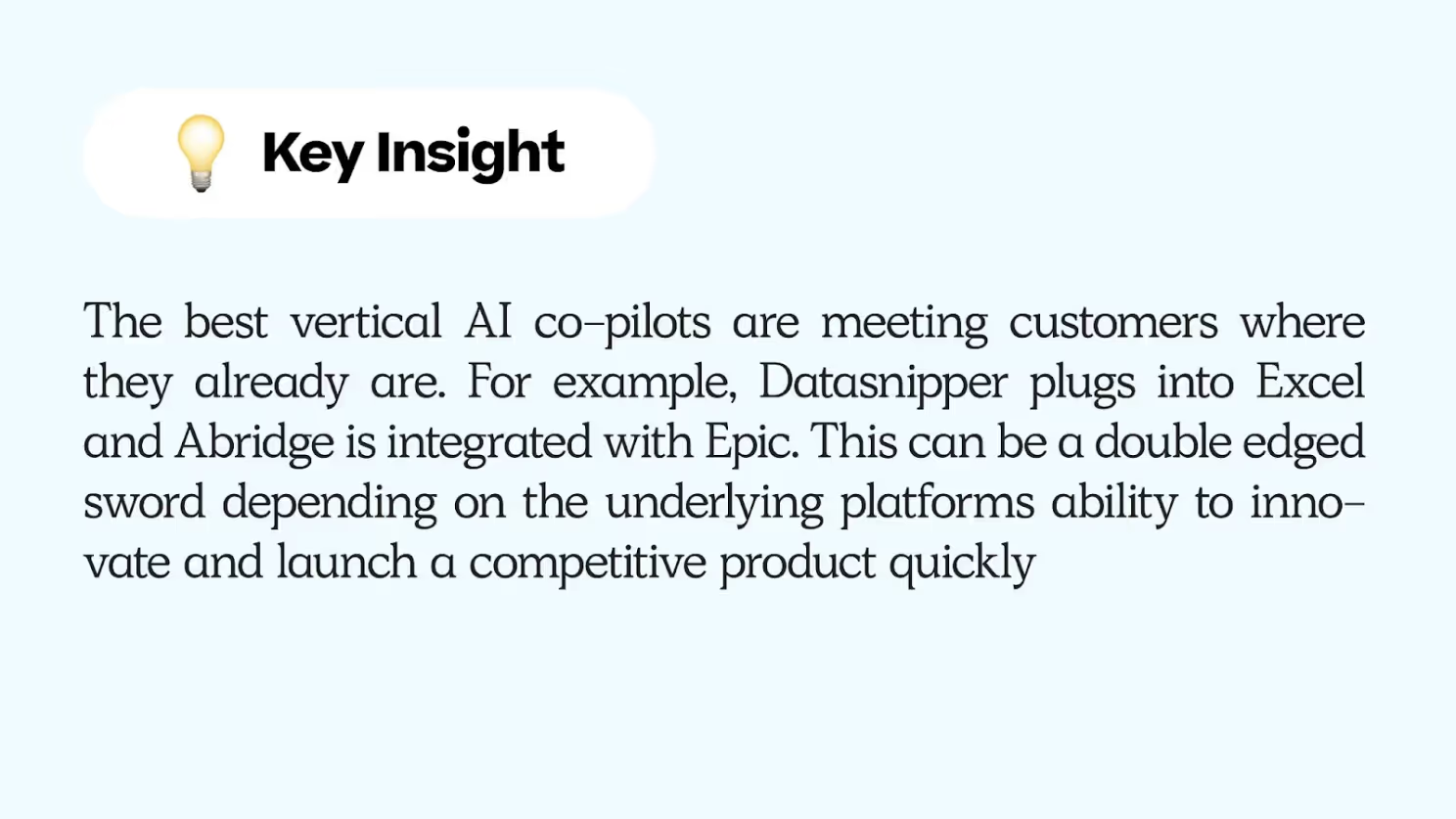
2. Product expansion beyond the wedge: We believe that there will be a massive number of successful wedge products that plug into the system of record and quickly grow to $50m+ ARR. At the same time, we have questions about how many of these companies will go on to become enduring generational businesses.
Reason to Win: The ones that do will have won because the founder determined the second act early into the company life cycle (ideally months or even weeks into launching the wedge product) and had a magical experience for end users from day 1. The profit pool or labor spend that you go after with your second act should dictate your pricing strategy and engineering resource allocation to determine the speed at which you should attack that second act.
Key Risk: The fundamental risk of meeting customers where they already work is that the system of record company can complicate or even turn off existing integrations. They can also launch their own version of your tool. If the end goal is to replace the core workflows of the system of record, vertical AI founders must be extremely clever and move fast in launching new products.
AI Native Service Provider to Other Service Providers
Companies like EvenUp have averted a core challenge of the co-pilot model—end user adoption. They’ve done this by becoming an outsourced service provider and selling work to the services firm, rather than selling software. These companies typically go after the labor pool of spend rather than software budgets. EvenUp, for example, prices as a percentage of a law firm’s existing paralegal staff. Consequently, they are able to drive larger ACVs from Day One, enabling them to grow revenue quickly.
Unlike many co-pilot solutions, service providers often go after enterprise customers first. This is because enterprise customers own a disproportionate percentage of industry data, which is critical for building an early data moat and offering a 10x better service as you go down market.
While these companies can grow fast, they also have two core challenges:
1. Pricing pressure from new entrants: Skeptics say the question surrounding AI native service providers like EvenUp is a lack of defensibility within their wedge product. While locking up enterprise customers and leveraging their data to build a better product gives these companies a strong first mover advantage, we don’t believe that is the sufficient driver of long-term defensibility.
The enduring service providers will have to find ways to build defensibility in their second act. If they don’t, they are likely to be undercut on price by new entrants and ultimately suffer from thin margins driven by downward pricing pressure.
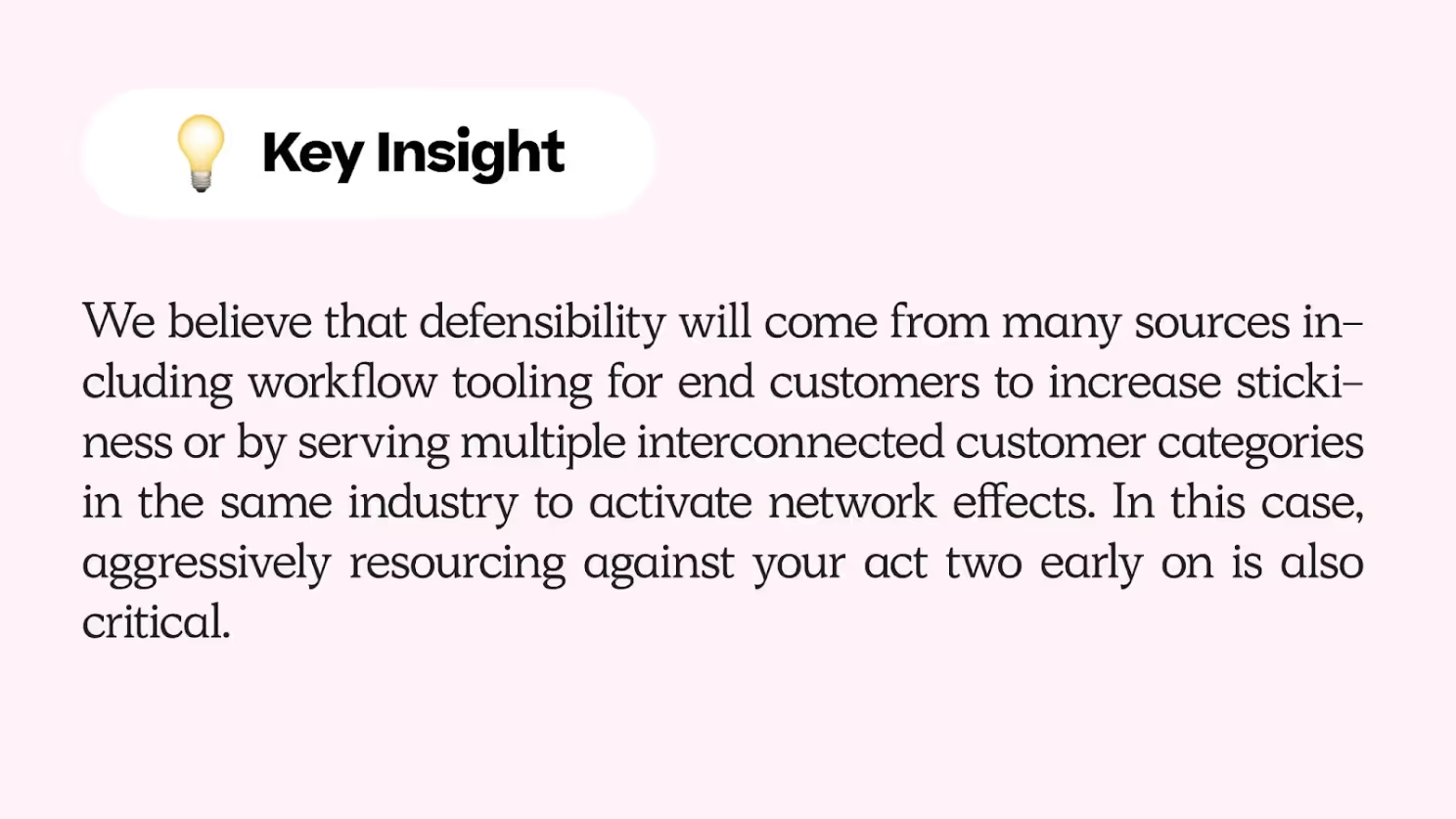
2. Operational complexity: Leveraging AI to build a services business does not negate the fact that it is still a tech-enabled service and may face many of the same challenges that services businesses have always faced. One obvious operational pitfall is lumpy, project-based revenue tied to market cycles. This creates two core issues: The first is around staffing utilization, which when sub-optimized can pull down gross margins; the second is around building a recurring, predictable revenue stream that will be valued at a higher multiple. To date, we’ve found that the best way to drive more predictable revenue is by charging a minimum spend upfront or using a credits-based system.
Ultimately, these companies will need to be very thoughtful in how they manage their “human in the loop” workforce and set up the right data infrastructure to enable their workforce to train the AI models over time.
Reason to win: AI native service providers selling to other service providers should be able to capture more gross profit dollars per a customer than their purely software peers. They should also find acquiring customers a bit easier than software tools as the change management problems they experience from an operational perspective is likely much lower than pure software, especially if their service provider customers already have a budget for outsourcing the specific activity.
AI-Native Marketplace
An often overlooked business model in the Vertical AI landscape is AI-native marketplaces. Once a hot business model in the early 2010s, marketplace investors have struggled to find true breakouts in recent years. Most of the large markets had been won by the time customer acquisition costs leveraging online marketing started to rise. We’re now entering an era where marketplaces can thrive again as AI fundamentally shifts the cost structure in some categories that were deemed too challenging prior.
This business model is relatively less common, though we’ve seen a couple take off and grow very quickly in the legal sector, including Manifest and Marble. Both of these companies are going after micro-SMB or solopreneur law firms who do not have the bandwidth or marketing muscle to spend significant time on customer acquisition.
These businesses leverage AI for customer acquisition, as well as customer success on the demand side and automation of work on the supply side.
By delivering a fully vetted customer (not a lead) and automating much of the low hanging fruit involved in servicing that customer through AI, these companies are able to command high take rates on each “job” they deliver and provide end consumers with a “better, faster, cheaper” option. They’re able to do so because AI enables two important efficiency gains:
- Each of the marketplace’s sales rep and CX agent can handle 10X the amount of customers they were able to before
- Each service provider on the other side (i.e., the law firm) can take on more clients as traditionally manual tasks are automated away with AI
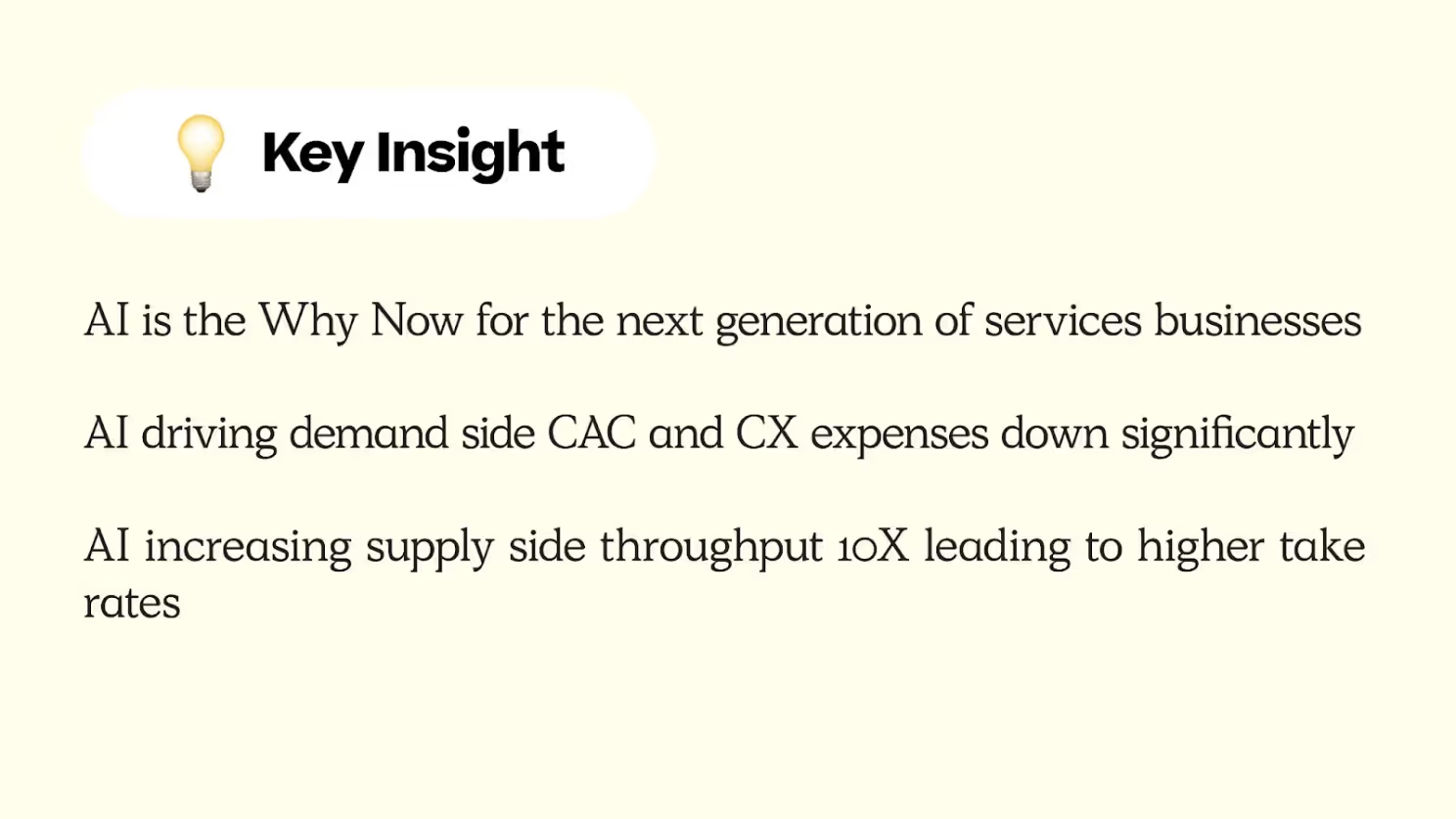
Another key insight that will lead to very strong AI-Native marketplaces is strong cash conversion cycle dynamics. Markets in which the marketplace can collect revenue on day 1, but not pay out the service provider until day 30-90, creates incredible dynamics whereby the company can reinvest the dollars into growth. Consequently they are able to grow very quickly.
In addition, marketplaces have an innate network effect built into their business model. They can also start building strong consumer brands through a high-quality customer service experience and transparent pricing. While these companies can be harder to scale as founders need to acquire both supply and demand, they’re inherently more defensible.
With that said, they come with their own set of challenges:
1. Price compression from new entrants: Similar to vertically integrated service providers, as these AI-native marketplaces start to truly take off, new players will enter the market. While marketplaces benefit from strong network effects, we believe that new entrants might drive up customer acquisition costs and put downward pressure on pricing. The 50%+ take rates we see today are likely not sustainable long term.
2. Bumpy, unpredictable revenue: Depending on the type of service, transactional revenue is typically not as predictable or valuable in the public markets as SaaS revenue. These companies will need to scale to much larger sizes to achieve similar valuations to their SaaS counterparts. The good news is that many of these markets are absolutely massive and represent strong wedges into more recurring revenue streams based on the building of trust with their end consumers (e.g. financial advisors making recommendations for annuities, insurance, etc.). It’s critical for founders to build in marketplaces where there is still a venture scale TAM opportunity even with pricing pressure.
Being a Service Provider
Vertically Integrated Services Firm
Unlike AI Native Service Providers, Vertically Integrated Services Firms are not selling discrete work to an existing service provider. In contrast, they are disrupting that service provider by offering an often cheaper, faster, and/or better experience to the end customer. They are able to do this by leveraging AI to automate away some traditionally manual, time consuming, and expensive processes that are done by humans today.
On the surface, AI Native Service Providers and Vertically Integrated Services Firms share many of the same advantages and disadvantages. However there are critical tradeoffs between being a services firm and enabling them.
Advantages of being a services firm no matter how you do it:
- Owing the profit pool: By being the services firm, businesses own the entire profit pool. You have more control over the core drivers of profitability and can experiment with different tooling to drive costs down over time.
- Capture and create truly complex and proprietary data: Vertically integrated services providers typically develop nuanced understanding of complex processes by having access to significantly more data than either type of Vertical AI business. With proprietary data comes key insights that typically lead to a higher level of automation and a more delightful customer experience over time, all of which are likely to drive true first mover advantages.
- Brand power: By offering a better service directly to end customers, these companies can build durable and lasting brands that users associate with a high trust experience and a quality product.
- Rethinking the end customer experience and internal operations from the ground up: Launching a new services firm means you get to reimagine firm operations and the customer experience. If a services firm charges customers on an hourly basis today, they’re not incentivized in most markets to leverage AI to become more efficient as it’ll impact their topline. When building a new firm, you could easily rewrite the rules and charge on a project basis. Additionally, legacy firms are stuck with old clunky software tools that they’ll likely struggle to replace and sub-optimal processes for their end customer. By launching a firm from scratch, you can fully reimagine operations and pass a lot of that value onto the end customer.
There is a core disadvantage:
- Operational complexity: Being a service provider is fundamentally more operationally complex than enabling an existing firm, especially on the onset. It takes an incredible amount of high quality hiring, process development, and industry expertise. Consequently, the capital requirements are often very high.
- Exit Multiples: Services firms have historically traded at lower multiples than software companies. This may impact a startups valuation in both the private and public markets, as well as deter some downstream investors from wanting to get involved.
Ultimately, founders need to weigh operational complexity with the possibility for larger profit pools and a stronger moat when choosing between becoming a services firm and enabling a services firm.
AI Enabled Roll Up
In order to avoid the cold start problem, some founders may consider purchasing an existing services firm and layering on AI tools in order to deliver a better, faster, and cheaper service. These companies are essentially a Vertically Integrated Service Provider but their core advantage is that they are skirting some of the operational complexity involved with starting a services business from scratch. They do not have to worry about hiring every employee and setting up all new systems; and immediately have access to a wealth of data. Most critically, they are starting with a book of business and from a place of trust with existing customers, which is critical in relationship driven industries like accounting.
They have one core disadvantage compared to Vertically Integrated Service Providers that are starting from scratch:
- They need to master M&A and product simultaneously: While this may seem like an issue that can be solved with the right talent, M&A and product are two very important yet very different core competencies. It’s rare for a founding team to have both. Consequently, many of these businesses may end up looking more like private equity roll-ups than a tech enabled services firm. On the other hand, the team may build great products but acquire bad assets. Either way presents a challenging path ahead.
- Change management: Acquiring an existing business means inheriting existing talent, culture, and ways of working. Large companies often hire slews of outside consultants to enact change management. While the process is usually simpler at smaller organizations, it is still likely to be challenging and time consuming, especially when it comes to digitizing traditional tech laggard industries.
AI Franchise
A third flavor or “being a services firm” is becoming an AI franchise. These founders recognize the operational complexity of building a services firm and instead of trying to scale on their own, they leverage the power of their tooling and brand to drive growth. The core advantage of this approach is scalability and capital efficiency. It’s easier to offload some of the growth and management to entrepreneurs who have expertise in their own markets. Additionally, it’s incredibly powerful in markets where the franchisee takes on some initial capex investments (e.g. robotics or other equipment) vs. the franchisor startup itself. In many instances AI franchises will have higher ACVs than pure SaaS companies selling to the same target customer base if you assume that their “franchise fee” is in line with the franchise royalty rates of today.
However, that same advantage comes with one core disadvantage:
- Quality control: It will be harder for entrepreneurs pursuing this approach to ensure that their brand power does not get eroded over time by sloppy operators. Having strong compliance mechanisms in place and a thorough onboarding process is critical for the success of AI franchises.
While these business models have their own unique challenges, we believe there will be multiple generational businesses built in each of these categories.
Founders who find the right business model market fit and nail their second act early in their company’s journey are poised to win. If you’re ideating or building in Vertical AI, please let us know. We’d love to chat with you!
Vertical AI business model overview
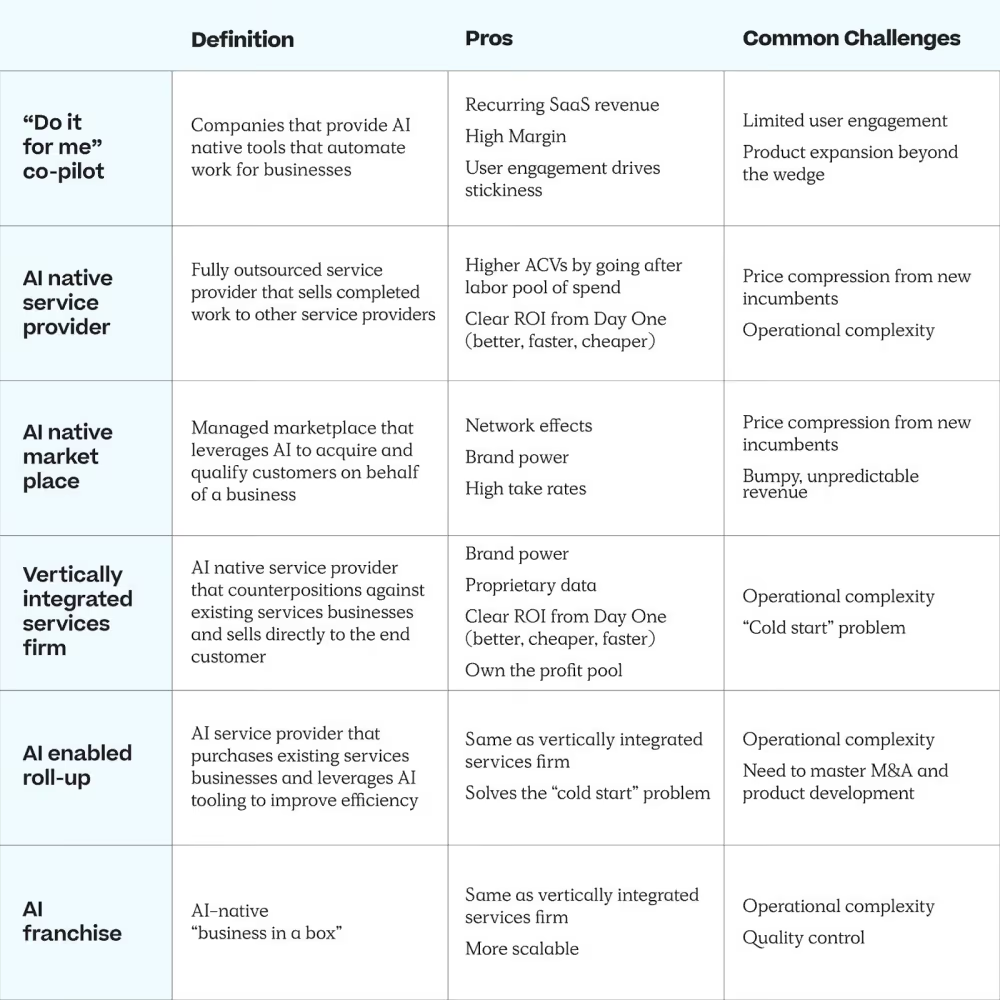

Building quantum's software layer before the hardware arrives
Richard Givhan, CEO and co-founder of Haiqu, is a founder who makes you question industry assumptions. Most VCs dismiss quantum, while semi-informed VCs offer predictable quasi-technical explanations as to why we’re “decades away”. But builders like Richard use first-principles and technical depth to plot a course that will upend convention. “What PyTorch did for AI, Haiqu will do for quantum,” he said, pointing to results whereby engineers were deploying today’s powerful algorithms on quantum computers with Haiqu. It’s the kind of progress the industry has been waiting for.
And it's picking up momentum. Last year marked a breakout year for quantum investments – over $11.6B was invested across public and private quantum companies, compared to only $2.4B the year prior and only $1B the year before that! From venture, quantum saw $4.5B in the last three years vs. $4B total in the 15 years prior.
The market is starting to believe. Quantum computing presents extraordinary, human civilization trajectory changing opportunities. Our world is, in part, governed by quantum dynamics that only quantum computers can reveal. This could unlock hard-to-fathom breakthroughs in areas like energy production and drug discovery. More practically, quantum computing could transform finance and insurance and upend encryption as we know it.
Despite investment and boundless potential, we have not yet reached “quantum advantage” – when a quantum computer can solve a problem faster and more efficiently than a classical computer, though there is debate about whether this must occur on a practical problem. When quantum advantage is reached, and quantum computers are performing economically valuable, practical problems better than classical computers, there will be a deluge of attention on quantum, dwarfing the past two years.
So how do we get quantum advantage? The existing state of deploying applications on quantum computers is challenged – expensive, hard-to-access computers that require experienced teams writing bespoke, non-standardized algorithms. Quantum teams need the right software and frameworks to deploy algorithms on today’s hardware, not waiting another decade. Haiqu provides circuit compression and error shielding software within easy to use frameworks that let teams focus on solving problems instead of wrestling with hardware. With Haiqu, teams can run applications at greater scale and with dramatically fewer computational steps on today’s early, error-prone quantum hardware.
Richard Givhan, CEO and co-founder of Haiqu, has long been captivated by quantum computing’s potential to tackle the world’s toughest problems. After growing up in Cyprus and studying applied physics at Stanford, he joined Creative Destruction Labs, where he teamed up with co-founder Mykola Maksymenko, a former quantum researcher at Max Planck Society and Weizmann Institute, to start Haiqu.
We are thrilled to announce Haiqu’s $11M seed round. We were fortunate to lead the round, with participation from Qudit Investments, Alumni Ventures, Collaborative Fund, Silicon Roundabout Ventures, Angel One Fund, and returning investors Toyota Ventures and Mac Venture Capital. We’re proud to back Richard, Mykola, and the entire Haiqu team in their bold endeavor to enable their customers to reach quantum advantage across every vertical.

Data security rebuilt for companies deploying AI
Data security is a burning problem in the AI age
There is a simple formula for seed investors: big market + strong tails winds + great founder = good investment. You don't know how these factors will play out before an investment, but sometimes they all get better than you had predicted. This is the case with Teleskope. We see no founder who grows as fast as Lizzy. The market she is in could not have better tailwinds. Lizzy started Teleskope to bring to market the data security solution she built while at Airbnb. We all believed that data would become more valuable over time, but then came the latest AI wave and our assumptions exploded. We're thrilled to share that Lizzy and team have raised a $25M Series A to go and tackle what is sure to be one of the most essential categories for the enterprise in the age of AI.
For a long time, data security has been a problem for security teams. Data lives everywhere, spanning SaaS applications, on-prem systems, and cloud resources. This means that data is hard to wrangle, and as a result, organizations risk sensitive data ending up in the hands of the wrong people.
This is not a new problem, but AI has accelerated the severity of it by 100x. Companies today see their data as a core asset more than ever before. They want to build differentiated products leveraging their data, make their enterprise tools more usable by enabling AI search, and fine-tune models for AI use cases using domain- and company-specific data. As companies rush to adopt AI, tools and agents like Microsoft Copilot can now surface sensitive information in seconds—far faster than any human search ever could or any attacker could extract manually—making existing risks of data exposure and breaches much easier to realize. Many companies and security teams recognize this risk and are holding back on AI adoption until they can clean up and secure their data.
This is where Teleskope comes in. Teleskope has built the category-leading agentic data security platform that goes beyond visibility and alerts to help teams actually fix data security issues. It enables CISOs and engineers to act on real risks through agents that learn the company’s policies and context, and through a natural-language workflow builder powered by small language models (SLMs) that drives remediation in milliseconds.
Imagine an internal rule that simply says “whenever PII is shared in Slack, delete it” and implements that rule in real-time. This is what Teleskope enables, across all types of data and applications. This kind of work would typically be impossible for engineers to do on their own, and take hours with existing tools sifting through alerts and doing manual remediations. Teleskope has proven to be a game changer, providing a jaw dropping customer experience to its users.
Teleskope was founded by Lizzy Nammour, who experienced the problem firsthand at Airbnb. She was tasked with getting Airbnb’s internal data GDPR-compliant and IPO-ready, and could not find anything on the market that would help find and remediate the problems. She founded Teleskope out of her own frustrations, and has done a miraculous job scaling the business quickly, delighting customers, and building a stellar team.
Why We Invested
Teleskope is off to the races, with customers like Ramp, Notion and Alloy. One of the most amazing testaments of Teleskope’s impact is the way its customers talk about the product and team. The customer love is palpable, and in our careers we have only come across such enthusiasm from users a handful of times. We’re excited for this fresh round of capital to enable the business to continue accelerating.
The progress of the company so far is exciting, but we are most looking forward to seeing where the business goes. In an AI age, so much manual, wasteful work will be automated. In security, we believe many automation opportunities exist, and data security is a great example. Data security engineers spend much of their time toiling away on manual scripts to solve data vulnerabilities and prevent exploits. In the future, this process needs to be augmented with AI, and Teleskope is positioned to be the agentic data security engineer.
We are thrilled to be collaborating with our friends at M13 and Lerer, along with many fantastic security leaders who are personally investing in this round. Congratulations to Lizzy and team Teleskope!

Incumbents can't follow you into AI-native
In the realm of business strategy, few concepts hold as much transformative potential as counter positioning. Originally articulated by Hamilton Helmer in the book 7 Powers, counter-positioning refers to the strategic maneuver of introducing a new, innovative business model or product that incumbents cannot or will not emulate. This often occurs because doing so would undermine their existing business model.
After incubating two businesses this year, one with the former CEO of Angi and the other with a handful of the largest real estate developers in the world, our goal of this post is to share our playbook with you to find your next counter positioning opportunity to enter into a vertical market.
This post is going to be the first of a multi-part Series where we dive into our learnings in Vertical AI across over 1K pitch meetings, customer meetings, founder and executive interviews across more than a dozen end markets.
What is Counter Positioning?
Hamilton Helmer, in his seminal work "7 Powers," defines counter positioning as a strategic advantage where a new competitor adopts a different business model that an incumbent cannot replicate without suffering significant losses. This forces the incumbent to either adopt the new model and cannibalize their own revenue or continue as is and lose market share. Examples of counter positioning include:
- Netflix vs. Blockbuster: Netflix’s subscription model and online streaming service disrupted Blockbuster's rental business, which relied heavily on late fees and physical stores.
- Amazon vs. Traditional Bookstores: Amazon’s online bookstore with vast selection and home delivery counter positioned against the traditional bookstore model.
- Dandy vs. Traditional Dental Labs: Dandy’s free intraoral scanner program was an attractive value proposition for dentists, but would’ve led to dramatically higher expenses for dental labs who had never provided them before and rarely invested in customer acquisition or tech
How You Can Leverage AI for Counter-Positioning
AI technology presents a unique and unprecedented opportunity for counter-positioning across various industries. Here’s how you can find your next business idea and leverage AI to establish a strategic advantage:
Step 1: Identify the right market
Find services that have been historically priced hourly and are reliant on heavy human labor
AI excels at automating repetitive and labor-intensive tasks.
Interview key buyers at large companies in your markets of interest. Ask them what 3rd party service providers they use who bill hourly, how much they spend on them and how they perform the service.
By targeting industries where services are billed by the hour and require significant human involvement, you can introduce AI solutions that offer superior efficiency and cost savings. This enables you to dramatically undercut on price while having a better margin profile.
It’s easiest to look into end markets where they frequently use BPOs for things like claims processing, scheduling or report writing.
OR
Find markets where companies outsource data processing or other projects on a fixed fee/project basis
Incumbent service providers who are used to charging $30K+/project or $10/job to be done are not strongly incentivized in the short-term to drop their prices, but they are incentivized to leverage AI to improve their gross margins.
In markets like this you can either:
Enable the services firms OR Be the Services Firm
Enabling the services firm (aka selling to them) approaches include:
- Delivering work to the Services Firm, which enables them to scale without adding additional operational complexity for a fraction of the cost - e.g. EvenUp
- Co-Pilots that equip the services firm with tools, which unlocks a massive increase in employee efficiency and helps the business grow their revenue/employee - e.g. DataSnipper, Harvey
- OR Enable net new service providers to counterposition - By selling directly to the service providers just getting started you can enable them to counterposition. This is best in markets where a high number of net new businesses are being started. Companies like Captions have taken off in the consumer world, but we’re also hearing that offshore companies who provide video editing services are thriving leveraging tools like it.
Be the services firm can look like:
- Start a vertically integrated services firm - Selling the AI X Human Support directly to the business and counter-positioning greatly on price (50%+) - e.g. Hedral, Pilot, Invisible Tech
- Start an AI marketplace business - Provide customers/revenue and AI software to the supply side to make them 10X more productive. Force them to use your software when serving the demand side/end clients, which you’ve acquired for them. This is best in market where a high number of solopreneurs or SMBs exist who spend way too much time on backoffice tasks and are historically bad buyers of software. By driving the supply side new business and leveraging a take rate model you’ll be able to make more gross profit per SMB than your SaaS counterparts. - e.g. Manifest and Flare/Marble Law
- Buy + modernize an existing services firm - Improve the businesses EBITDA margins 2X+ overnight and help drive more demand through sophisticated AI-powered customer acquisition techniques - e.g. Metropolis
- Franchise a services firm concept - help people launch their own business in a turnkey way where they can leverage AI to make operating the business 10X easier, while undercutting competitors on price and experience - e.g. Farther
Step 2: Analyze the market structure
Is this a fragmented market with lots of Mom and Pops providing the service who use onshore labor?
Or is it a market with sophisticated, scaled players who efficiently leverage technology and offshore labor to drive the COGS down already?
The more fragmented and less sophisticated the market the better.
Step 3: Analyze the role AI can play
Talk to experts in the market to understand how the service is specifically delivered.
Perform a process, task and communication mining exercises where you map out how the service is actually provided.
Then think through this question:
How can I introduce human-in-the-loop products that are better, faster, and cheaper into a great market?
Combining AI with human oversight via a service or co-pilot can result in products that outshine traditional services on multiple fronts. You want to find jobs to be done that will result in:
- Better Quality: In markets where accuracy is crucial, AI can deliver superior quality. For instance, image recognition technology powered by AI can outperform human capabilities in terms of speed and precision, proving invaluable in fields like medical imaging and security (e.g. Verkada, AmbientAI).
- Faster Service Delivery: In industries constrained by human labor supply, such as healthcare and legal services, AI can significantly accelerate processes. Moreover, markets that require extensive licensing and training (e.g., specialized medical practitioners, architecture and engineering ) can benefit from AI-driven solutions that bypass these constraints with signoff by a licensed professional (when allowed), providing faster service delivery when the human can play more of a quality assurance role.
- Cheaper Cost: Identifying and targeting major cost components in traditional business models can yield substantial savings. For instance, AI-driven customer service solutions can reduce the need for large call centers, cutting down on overhead costs while improving response times and customer satisfaction.
Step 4: Figure out if it is a Great Market, not just a good one
A million opportunities exist out there, but you can only choose one. The difference between a good market and a great market will ultimately decide your longterm enterprise value. So what do we think makes a great market?
Better quality leads to 10X+ ROI, preferably driving revenue
Markets where higher quality results will lead to a significant ROI are great. Examples include:
- AI medical billing leads to higher collection rates
- AI procurement leads to more price transparency and immediate savings
- AI call answering increases conversion rate of customers leading to more revenue
Faster Service Delivery leads to better returns or cash flow
In real estate for instance, developers find themselves consistently waiting for service providers to deliver their product. This delay creates a drag on the internal rate of return (IRR), so speeding things up for them will make them look better in the eyes of their investors.
Similarly, many businesses have challenging cashflow dynamics whereby they have to pay their employees every other week, but do not get paid by the end customer until the project is completed. In instances where you can expedite service delivery, you might be able to radically improve the cash flow of the business and reduce the stress levels of the owner.
High immediate savings in markets that clearly flow right to a tight bottomline
Markets where margins are very tight and you are able to quickly and predictably reduce the cost of a major line item are bound to see a lot of demand.
If companies are running at 15-35% gross margins or 5-15% EBITDA margins, and you can provide them with a major expense at 50% of the price, the demand will come either way.
The Real Winner: Obvious workflows to build into post service delivery
This is the major key! A great AI powered tech-enabled service company or Co-Pilot will watch its margins get compressed over time if it cannot figure out a way to build stickiness.
An ideal scenario would be that the service is delivered via a proprietary workflow platform that involves multiple stakeholders in the company (or outside) receiving the service who are then able to leverage the platform to complete downstream tasks .
Conclusion
AI is poised to create the greatest counter positioning opportunity of our lifetime.
By understanding and strategically applying AI to disrupt traditional business models, you can achieve a competitive edge that incumbents find difficult to replicate.
Whether it’s through improved quality, faster service, or cost reductions, the potential for leveraging AI with counter positioning is immense.
If you’re embracing this transformative technology to redefine an industry we want to talk to you! No matter what market you’re playing in, as we believe the opportunities are endless.
.avif)
Interoperability Is a Huge Challenge—and Opportunity—in Supply Chain
If you’ve ever worked in a logistics or manufacturing centric role, you know how much of a hassle it is to integrate new products and share data with customers and vendors. You’ve lived in a world of inbox anxiety and waited for painstakingly slow EDI integrations to get built in exchange for an arm and a leg. The brave entrepreneurs who have tried to bring new supply chain software to market also know the pain of integrating with legacy supply chain systems, and many of them have failed trying.
This challenge will only become more acute given the macro forces driving change in supply chains. As companies work towards building more durable supply chains, they will have to add more workflow software to their supply chain stack, work with more supply chain vendors, and move a lot more data. Whether you are a software startup looking to build on TMS data or a logistics company looking to build EDI integrations with customers, we think that supply chain interoperability is going to continue to be a huge but essential challenge. Solving it will be critical to meeting global demands for supply chain durability.
We've seen plenty of startups building unified APIs for specific pieces of supply chain data. These opportunities have all been difficult for us to get excited about because they are either too niche, not defensible, or heavily service-oriented. That said, we know that building these integrations is a huge pain point for software players in the supply chain stack and vendors and customers in supply chain orgs trying to integrate with each other. In this piece we’ll break down the different integrations that are needed in the supply chain, the players that exist in the space today, and where we see opportunities for new, venture scale businesses.
Complexity of supply chain data sharing
There is a flood of software adoption and new partnerships being formed in supply chain organizations, but a real lack of infrastructure to stitch all these systems together. Other industries have seen similar problems in their software maturity curves and many a unicorn has been born out of solving those problems. Plaid famously aggregated consumer banking data from thousands of banks and made it available through a universal API, which enabled the birth and success of countless consumer fintech applications. These applications would have otherwise died spending resources on integrations, each of which would only give them access to slivers of their potential customer base.
The data sharing needs of a modern supply chain include a huge number of participants, each with their own tech stack. A large enterprise will have horizontal ERPs (Oracle, SAP, Netsuite, etc) and data warehouses (Azure, AWS, Snowflake, etc) that need to connect to their core supply chain management systems (TMS, WMS, etc). They will also have additional supply chain analytics and execution applications (Lyric, O9, GoodShip, Loop, Parade, Project44, etc) that need to integrate with their core systems. Then on top of that they need to connect with all their suppliers, customers, transportation vendors, and more.
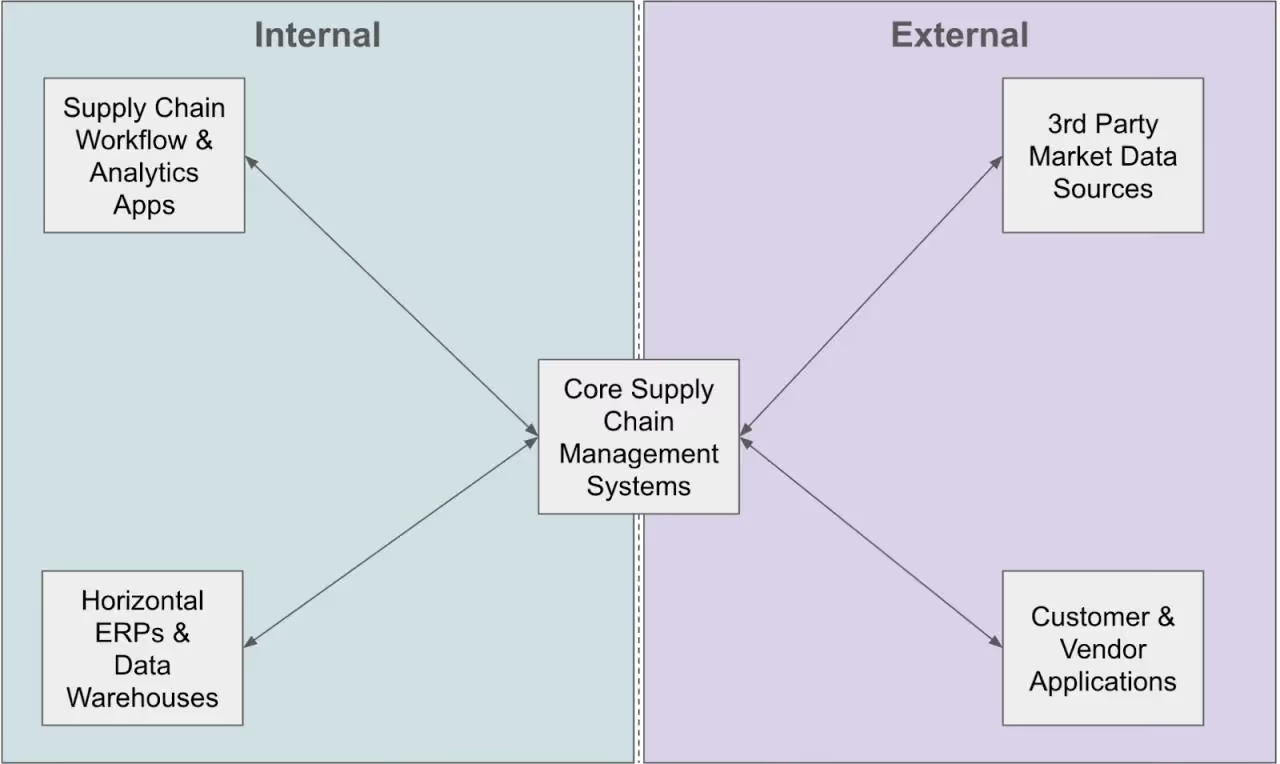
In the graphic above, we’ve laid out a very simple illustration of how various nodes of the supply chain system must come together. In reality, though, with all the different tech stacks at play, the data sharing needs look much more like the brutally complex, spiderweb system here.
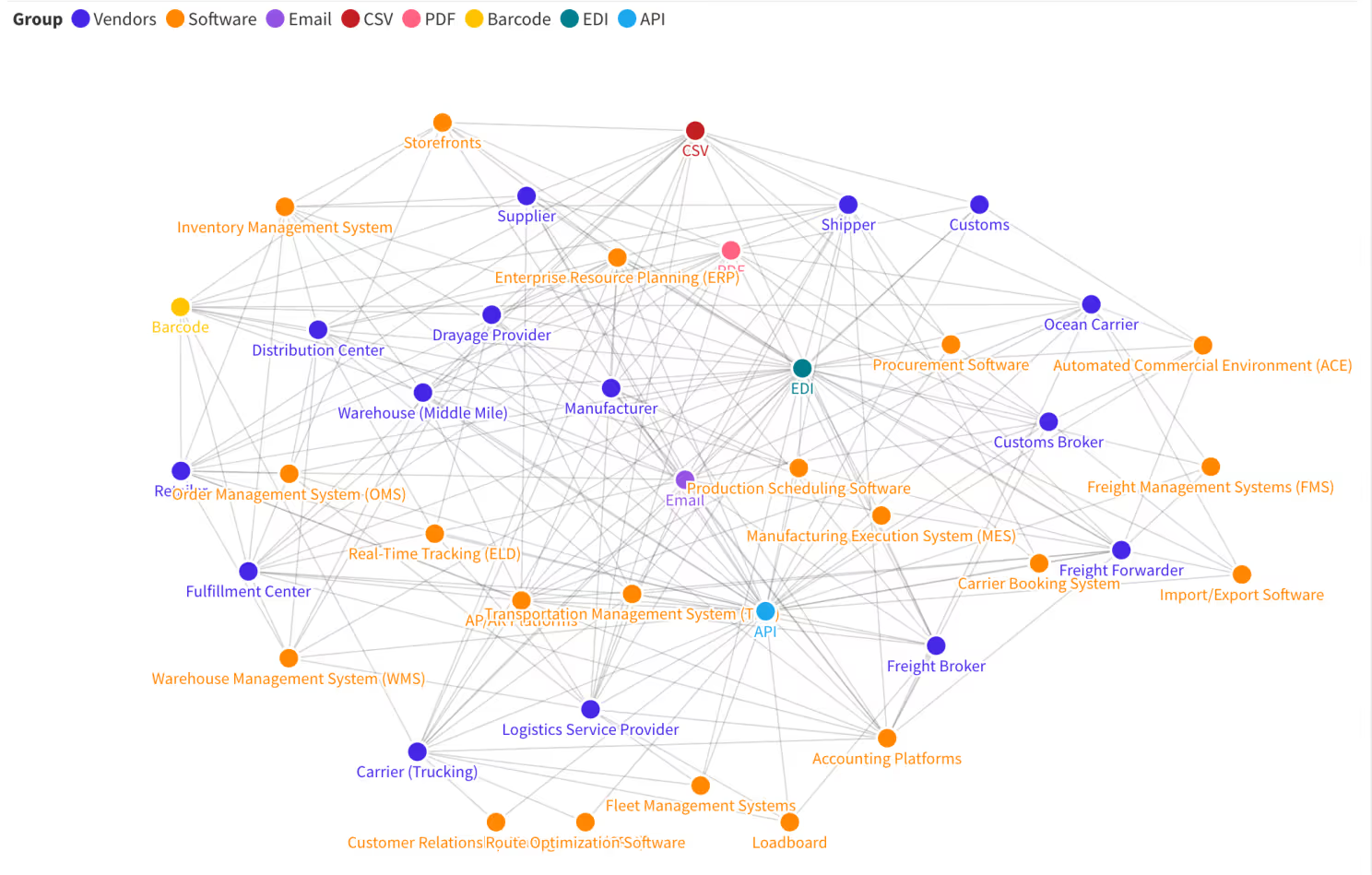
An interactive version of the image above can be found here.
How integrations are getting done today
There are a lot of solutions in the market today that address supply chain infrastructure. Most of the incumbents in this world are integration service providers that come in two main types: turnkey development tailored for businesses and iPaaS (Integration Platform as a Service). Both primarily target business teams as their core users, handling internal and external business logic to establish data mappings, which are then passed on to engineers. These solutions are beneficial for teams with limited engineering resources and therefore common in transportation and manufacturing spaces. Their effectiveness, of course, relies heavily on customer service. Those who have executed integrations through this method can confirm the considerable time investment involved, often posing more of a project management challenge than a technical solution.
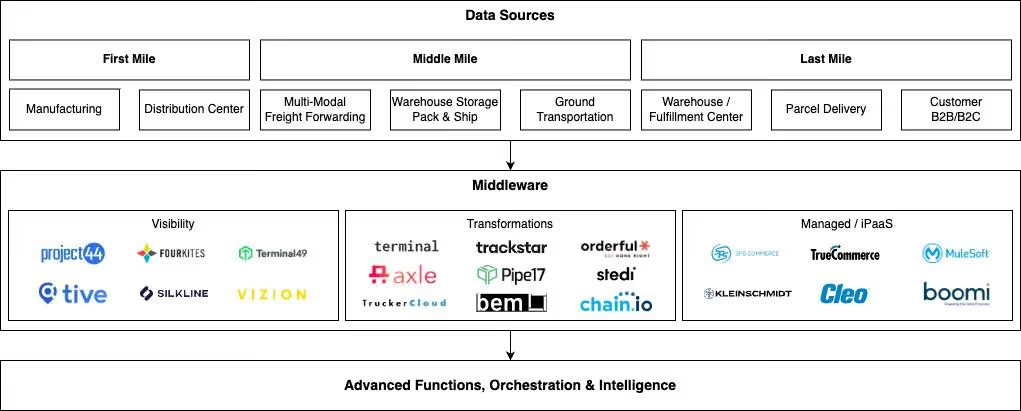
Startups are adopting an alternative approach by developing API-first solutions tailored for engineers. These solutions are typically categorized into two types: visibility aggregators and vertical-specific transformations.
Visibility aggregators, like Project44 and FourKites, consolidate data from various third-party sources to construct comprehensive datasets that companies can utilize to track the location and transport status of their goods. On the other hand, vertical-specific data transformers concentrate on standardizing data within specific industries, such as ocean freight or direct-to-consumer fulfillment, offering a unified access point to multiple platforms, allowing companies to easily transact across many platforms in the same way. We’ve noticed the first wave of data transformation startups in this space have still required a significant amount of professional service support to scale. That said, there is a new crop of universal API for “x” companies that have raised recently that stand a good chance of being lower touch and developer-facing. Companies in this batch typically focus on smaller opportunities when getting started and have frequently struggled to find ways to expand their footprint across the supply chain stack.
Where opportunities exist
We're trying to look at the opportunity more holistically, by seeing what consistent data is needed by all players across the supply chain in each of their stacks. We think the basics of a great universal connector business is likely there. This confidence is born of three reasons: 1) there’s a big market of customers who need this data, 2) a lot of systems that need to be connected leaving room for a first-mover moat, and 3) there are consistent data structures needed across each of these systems. We believe that to achieve venture scale, you must set the standard for all data flows, rather than just being a piece of the puzzle.
We believe there are solutions that transcend the multitude of file formats and custom integrations required to manage a supply chain tech stack in today's landscape. Despite the complexity of systems and vendors, the data needs are fairly consistent. Supply chain data centers around quotes, orders, order statuses, invoices, and partner information. This is of course a simplification of all the different end points that would be needed to build a universal integration platform for supply chain, but that consistency tells us that it’s actually possible for someone to aggregate data from a lot of systems and deliver value to a lot of customers. The harder part will likely be building all of these integrations and deciding which systems and customers to target. We are convinced that there is a substantial opportunity to harness generative AI to significantly diminish the overhead associated with building integrations. We’re less confident on which systems and customers to target. We have some ideas, but would love to hear yours. If building at the intersection of data infrastructure and supply chain gets you excited (how could it not??), don’t be a stranger!