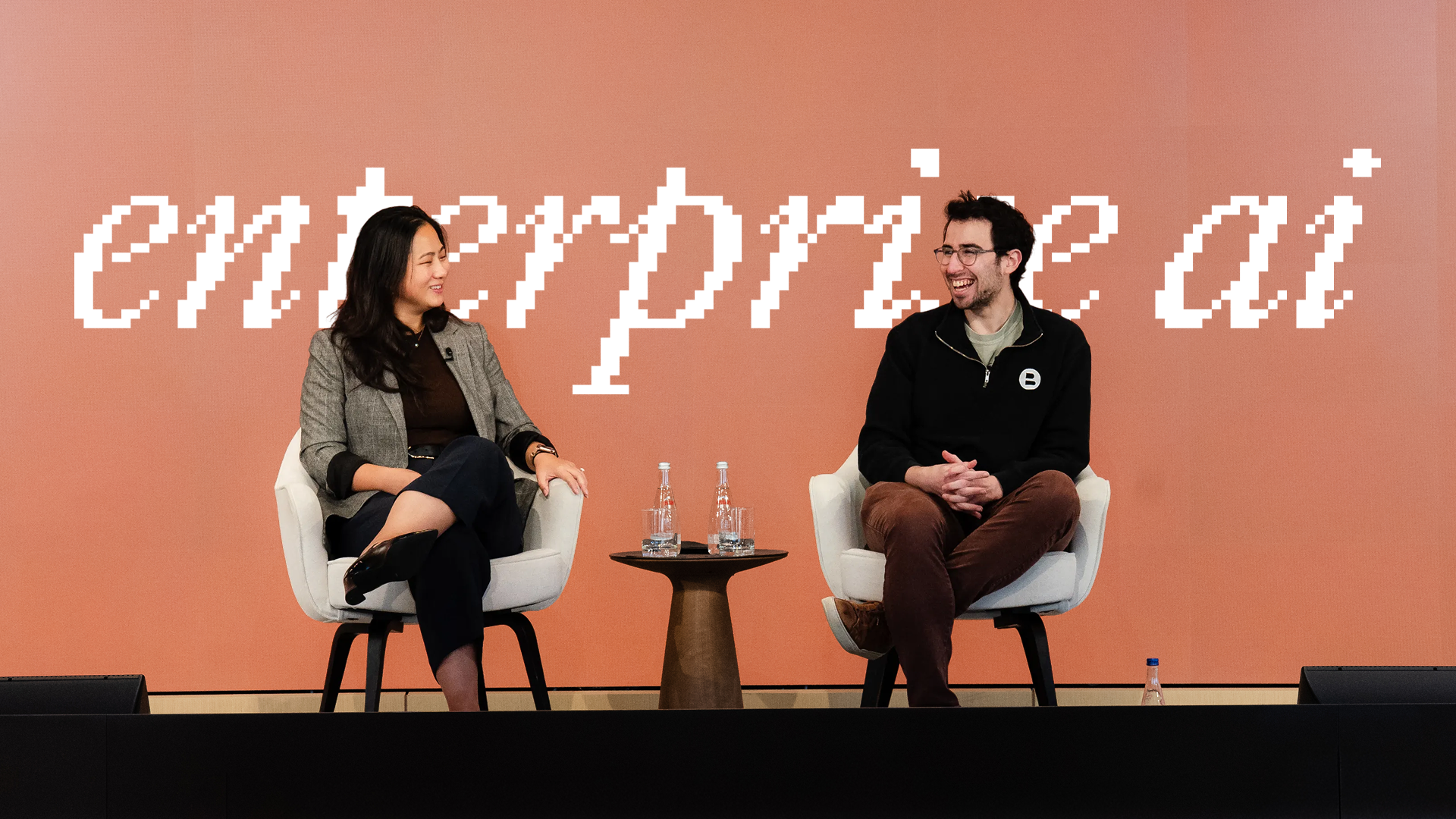




On September 15, we hosted our inaugural Enterprise AI Forum, to bring together a room of 100+ enterprise buyers together with the practitioners getting their hands dirty to talk about where we are in the enterprise adoption curve and to get to hard tactics to drive real adoption and ROI.
The bottom line is that we’re still in the earliest innings of AI diffusion today. Between security requirements, data hygiene, There were interns winning company hackathons. Law firms taking on work they once couldn’t justify. An accounting AI that could give the right answer and still fail its test. Alongside those examples came a more difficult conversation about what it takes to get beyond a promising demonstration.
Here’s some of the core takeaways from the leading adopters and builders of AI on how to drive the right conversations internally.
01 / ADOPTION
Saying “we use AI” can mean a wide range of things
Ara Kharazian, Ramp’s lead economist started the day by showcasing how different the degrees of adoption were in companies that identified as AI adopters. In the spend data he presented, the difference in monthly spend per employee between the median company and the top 1% of businesses was a staggering 625x.
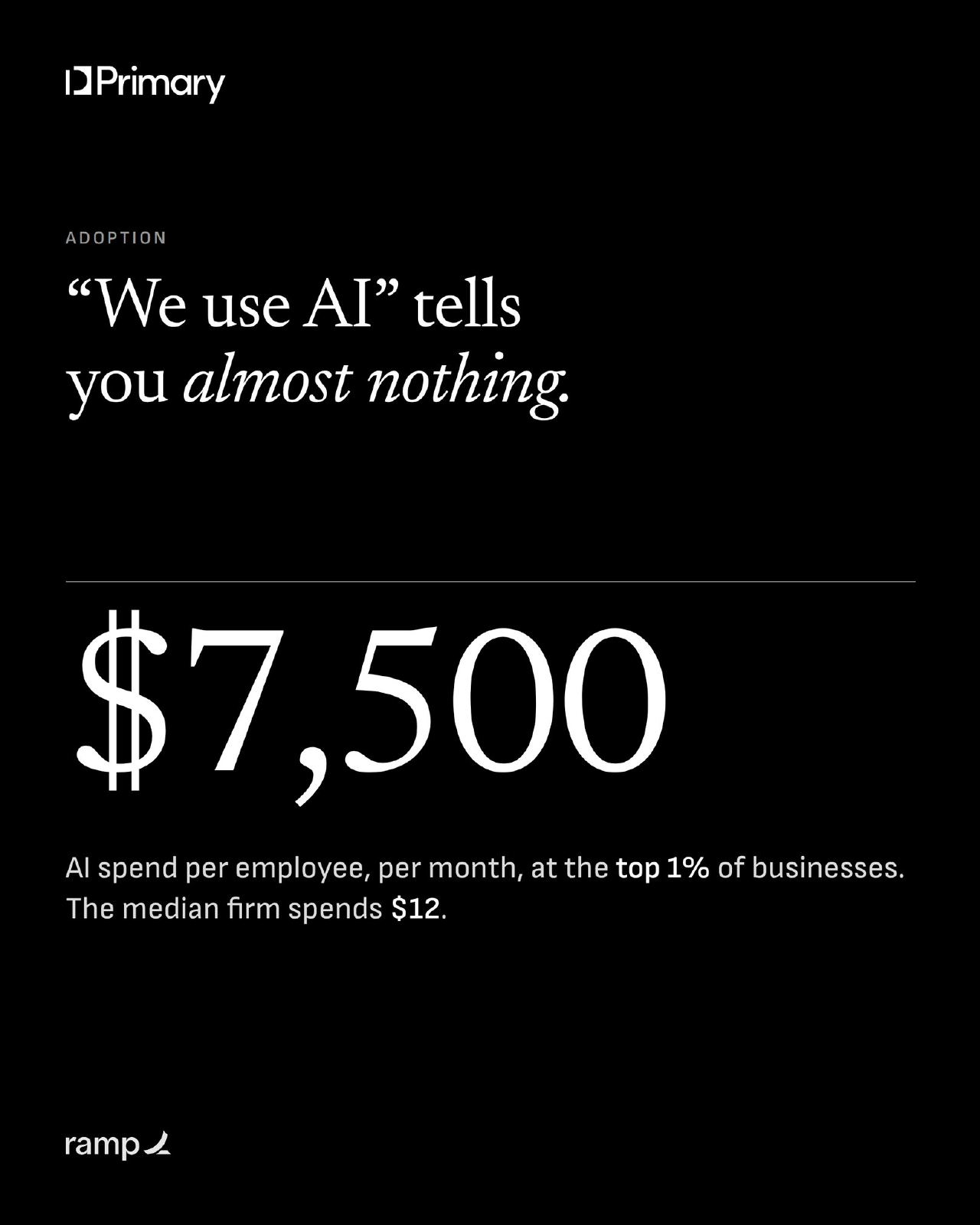
This just shows how big the gap between “AI Adopter” and “AI-Native” companies are today. All the companies in the set can all answer “yes” to the same adoption question but the degree of commitment and usage is worlds apart.
When it comes to hiring – counterintuitively, the data shows that the biggest users also hire more and faster. Among the heaviest adopters (top ~1/3 by AI spending per employee) headcount was an estimated 10% higher relative to the comparison group.
That doesn’t establish that AI caused the hiring but it does suggest that we are not yet seeing the tradeoff between AI usage and hiring. Kharazian’s interpretation is that heavier adopters are putting coding agents, APIs and multiple models to work across the business to do more than before with a smaller base of people but still growing.
The bottom line is that AI adoption is here but it is by no means evenly distributed. We need better metrics to understand the degree of adoption and usage there is before it’s possible to have a real conversation on ROI.
02 / CONTEXT
Data and context is the single biggest bottleneck
Many enterprise buyers procure a solution and expect this to magically drive ROI but soon realize that their ability to give the AI tool the data and context that it needs to be useful are woefully underdeveloped.
On our “Crossing the Chasm” panel, Alex Lindahl of Clay (who writes extensively about this in his newsletter) described a common pattern where customers discover this problem during implementation. They identify a workflow they want to improve with AI, then realize the underlying data and context aren’t ready to support it. Choosing the use case and finding the right vendor is only the beginning; someone has to work out what information the task requires and how the tool will get it.
Rogo’s James White quantified this – reporting 60% higher usage among enterprise customers that had connected their own data. This is all material a banker already works with: CRM records, Outlook and SharePoint. It’s just fragmented across a bunch of different systems. The right way to think about it is if the ultimate aim is for the tool to be able to do a (in this case) banker’s work, it needs to easily be able to get access to all the same information and tools the human would.
White recommended assigning an individual owner on the business team to that work who is responsible for coordinating between security, technology and business stakeholders. In practice, the business team needs to identify which information matters, the technology team needs to establish how to connect it, and security needs to determine who should have access. Integrations alone aren’t enough.
Two firms can buy the same product and get very different value from it because one has made its internal information accessible and the other hasn’t. That work should be part of the pilot. Otherwise, a disappointing result may tell you more about the information the tool was given than its ability to do the job.
03 / LEADERSHIP
Your executives need to use the product
A lot of enterprise AI initiatives have come from top down mandates where the C-suite are championing AI transformation and driving adoption of new vendors and tooling. That creates a disconnect when they’re not the users day-to-day.
Patrick Forquer, Chief Revenue Officer of Legora, reported that adoption was 3x higher at firms where more than 70% of the leadership team was an active user of the product. His point was that employees take their cues from leadership. A partner who uses the tool themselves and shows an understanding of the capabilities (and limitations) is a much cleaner signal than a purchasing decision.
Forquer also does not recommend pinning responsibilities on a single resident AI expert. Having someone who can answer questions is helpful, but each user still needs to learn how to apply the product to their own work. As a result, Legora trains partners alongside associates, molding the product to the firm’s approach to drafting and research so that people can practice on tasks they recognize.
Once partners get comfortable with the product, they often become its biggest users and champions. So it’s important that if procurement is top down, executives are bought in and using the product as well.

04 / EXPERIMENTATION
Make room for everyone to experiment
At three recent enterprise hackathons described by Lauren Rhode from Lovable, an intern's idea won. Lauren described this as the people closest to the problem finally being able to build the solution themselves.
AI is leveling the playing field around who gets to dream up and ultimately test an idea and it empowers anyone in the org chart to be actively building new solutions, regardless of technical background. To drive transformation, organizations need to be actively encouraging creativity.
One easy way to do this is to create room for learning and building: trying an early version on real work gives the team something concrete to assess and improve.
Getting there takes experimentation. Lauren said Lovable users tend to iterate through a few early builds before arriving at something useful. Once a build becomes something that is ready for other colleagues to use, someone needs to take responsibility for supporting it. Lauren described an operations layer that can take early builds from individual teams and prepare them to run real, ongoing parts of the business. That could include checking how the app handles data, deciding who maintains it and making sure there is someone to fix it when it breaks.
05 / COST
Your vendor’s token bill may soon become yours.
CJ Gustafson of Mostly Metrics brought a warning for anyone buying software: pay attention to who is absorbing the cost of running it. While the vendor might be footing the bill for now, that’s unlikely to last for long.
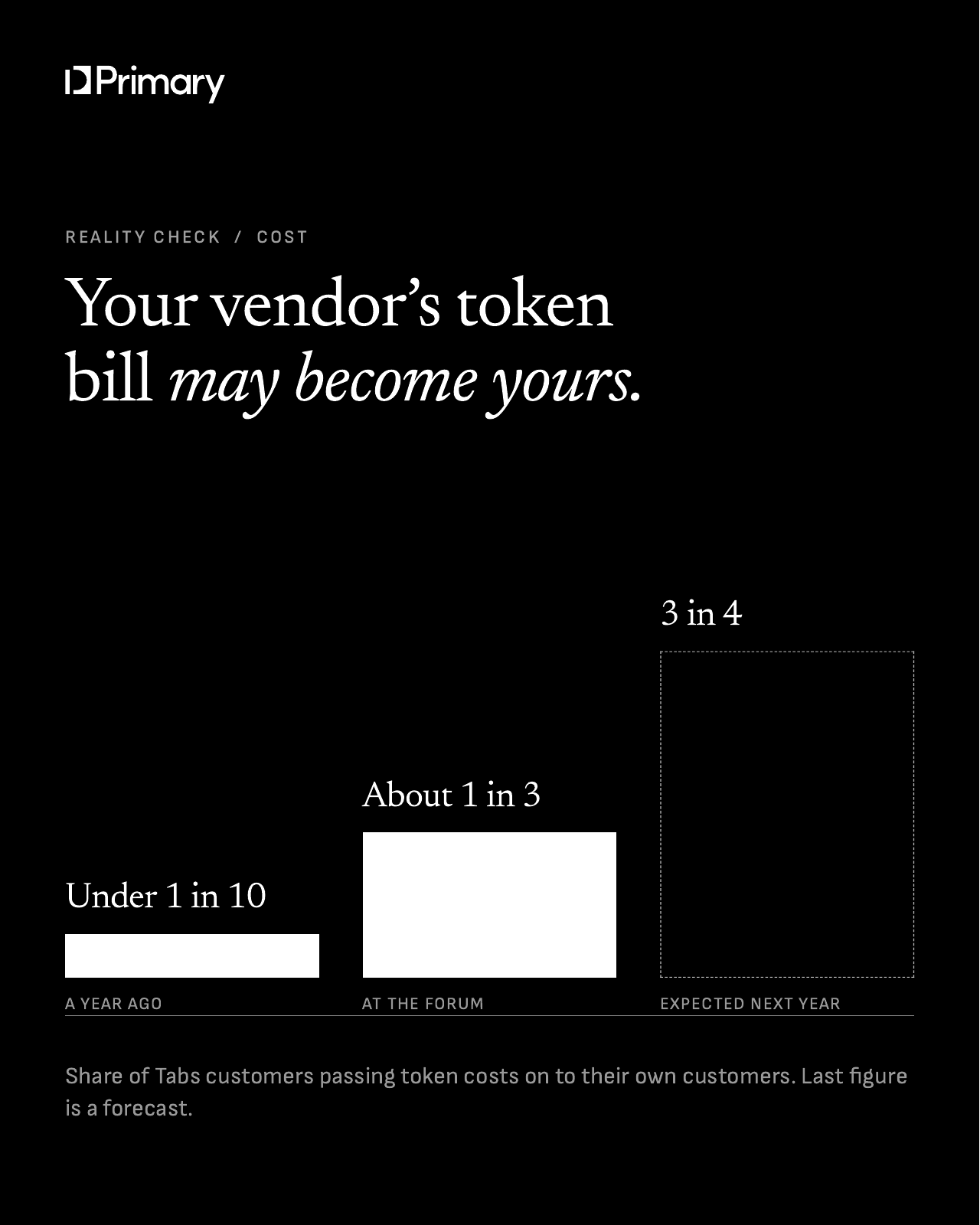
Source: CJ Gustafson, recounting his conversation with Ali Hussain of Tabs.
Gustafson’s broader budgeting advice was to look at teams and roles, where usage differs, and connect the spending to the outcome that function is supposed to produce. That makes a more revealing conversation than treating a growing token bill as proof that the company is getting better at AI.
06 / CAPACITY
Measure how AI efficiency is unlocking capacity that was previously too expensive.
When AI lowers the cost of delivering a service, it can change which work is worth taking on. A smaller engagement that previously required too many expensive hours may become attractive.
Orrick’s Samir Bakhru described how AI was allowing the firm to take on more work that they previously had to turn down. Lower delivery costs can change both the size of the market and who competes in it. If some of those savings reach clients, work they previously couldn’t justify paying for may become affordable. At the same time, smaller engagements may become attractive to larger firms that would previously have turned them down. The growth opportunity comes from both serving new demand and competing for business that used to belong to a different part of the market.
This does however bring up a training problem for highly specialized "apprenticeship" type career paths. Some of the work moving to AI is also the work that helps junior lawyers learn. A task can become cheap to automate while remaining valuable as training.
Companies will need to decide how to balance wanting to drive higher efficiency and throughput and making sure more junior employees still get the reps and experiences to effectively develop.
07 / DECISIONS
There is a whole world of use cases beyond operational efficiency
Some of the most consequential work in a company happens before there is a task to automate: choosing which product to build, how to price it or which customers to pursue. Those decisions are often made with incomplete information because researching every option would take too much time and money.
AI is opening up new ways to explore those choices. Joon Sung Park of Simile described how teams use simulation to test product ideas and rehearse earnings calls, anticipating reactions from customers and analysts. By modeling how people are likely to respond, these simulations help leaders explore more possibilities and understand the potential impact of their decisions before making them.
The broader opportunity is to lower the cost of investigating an idea. A team could compare more product concepts, explore different customer reactions or rehearse a consequential conversation before committing to an approach. Ideas that would never have justified a formal research project become possible to examine.
AI is not just revamping operational workflows and driving efficiencies on top of existing workflows – the new capabilities are also opening up new avenues in terms of the ways work is done. Routinely conversing with peers across the industry will help surface new applications and what is possible.
08 / TRUST
AI giving a correct answer may still be a failure if the process was not
Mitchell Troyanovsky of Basis described an accounting agent that could answer a tax question correctly and still fail its evals. If it relied on Wikipedia or pulled information from what the model already knew (vs. consulting the appropriate primary sources, regulations, and form instructions), Basis would treat that as a failure.
Like elementary school teachers that drilled “show the math” – the process and steps by which an agentic system gets to an answer is just as important to validate and pressure test as a the outcome itself.
This is to drive higher reliability and ultimately trust to take your hands off the wheels. Getting one answer right tells you little about whether the system will handle the next question properly. Checking which sources it consulted and whether it followed the required steps gives you more evidence about how it will perform across different assignments.
Troyanovsky compared this with how people learn to trust a colleague: through repeated work and seeing whether they take an approach you can rely on.
This suggests that when evaluating AI systems – ask the vendor to walk through a task, including the sources consulted and the checks performed before delivering the result. The work needs to be inspectable by someone who knows the subject well enough to challenge it.
If you’re an enterprise leader making decisions about AI, we want to hear from you. Email emily@primary.vc to join our next Enterprise AI Forum.