




Labor constraints and shortages are a permanent feature of US healthcare. Over the last hundred years, the system’s response to these constraints has been the same: when the healthcare system runs short of one kind of worker, it mints a new one. Physician assistants and nurse practitioners came in 1965. Then medical assistants and community health workers in the decades that followed. This approach clearly didn’t solve healthcare access or cost in the US, but each new tier of providers did enable specific workloads to be spread across varying levels of training and licensure. The result was leverage, expanding the effective output of a holistic care team.
Agentic AI is the next iteration of a new “medical provider” entering the system and creating leverage. But, the implications are much larger than in the past. Democratizing access to the best medical care, for pennies on the dollar, will structurally shift the global healthcare system. If the cost of care compresses to the cost of compute, it’s not hard to suddenly imagine millions of newly minted clinical agents delivering specific clinical work across the world.
To reach a multi-agent care future, we need to ask the same question that the US healthcare system has asked in the past, “What work can and should be shifted to this new medical provider?”
To do this, we went deeper into specific clinical roles across healthcare to better understand where there are actual opportunities to deliver care agentically and the potential business impacts of doing so. Making this a reality is multi-faceted, nuanced, and complex. We are not attempting to answer every question here, but we know this is a topic worth exploring.
The future of clinical AI is clear. Software won’t just assist the clinician. Agents will deliver care and create true leverage in the system. This will not hollow out the practice of medicine. It will instead return time to providers, increase the quality of care for patients, and make medicine more human.
The clinical AI opportunity
Today, when people talk about clinical AI, they start in the wrong place. The conversation often starts with the same number: over $1 trillion of annual clinical labor spend in the US. But, not every minute or dollar of clinical labor is equally exposed to AI.
An ICU nurse still needs to be at the bedside. An anesthesiologist still needs to administer drugs in the OR. A phlebotomist still needs to physically draw a patient’s blood. Even if AI models get dramatically better (which we have no doubt they will), large portions of clinical labor will remain tied to physical presence, licensure requirements, and workflows that simply cannot be automated. Robotics could eventually change all this, but that’s a separate topic.
To find where the real leverage sits, you have to go role by role and workflow by workflow to identify the work AI can realistically manage. Based on the work we've done, we believe there is ~$425B of work that can be directly affected by AI today. It is not perfect, but we use dollars as our proxy for AI exposure and impact on the US healthcare system, given it’s an indication of time and labor today. The the reality is that AI could both increase healthcare spend by generating more billable care in some case, while also reducing spend in other scenarios.
To get to $425B, we split the $1.05T of clinical labor into four buckets:
- Physicians (~1.1M practicing physicians and ~$350B in wage spend):
The largest line item per worker, roughly 20-21% of national health expenditures, the only group that bills the bulk of clinical encounters directly
- Advanced practice providers (~740K NPs and PAs and ~$65-100B in wage spend):
Billable in most states under varying scope-of-practice rules, often supervised, often the marginal unit of throughput growth in primary and specialty care
- Nurses (~5M RNs, LPNs and $375B in wage spend):
The largest clinical workforce by headcount
- Allied health and medical assistants (10M+ workers across dozens of professions and $200-300B in wage spend):
Radiology and lab techs, MAs, therapists, phlebotomists. Labor-intensive, fragmented
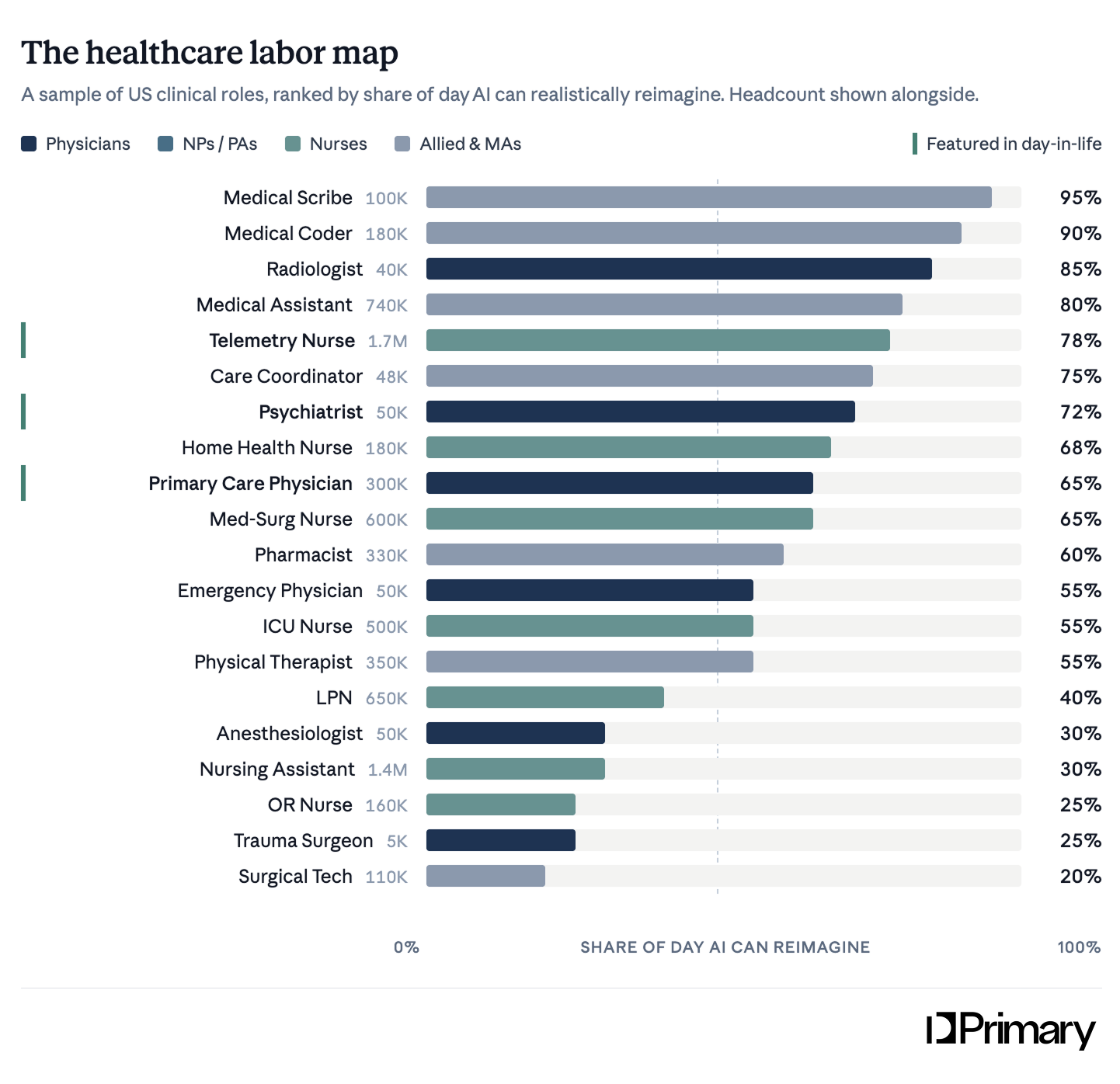
For each medical provider type, we broke the average workday into 6-8 core workflows (documentation, patient encounters, procedural work, monitoring, inbox, prior auth, coding, coordination, etc.), estimated how much of each workflow AI can realistically reimagine, and then weighted each by how much of the day it consumes. We then repeated the exercise for specific roles inside each bucket, since the average hides big differences (e.g. a radiologist’s job could be impacted more than a trauma surgeon's). The map below ranks ~20 clinical roles by how much of their workday AI can reimagine. Our approach isn’t perfect, but we think it's directionally the right way to think about this.
Managing multi-agent care
Pushing deeper into the world of autonomous clinical agents, or as we are calling it “multi-agent care,” we look to software development as a mental model for how the world will continue to evolve. Despite the proliferation of amazing coding agents, the job of a software developer is far from dead dead, but it's very different than it was a few years ago.
Top engineers now manage tens, if not hundreds, of different agents at a time. Each agent is specialized and hyperfocused on a specific task at hand. The writing of high quality code is more accessible now than ever before as developers oversee and guide these agents. Many of the tasks, or workloads, associated with the medical field are based on interpreting a combination of text, voice, and imaging, tasks all particularly well-suited for large language, vision, speech, and multimodal models. Software engineers have orders of magnitude more leverage today than ever before. Why can’t medical providers?
It’s not a 1:1 analogy (clinical work isn’t always deterministic the way code is and takes longer to verify), but the mental model holds. As we consider this future, we're not currently modeling zero clinician involvement. What we're modeling is the physician managing multiple AI agents at once and retaining accountability while the agents do the work. To bring this to life, we went deeper into three specific roles to see how AI could reimagine both the administrative and clinical aspects of each job.
Primary Care Physician

Today’s primary care physicians are overloaded generalists: 20 fifteen-minute visits a day, 40 portal messages, hours of pajama-time charting, and a dozen prior auth calls a week, with a panel that caps out around 1,800 patients, if not much lower. By leveraging ambient scribes and AI-triaged inboxes, one could potentially expand panel sizes to around 2,500.
But, the vision that changes everything is when a primary care physician starts to manage multiple different agents, each focused on specific tasks. Imagine a physician cosigning 200 AI-drafted encounters a day, seeing only 3-4 escalation visits, supervising 8 concurrent AI virtual visits, and covering a panel of 12,000+ lives. At that scale, the existing US PCP workforce could theoretically cover every American, and then some.
Psychiatrist
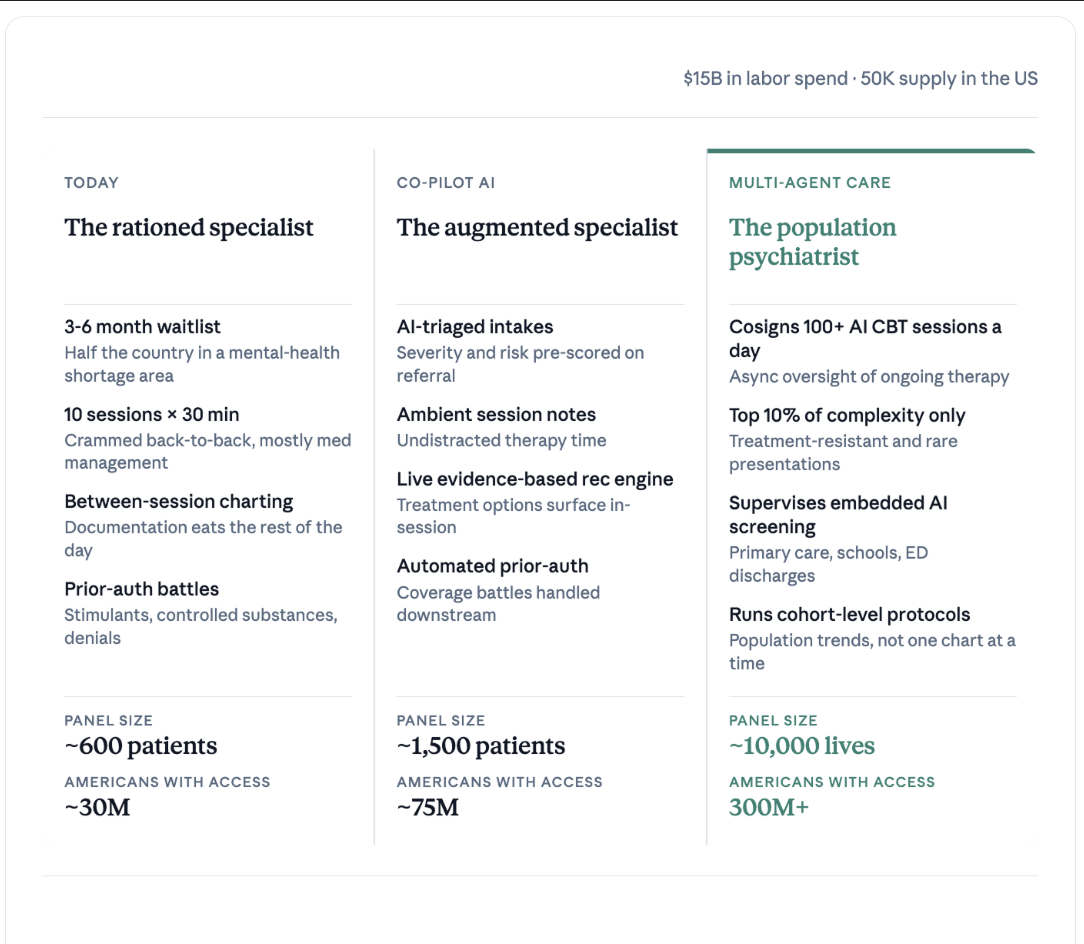
We see a similar opportunity for mental health. Psychiatrists are overwhelmed today with triage and administrative work. Only 30 million Americans have practical access to a psychiatrist today and half the country lives in a mental health shortage area.
Even when imagining a human still being in the loop, with autonomous multi-care agents, access to mental health has the opportunity to explode. With multi-agent care, one psychiatrist could cosign and review 100+ AI-delivered CBT sessions a day, while focusing their time on the most complex, highest acuity cases.
Telemetry Nurse

Today’s telemetry nurse is monitor-bound: eyes on 4 patients at once, 100+ alarms per shift with 85% of them false, every vital hand-charted, and roughly 90 minutes of actual bedside time in a 12-hour shift.
Multi-agent care, coupled with hardware, turns the role into a completely different job: a rapid-response clinician on standby vs on watch, intervening on the 3-5 events per shift that AI escalates. This could unlock continuous monitoring across 40 rooms, pushing the nurse-to-patient staffing ratio much higher.
What does this mean for the business of healthcare?
In the simplest terms, the leverage created by AI and autonomous clinical agents shows up in two distinct places: the revenue line (through more care delivered per clinician) or the cost line (through fewer people needed to deliver the same care).
- Revenue:
Increased care delivery with the same headcount and revenue increases. This greatly expands patient access and is often framed as “care abundance.”
- Cost:
Deliver that same care, or more, but with fewer people. Simply put, the labor bill shrinks and savings flow to operating margin.
If AI is fully adopted, most provider organizations will see some mix of the two, but the impact will depend on their business model, payer mix, and willingness to adapt.
As we look at the income statement, physicians, NPs, and PAs generate billable encounters, so their AI leverage primarily sits on the revenue side. In a fee-for-service world (holding current reimbursement paradigms steady), more productivity means more billable events. At the same time, it will also mean more total spend, which is good for a health system billing fee-for-service, but not for the health plan. Today, there’s a fundamental tension between the abundance story (closing the access gap) and increasing the total cost of care. Admittedly, a value-based structure resolves some of this tension, but solving the FFS and reimbursement tension is the only way to drive true abundance in US healthcare.
Nurses and allied health professionals are on the cost side of the income statement. The AI-oriented math becomes “easier” to understand, but is still incredibly hard to operationalize. Because, although nurses and allied health professionals are a fixed expense, the healthcare system breaks without them. They are the operational backbone that creates leverage for physicians.
From a math perspective, the impacts of AI on cost are cleaner. Labor is a fixed expense, so creating leverage and efficiency flows straight to operating margin. If you have 20 telemetry nurses and clinical agents create a 40% efficiency gain, you can then theoretically manage the same amount of work with 15 telemetry nurses. We are not advocating for the firing of clinical staff, but it is a simpler story to unpack since it's decoupled from the realities of reimbursement and billing.
Sorting through the above dynamics on the revenue and cost side of delivering healthcare will not be simple given regulation, reimbursement, and people’s livelihoods, but it will be a key imperative as the world of multi-agent clinical care starts to take shape.
Restoring humanity back to medicine
There is a common fear that AI will hollow out the practice of medicine. Less human contact. Less human judgment. A patient talking to a “machine” instead of a doctor. We think AI does the opposite.
Look at what a clinician's day actually consists of today. A PCP spends three hours after clinic writing notes she'll likely never read again. A telemetry nurse spends 85% of her shift dismissing false alarms and hand-charting vitals. A psychiatrist spends half her day arguing with the payer over a prescription refill. None of that is the work these people trained for. None of it is why they went into medicine. None of it is the human core of the encounter.
There’s a tension here that we are still thinking through. Under FFS, freed time has historically gone to more visits vs more meaningful visits. Payment reform will be necessary for AI adoption to truly take off. Done well , though, the version of AI worth building doesn't remove humans from medicine. It supercharges them. It removes from medicine the work humans shouldn't be doing in the first place and lets people focus on the human elements of delivering care.
What we’re still contemplating
As we consider the implications of clinical AI, autonomous agents, and the effects they will have on the business of healthcare, we’re still working through lots of things:
- The billing code question.
If AI delivers clinical care, who bills for that encounter, and at what rate? The AMA, CMS, and CMMI are all actively working on new codes and coverage frameworks, with the AMA’s proposed CMAA codes for autonomous AI furthest along.
- The regulatory question.
FDA pathways were designed for software as a medical device, not for clinical agents. State medical practice laws were designed for human licensees. The companies that figure out how to operate inside both, or help build new licensure paradigms, will end up with a structural moat.
- The liability question.
Co-pilots today explicitly defer liability to the clinician, which is one of their core legal design features. Agents can't, so who carries the malpractice risk when an AI agent makes a clinical decision, and how does that risk get actuarially priced?
- The abundance vs. cost-savings tension.
Same clinician, cheaper encounters, more of them, higher total spend. That math is bullish for a health system billing FFS, bearish for a payer holding risk, and mixed from a public-health lens. Which side of it the AI vendor lands on determines whether the product is worth paying for, and by whom.
We will continue to work to answer these questions for the months to come. Today's clinical AI mostly falls into a few familiar buckets (e.g. documentation, decision support, empathetic agents, and narrow software-as-a-medical-device). The one we're most interested in sits outside all of them: where AI itself is the credentialed, insured, billable unit of clinical work.
If you're working anywhere on this map, or have thoughts on the above piece, we’d love to hear from you.
- Email: sam@primary.vc & hannah@primary.vc
- LinkedIn: Sam Toole & Hannah McQuaid