


Supply chains weren’t built for the world we live in now.
Pandemics, geopolitical risk, climate shocks, volatile demand, and an AI-fueled productivity race have put operators under more pressure than ever. But while everything around them is changing, the software they rely on hasn’t kept up.
Legacy supply chain tools like SAP, Blue Yonder, and Coupa were built for static environments. They offer rigid templates, brittle implementations, and expensive services arms that struggle to adapt to real-world variability. Even Gen 2 “smart” platforms like Palantir lean heavily on forward-deployed engineers to tailor models to each customer, resulting in long timelines, high cost of ownership, and limited reach.
In a world where operational agility is the difference between growth and chaos, the software that powers our supply chains can’t be static. It has to be composable, context-aware, user-extendable and fast.
In 2023, we led the seed round in Lyric because we believed the services-heavy playbook for enterprise software was breaking down, especially in supply chain. We saw a world where bespoke AI tooling was finally colliding with business reality: long-tail complexity, fragmented data, and a crippling reliance on forward-deployed engineers. Lyric offered a new path: a composable platform that could absorb complexity without defaulting to custom work. We were honored that a sophisticated repeat founder like Ganesh Ramakrishna opted to partner with us on what we do best: seed-specific operational partnership.
Today, we’re proud to double down in Lyric’s $44 million Series B alongside Insight Partners, VMG Catalyst, Permanent Capital, and other insiders.
Why? Because Lyric isn’t just delivering on the original thesis—it’s blowing past it.
The Product Problem Nobody Solved
Ganesh Ramakrishna knows this world inside and out.
Before Lyric, he built Opex Analytics, a services business that delivered custom data applications to Fortune 500 supply chains. But every win came at a cost: each solution was a one-off. The team shipped bespoke code for every engagement.
That’s the problem with most enterprise AI today. It generates project-level IP useful for one customer, once. Not product-level IP that scales across use cases and companies.
Ganesh started Lyric to change that.
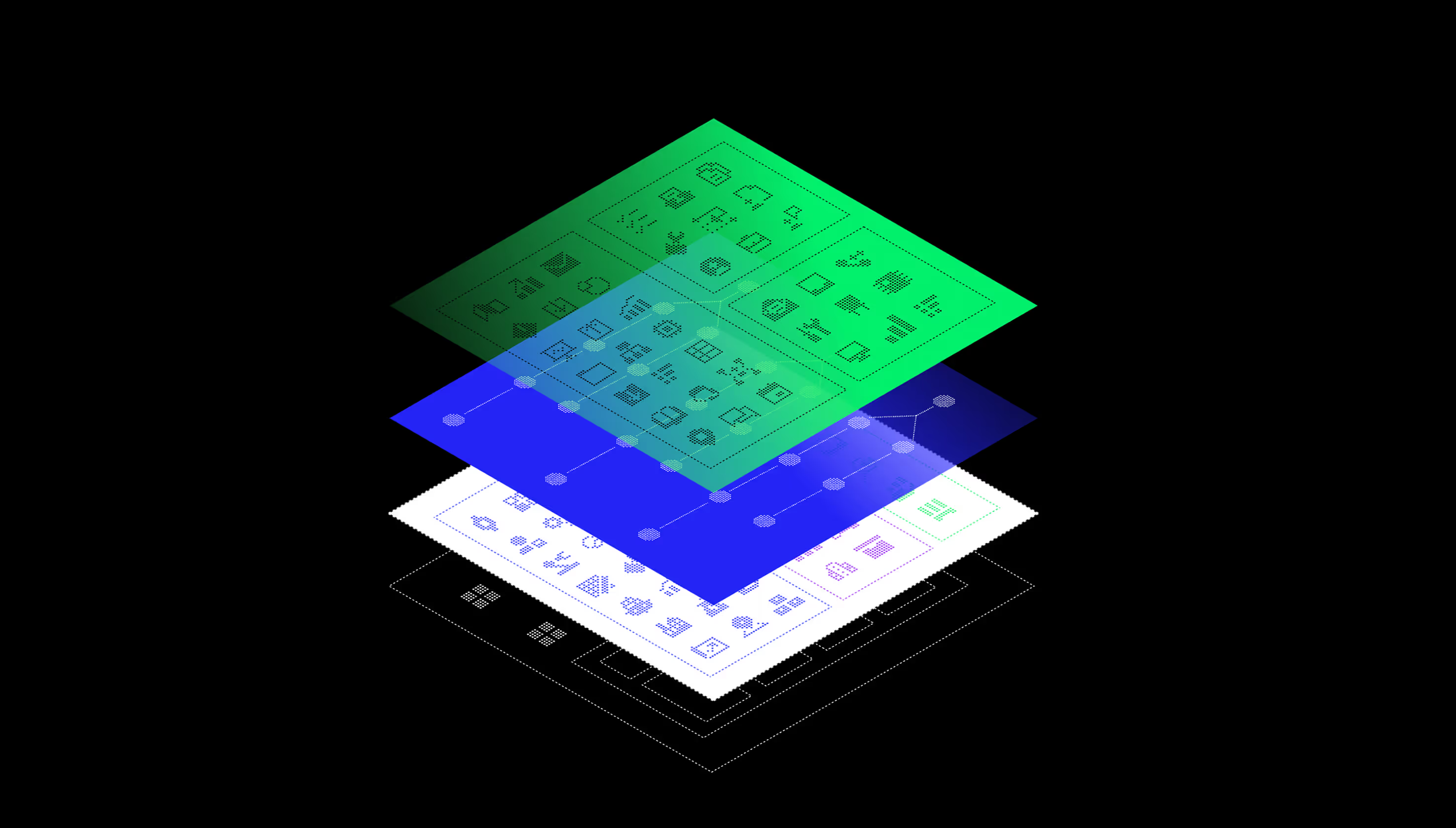
Lyric is a composable, AI-powered platform that turns operational complexity into decision intelligence. The platform layers domain-aware data infrastructure, a rich library of optimization and ML models, a no-code sequence builder, and intuitive UIs, all wrapped in agentic AI tools that accelerate development and deployment.
It doesn’t just solve problems. It productizes the solutions.
From Six Months to Six Hours
What does this mean in practice?
At a major beverage company, Lyric started with just two use cases: out-of-stock forensics and production planning. These weren’t problems the customer’s existing stack (Palantir, Blue Yonder, Oracle) could solve. But Lyric could. The first few apps saved $8 million in value. Soon the customer had built 20+ apps on their own with no consultants involved. Today, Lyric powers more than $40 million in ongoing ROI inside that enterprise.
At another global CPG, Lyric replaced a $2 million, six-month failed implementation with a working solution in four weeks. That app saved $1 million per quarter and led to a wave of expansion across planning, logistics, and risk analytics.
The POC Factory deserves special mention. Lyric can go from raw data to a full-featured production-grade application in as little as six hours. Customers aren’t pitched with decks or mockups. Instead, they’re handed a live app tailored to their business. That experience doesn’t just accelerate sales. It sets a new bar for customer expectation.
It’s no surprise that Lyric’s go-to-market motion, which until recently was entirely founder-led, has scaled with remarkable efficiency and unprecedented ACV expansion.
The Platform Is the Product
Lyric’s true innovation is about speed and scale. Most enterprise AI platforms still operate like bespoke consultancies. They promise flexibility, but that flexibility is serviced, not shipped. Lyric’s composable architecture flips that model. It allows customers to build once and scale infinitely. Applications are modular, models are extensible, and integrations are already in place across the dominant enterprise data and planning systems.
What we’re seeing now is the platform unfolding across use cases far beyond what it was originally built for. Customers who began with core supply chain planning and network design are now solving for fleet and workforce optimization, predictive maintenance, sustainability forecasting, warehouse layout, and more. These weren’t on the roadmap a year ago, but because Lyric’s platform is composable by design, these apps aren’t exceptions. They’re natural extensions.
This is how platforms grow. Not by narrowly optimizing a single workflow, but by adapting to the evolving needs of the enterprise. Lyric isn’t just flexible software. It’s infrastructure for operational intelligence.
What’s Next
Lyric now has the team, product, and momentum to scale into the broader vision it was always meant to fulfill. With seasoned GTM leadership in seat, the company is ready to go from founder-led selling to full GTM scale. The POC Factory remains a superpower, dramatically shortening the distance between interest and impact, and will continue to be a cornerstone of the buyer experience.
Under the hood, Lyric is pushing aggressively into agentic AI. New copilots are being trained to help customers test scenarios, build workflows, and deploy models even faster. As the product expands, so does the community: more customers are building their own apps, repurposing existing ones, and contributing to a growing library of reusable solutions.
Most importantly, Lyric’s market is expanding. What began as a bet on supply chain planning is now becoming a horizontal platform for any operationally complex, data-rich decision in the enterprise. In a world where cost structures are shifting, AI tooling is democratizing, and operational resilience is a board-level priority, we believe Lyric has the chance to define a new category.
Lyric isn’t just rewriting how enterprise software is built. It’s redefining how real-world decisions get made. We’re proud to be along for the ride—again.